

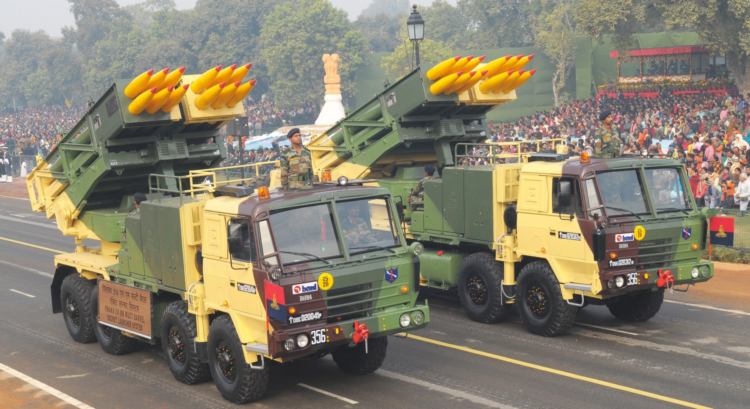
Compared to the American M270 Multiple Launch Rocket System that can fire up to 300 km (MGM-140 ATACMS), the Pinaka MBRL system has only a maximum range of nearly 40 km for Mark-I and up to 60 km for the enhanced Mark-I version that can be mounted on a Czech-made truck for mobility. Its launching system comprises two pods containing six rockets each, capable of firing in salvo mode within 48 sec, neutralizing the area of 700×500 m—outfitted with a DIGICORA MET radar. Each Pinaka launcher can fire in a different direction and launch all the rockets at once or just a few. On the other hand, its radar can track incoming missiles, mortars, and artillery shells and pinpoint enemy launchers and positions.
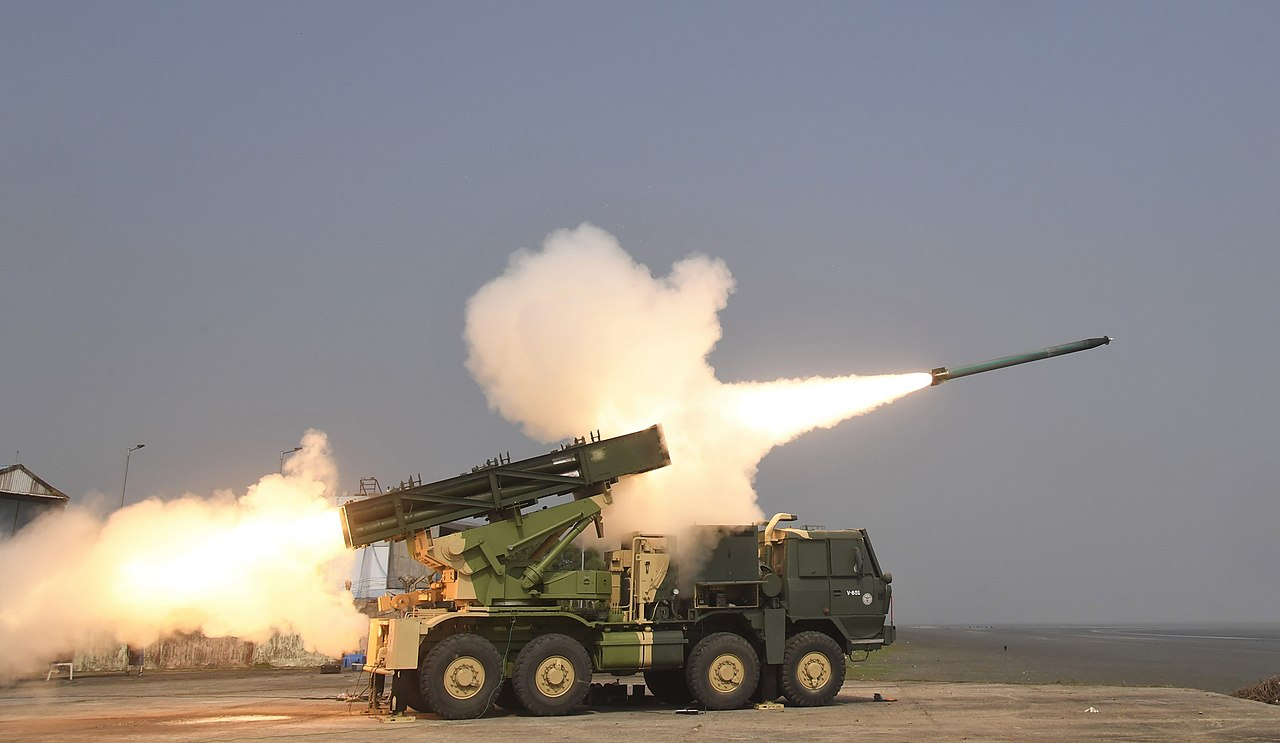
Moreover, it can be loaded by different types of warheads and fuzes as well as mounted on “a multi-tube launcher vehicle, a replenishment-cum-loader vehicle, a replenishment vehicle, and a command post vehicle.”
The Pinaka MBRL system has been officially inducted into the Indian Army since its successful debut on the battlefield during the Kargil War in 1999 against Pakistan. The production continued, with an estimated 5,000 missiles produced yearly by 2014.
With the recent arms deal with Armenia, India has increased its defense exports by an impressive feat of 334 percent in the last five years.
Armenia-Azerbaijan Peace Talks Underway
Top diplomats from Armenia and Azerbaijan will once again hold talks, this time in Geneva, to discuss future peace treaty plans and possibly begin drafting the agreement following a deadly skirmish last month. High-ranking officials from both sides have previously tackled its border dispute on August 31 during a European Union-mediated meeting in Brussels.
"We call on #Azerbaijan to return troops to their initial positions. We urge disengagement of military forces & work to resolve all outstanding issues between #Armenia & Azerbaijan through peaceful negotiations. The use of force is not an acceptable path." @StateDeptSpox pic.twitter.com/eRFgURl8zj
— CIVILNET (@CivilNetTV) September 27, 2022
According to reports, both parties have exchanged ideas on how to compromise that would include both sides’ rights and security and maintain peace in the Nagorno-Karabakh region. Withdrawal of military troops in the area will be in place as well as the release of Prisoners of War (POWs) and allowing international mechanisms to help control the border issue.
The border dispute in the Nagorno-Karabakh region has been a long-standing issue between Yerevan and Baku which is a cause of ethnic differences and territorial claims with fighting traced as far back as the early 20th century. It wasn’t until the late 1980s, though, that the intense fighting commenced, triggered by Karabakh Armenians (known as the Karabakh Movement) demanding the transfer of the region from Soviet Azerbaijan to Soviet Armenia. What began as a peaceful movement escalated into a full-blown war in the early 1990s, which diluted into a sporadic, low-intensity skirmish until the four-day escalation in 2016 and deadly full-scale war in 2020.








.jpg)
COMMENTS