
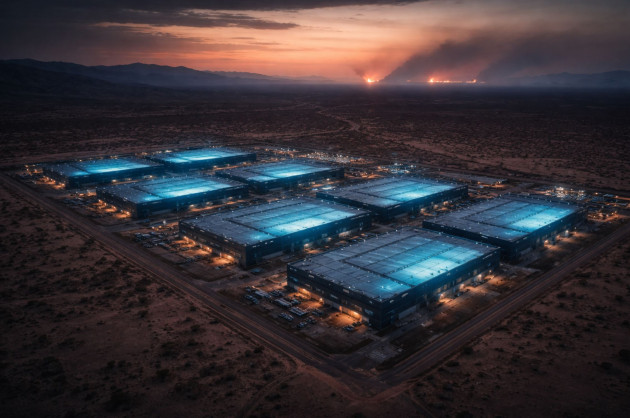
An Amazon Web Services data center went offline in the UAE.
Not a radar array. Not an ammunition depot. A data center… servers, cooling systems, fiber optic cable, all sitting in the desert outside Abu Dhabi, doing the quiet work of running the internet.
Iran hit it on purpose.
If you want to work around the propaganda and understand what this war is actually about, that one target tells you more than everything else combined.
I worked undercover inside a violent criminal organization. Eighteen months, watching people say one thing and do another… learning that the stated reason someone pulls a trigger is almost never the whole reason, and sometimes isn’t even close.
John Kiriakou, a former CIA officer and guest on my podcast, put it plainly. The official justification for any operation is the version they needed you to believe. The real calculus happens in rooms most people never get near.
I’m not a financial analyst or a geopolitical strategist. But I’ve spent enough time watching motivation and justification diverge in real time to know when the briefing isn’t the whole story. First principles, non-partisan observation, and history can still tell us more than we think.
This is one of those times.
To understand why that data center matters, you have to go back to 1971.
When Nixon cut the dollar loose from gold, it should have collapsed. Instead, it was saved by one of the most consequential backroom deals in modern history. We call it the petrodollar.
Saudi Arabia, the UAE, Kuwait, and the rest of the GCC sell their oil exclusively in US dollars. So, every country on earth that needs energy has to acquire dollars first. Every country needs energy every day. That structural demand keeps the dollar as the world’s reserve currency, even as America runs deficits that would have collapsed any other currency on earth.
Those dollars don’t sit in vaults, either. They get recycled back into US Treasury bonds, then US equity markets, and recently, massive quantities into US artificial intelligence infrastructure. Trump returned from his Middle East tour with $2 trillion in Gulf investment commitments, the overwhelming majority earmarked for AI data centers and chips. Saudi Arabia alone committed $600 billion through its Public Investment Fund. The UAE committed $200 billion on top of an existing $1.4 trillion plan anchored by a multi-gigawatt AI campus.
Two of America’s most critical economic pillars, the petrodollar and the AI buildout we’re banking our future on, both run through the Strait of Hormuz.
Iran knows that. They’ve always known that.
Now look at the map as British geographer Halford Mackinder saw it in 1904.
Most haven’t heard of Mackinder. They should have. What he published that year quietly controlled the behavior of empires for the next century… and still does.
His insight was precise. Britain ruled the world through naval power because trade moved on water. But railroads were changing everything. For the first time, you could move armies and goods across land faster than ships could carry them by sea. Whoever unified Eastern Europe through Russia, the Middle East, and China would command a pool of energy, manufacturing, and population that no navy could touch.
Mackinder called it the Heartland. Which is a very polite name for the thing that kept Britain up at night for 150 years.
His warning was simple: unite it, and the game is over for whoever controls the seas.
Britain spent 150 years unofficially starting wars to keep that map from becoming real. The Napoleonic Wars, Russian expansion toward warm-water ports, backing the Ottomans… all variations on one theme. Keep the Heartland divided. When Britain was too battered after World War II to keep running that playbook, they handed it to the United States. Different tools. Same objective.
Now look at Iran through that lens.
Russia provides energy. China provides manufacturing. Iran is the keystone geographic bridge between Russian energy to the north, Chinese manufacturing to the east, and Middle Eastern oil fields to the south. It anchors China’s Belt and Road Initiative, the land-based trade network Beijing has been quietly building to route around the sea lanes controlled by the US Navy.
Iran is the third leg of a completed Heartland alliance. And because it’s the weakest leg, it’s the target.
A nuclear-armed Iran that shakes off sanctions and cooperates fully with Russia and China is powerful enough to relegate the US to a far less dominant role on the global stage.
When you’re the reserve currency, that is existential.
Professor Jiang, a Canadian educator, predicted this war in a 2024 lecture, nearly two years before the first strike. Entrepreneur Tom Bilyeau has been walking his audience through the economic mechanics in real time. Their frameworks converge on the same conclusion.
Iran doesn’t need to beat the US military. They never planned to.
They need to make the Strait of Hormuz unusable. Mines, drones, missiles… asymmetric warfare that doesn’t require a navy. Just enough chaos to crack the petrodollar, panic the Gulf states, and redirect that $2 trillion from Nvidia chips into Iranian interceptors and reconstruction contracts.
They’ve already done part of it without touching the Strait. UK insurance companies assessed the risk and walked. The strait didn’t need mines. It just needed to feel dangerous enough that the people insuring the ships decided it wasn’t worth it. Iran then hit every GCC nation in a single day for the first time in history, striking Bahrain, Kuwait, Qatar, Saudi Arabia, and the UAE simultaneously. Airports closed. Ports suspended. An AWS data center went dark.
Every interceptor missile fired at an Iranian drone costs money the Gulf states aren’t sending to fund AI campuses in the American desert. The tech sector was already down over 11% from its October high before this started. The chain reaction Iran is trying to trigger isn’t military… it’s economic. Redirect the capital. Slow the investment. Watch the downstream effects spread until the dollar in your wallet starts telling the story.
Now here’s the part nobody’s putting in the briefing.
Jiang’s framework asks two questions most analysts won’t touch: Who actually wants America in this war? And do they all want America to win it?
Saudi Arabia looks like an ally on the surface. Zoom out and the picture changes. They want to be the dominant power in the Middle East. A US that decisively wins this war and plants a permanent flag in the region isn’t in Riyadh’s best interests. They’ve been quietly building relationships with China. They’ve even floated the idea of pricing oil in yuan. They want options. The ideal outcome for Saudi Arabia is a wounded Iran and a distracted, overextended America that needs their cooperation more than ever.
They want the US in this war. They just don’t want the US to win it cleanly.
In 415 BCE, Athens assembled the most powerful naval expedition the ancient world had ever seen and sent it against the much weaker Sicily. Defeat seemed genuinely impossible. Every ship that left never came home. The expedition was annihilated, and the Athenian Empire… the greatest military force of its age… never recovered.
America has been handed a version of that invitation. The strongest military on earth. An enemy that doesn’t need to beat it, just bleed it. Terrain that neutralizes almost every advantage once boots hit the ground. And allies who engineered the engagement with their own finish lines in mind.
None of this makes the nuclear concern less real. It doesn’t erase the humanitarian stakes. American service members are dying. That weight doesn’t disappear because economics explains the strategy.
But here’s what eighteen months inside a criminal organization taught me:
If your explanation doesn’t account for the money, the odds it’s accurate are close to zero.
The stated justification changed at least four times in the first week. Nuclear weapons. Ballistic missiles. Israel’s timeline. Imminent threat. Each version slightly different. Each one calibrated to be exactly what the American people needed to hear to stay on board.
Kiriakou and I both agree… the best narratives are built around the version of the truth that’s closest to what people already want to believe.
The real truth is far less comfortable.
The data center in Abu Dhabi is back online. The war continues. The $2 trillion is still mostly committed, still mostly pointed at AI infrastructure that will determine who runs the next fifty years of the global economy.
The Heartland Mackinder spent his career warning about is half-built. The petrodollar system that has underwritten American power since 1971 is structurally dependent on a strait that Iran can threaten without a navy. The allies who encouraged this war have their own finish lines.
And the briefing being delivered to the American people right now is the version they needed you to believe.
They’re not just bombing troops and installations.
They’re bombing the architecture.
And whether we’re protecting the same thing they’re attacking…
is the question nobody in the briefing room is going to answer out loud.
—
“I don’t try to change minds… just deepen them.” — Tegan Broadwater
Tegan spent 13 years with the Fort Worth Police Department, including two years assigned to the FBI working deep undercover inside a violent Crip organization. That operation, detailed in his book Life in the Fishbowl, resulted in 51 convictions. He has since founded Tactical Systems Network, an armed security & protection firm primarily staffed by veterans, is a creative writer and musician, and hosts The Tegan Broadwater Podcast. All book profits benefit children of incarcerated parents. Learn more at TeganBroadwater.com








COMMENTS