

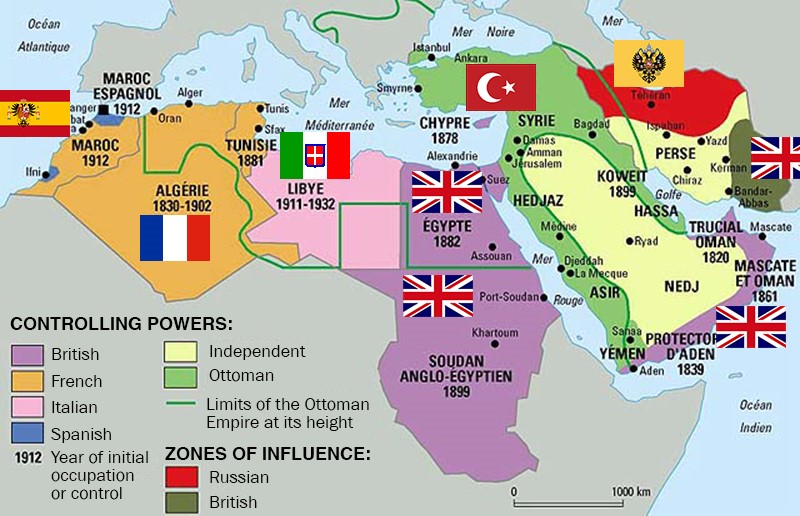
Crescent Map (World History Maps: Patterns of Interaction)
Introduction to ISIS
The Islamic State in Iraq and al-Sham, known derogatorily as “Daash” among its adversaries in Iraq, did not form in a vacuum. It was founded in 2003 as Jama’at al-Tawhid wal-Jihad (Group of Monotheism and Jihad), by Abu Musab al Zarqawi, a Jordanian, and in October 2004, Zarqawi pledged allegiance to Osama bin Laden and Al Qaeda, renaming the organization Tanzim Qaidat al-Jihad fi Bilad al-Rafidayn or, more simply, Al Qaeda in Iraq. Under this moniker, the group fought Coalition forces and Iraqi Security Forces for the bulk of the American occupation phase of the war.
In October 2006, the group renamed itself again, this time as the Islamic State in Iraq, under Abu Omar al-Baghdadi and Abu Ayyub al-Masri. As ISI, the group was still the primary Al Qaeda affiliate in the region, and it was instrumental in forming and deploying Jabhat al-Nusra, which was formally founded as Al Qaeda’s affiliate in Syria.
In 2013, ISI renamed itself yet again, as the Islamic State in Iraq and al-Sham (the Levant) and, in so doing, declared that it held overall command over Jabhat al-Nusra. The resulting feud, although arbitrated by Al Qaeda’s emir, Ayman al Zawahiri, has still not been resolved.
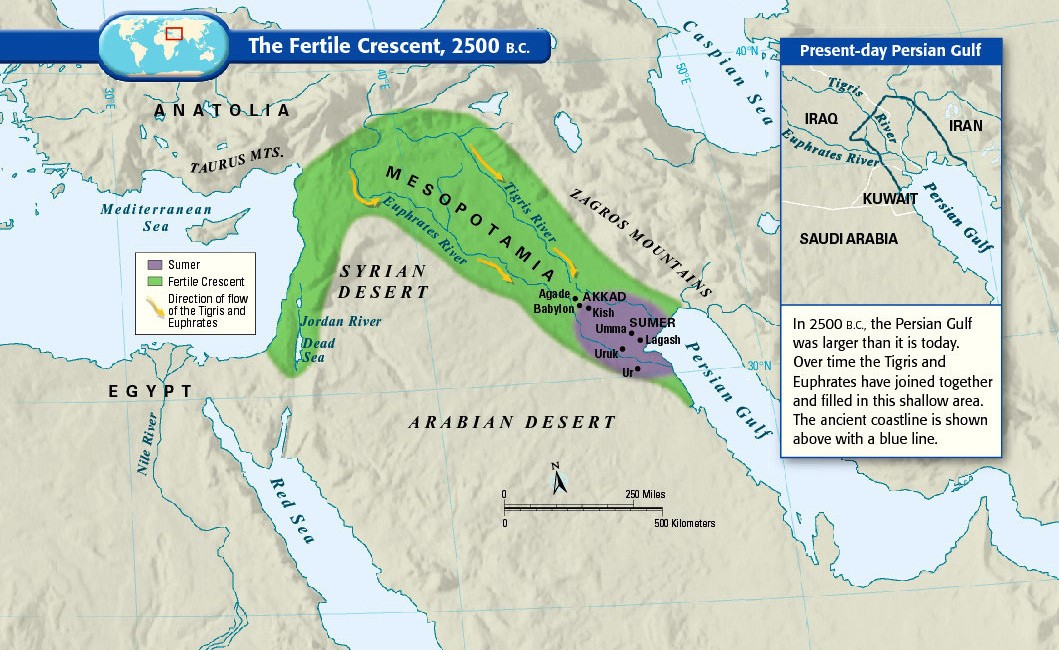
Fertile Crescent, 1914 (Le Monde Diplomatique)
Just as the organization itself has not come out of a vacuum, its strategy and tactics have not developed in a vacuum, either. There is a consistency in its approach going back to the days of Zarqawi.
So who or what is ISIS or IS? It can be argued that Al Qaeda and the Islamic State (IS) are one in the same—both organizations spring from the same radical interpretation of Islam, and they are closely connected in many ways. This is not a group to be defeated in a traditional sense; it’s an ideology that has gained massive popularity in the Middle East and beyond. If the Islamic State goes unchecked, it will not be long before the IS shows up on America’s doorstep. In fact, in many ways it already has, we just haven’t seen the effects yet.
We are in your state We are in your Cities We are in your streets You are our goals anywhere.—#AmessagefromISIStoUS, Twitter
Polarization, religious bias, and public opinion influence the halls of power in American politics. Making decisions based on bias and popular opinion (what do the polls tell us?) is not leadership and is large problem with our current government. The War on Terror has never been bigger than it is today.
Americans need to wake from their deep slumber and notice that they have been manipulated to choose sides, conservative or liberal, right or left, and that this has been done by our own leadership and with the mainstream press feeding off it like sharks in bloodied seawater—it’s news entertainment at its finest in the twenty-first century.
The Internet is a powerful tool to pressure the system for change. In the last part of this book we tell you how to start using it for good. Americans need to embrace independent and optimistic thought leaders, people who get stuff done (doers, not talkers), and crash through the brick walls of bureaucracy. Reject decisions based on popular sentiment and question reactionary strategies.
The Objectives of This Book
This book has two goals: to introduce and explain ISIS, and to present new definitive thinking with the ultimate goal of making radical Islam—radicalism of any sort, for that matter—out of fashion. We need to make it not cool.
There’s a saying in the Special Operations community: “Don’t complain about something unless you are prepared to present solutions to the problem.” The editors of SOFREP.com are not here to complain; we are here to offer real strategies when current leadership presents reactionary solutions based on popularity and traditional methods. These traditional methods have failed, and the proof is in the rise of ISIS itself. Have we defeated Al Qaeda yet?
More air strikes from U.S. naval warships will not win people over to a new way of looking at America and the free world. America must cross a new bridge in order to change its way of thinking toward foreign policy and dealing with radical Islam. Our current strategy, led by George W. Bush and carried forward by Barack Obama, has produced a stalemate on the global chessboard with the Islamic State (IS) and radical Islam.
If we don’t design and plan our own future, it will be designed for us—the same way ISIS has been designing and defining its future in the Middle East in a post-American Iraq.
If the world has learned one thing since September 11, 2001, it’s that tolerance and peace cannot be achieved with the current approach to radical Islamic ideology, which promotes change through violent terror. This book presents new thinking on the issue. We don’t claim to hold all the answers, but we are prepared to lead a conversation toward new and unconventional strategic thought that is focused on long-term solutions to wipe out violent terror as a popular movement.








COMMENTS