

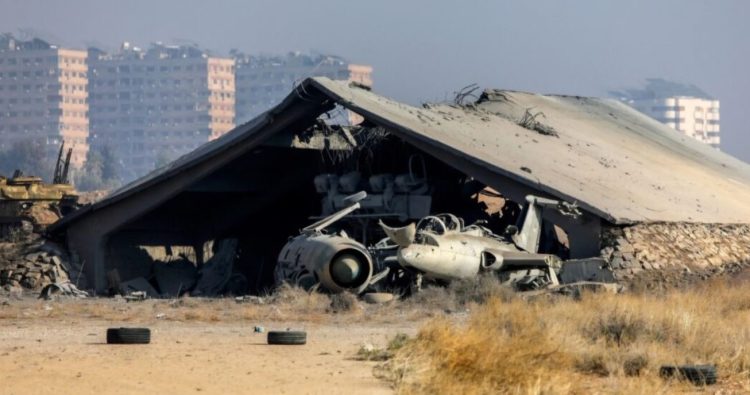
Katz also stated that the military’s objective includes the complete destruction of Syria’s heavy strategic weapons, such as surface-to-air missiles, ensuring they cannot be used by those who would seek to do harm to Israel.
The strikes have specifically targeted key military facilities, including airports, air bases, chemical weapons storage sites, long-range missile depots, and military production facilities. Katz further emphasized the importance of creating a “security zone free of heavy strategic weapons and terrorist infrastructures” in southern Syria. He elaborated on this plan, stating,
“We will create a defense zone free of weapons and terrorist threats in southern Syria, without a permanent Israeli presence, to prevent terrorism from taking root.”
Israeli military estimates suggest that the campaign has destroyed 70-80% of the former Assad regime’s strategic military capabilities. This massive operation represents one of the most extensive air campaigns ever undertaken by the Israeli Air Force, according to high-ranking security officials cited by Israeli media. The success of these operations underscores Israel’s determination to neutralize potential threats and establish greater security along its northern border.
Ground Operations and Territorial Control
Israel’s recent ground operations in Syria represent a dramatic escalation in its military strategy and mark the first overt deployment of Israeli forces into Syrian territory since the 1973 October War. These operations demonstrate a shift from purely air-based campaigns to direct territorial intervention, underscoring the severity of the perceived threats along Israel’s northern border.
Israeli ground troops have moved well beyond the established demilitarized buffer zone along the Israel-Syria border. Reports indicate that Israeli forces have penetrated deep into southern Syria, reaching as far as Qatana, a locality approximately 16 miles southwest of Damascus. This deep advance shows Israel’s commitment to neutralizing regional threats and securing critical positions.
Key strategic locations have been seized during these operations. Territories captured include several border areas up to 18 kilometers deep, such as Quneitra city, Baath city, and al-Hamidiya.
The new “sterile defense zone” is designed to prevent terrorist threats and heavy weaponry from taking root near Israel’s borders. Prime Minister Benjamin Netanyahu justified this action by declaring that the 1974 border agreement with Syria is no longer valid in the current context.
In addition to territorial gains, Israel has deployed tanks and military vehicles in the Quneitra region within the Golan Heights. Lt. Gen. Herzi Halevi, the Israeli military’s chief of staff, confirmed the presence of troops inside Syrian territory. This enhanced military posture signals Israel’s readiness to take decisive action to safeguard its national security.
International Reactions and Concerns
International reactions to Israel’s military operations in Syria have been largely critical, with numerous countries and organizations expressing serious concerns about the implications for regional stability and international law.
Arab Nations’ Response
Arab powers have strongly condemned Israel’s actions, accusing it of exploiting Syria’s chaos and violating international law. Qatar’s Ministry of Foreign Affairs warned that Israel’s actions would escalate violence and tensions in the region. Saudi Arabia also criticized Israel, stating that its actions reflect a pattern of persistent violations of international law. Similarly, the Arab League accused Israel of “exploiting the developments in the internal situation in Syria,” while Egypt claimed that Israel was taking advantage of the power vacuum to occupy more Syrian territory.
Other International Reactions
Iran sharply condemned Israel’s military maneuvers, labeling them a violation of the United Nations Charter and urging the U.N. Security Council to intervene. Turkey, a NATO ally, criticized Israel for “once again exhibiting its occupying mindset.” Russia also joined in the condemnation, accusing Israel of destabilizing an already fragile Syria.
United Nations Stance
The United Nations has cautioned that Israel’s actions violate the 1974 disengagement agreement between Israel and Syria, which established a buffer zone in the Golan Heights. U.N. officials expressed concerns that these actions could lead to further instability in the region. As noted earlier, Mr. Netanyahu begs to differ.
Israeli Response
Israel has defended its operations, describing them as a “limited and temporary measure” necessary for national security. Israeli officials emphasized that the strikes were preemptive, aimed at preventing future threats rather than responding to immediate attacks. This justification reflects Israel’s intent to neutralize potential risks while securing its borders.
The widespread criticism highlights international concerns over the potential for Israel’s actions to further destabilize the region and their broader implications for international law and regional security. The situation remains fluid, with many watching closely to see how these developments unfold in the coming days.
Implications for Regional Stability
The collapse of the Assad regime in Syria has unleashed a wave of uncertainty with significant implications for regional stability. At the forefront is the dangerous power vacuum left behind, which could lead to intensified competition among regional and international actors vying for influence in Syria. This instability creates fertile ground for extremist groups to exploit the chaos, potentially seizing strategic assets and territories, a scenario that raises alarms across the region.
For Iran, Assad’s downfall represents a major setback. As a key ally, his regime played a vital role in Tehran’s “Axis of Resistance” and facilitated the transfer of weapons to Hezbollah. The collapse disrupts these operations, weakening Iran’s regional influence. Meanwhile, Israel faces heightened security threats as the destabilization of Syria’s northern border necessitates enhanced defensive measures, particularly in the strategically sensitive Golan Heights.
The humanitarian impact is also profound, with thousands of refugees fleeing the conflict and pouring into neighboring countries. This influx strains resources and threatens to destabilize host nations, further compounding the regional crisis. Additionally, the proliferation of weapons, including strategic and chemical arms, into the hands of hostile groups presents a serious threat to regional and global security.
Turkey has expanded its proxy network in Syria, capitalizing on the vacuum to further its influence, a development that challenges regional stability and Western interests. At the same time, the situation poses challenges for the Kurdish autonomous region, which has acted as a buffer against various threats and served as a crucial ally for Western powers in combating extremism.
The collapse of Assad’s regime also has broader implications for Middle Eastern power dynamics. Relationships between state and non-state actors are likely to shift, potentially reshaping the region’s security architecture. These developments may prompt increased international intervention as global and regional powers attempt to manage the fallout, but such involvement risks further complications and conflicts.
Together, these factors create a volatile and unpredictable environment with far-reaching consequences for Syria, its neighbors, and the broader Middle East. The region stands at a critical crossroads, with the potential for both heightened conflict and opportunities for reshaping the future of the Middle East.
Summation
As the situation in Syria remains highly fluid, Israel’s leadership appears determined to neutralize emerging threats and reshape the strategic landscape to its advantage. However, the risks of escalation and unintended consequences remain high, making this a potential tipping point in the ongoing saga of Middle Eastern conflict and diplomacy.








COMMENTS