

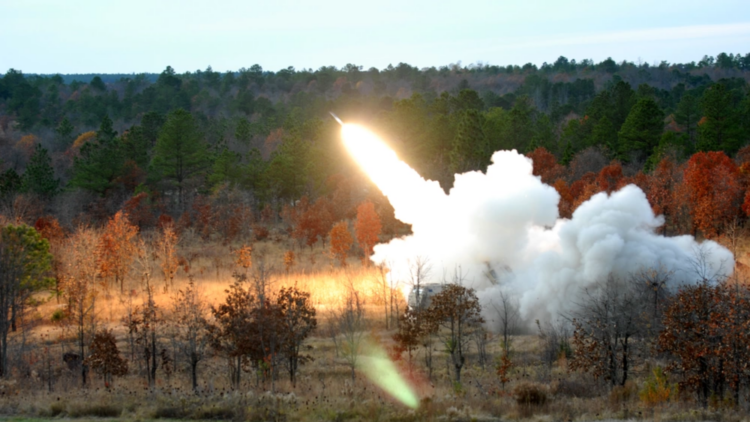
Nations are lining up—Australia, Estonia, Italy, Latvia, Lithuania, Morocco, Taiwan, not to mention ongoing deals with Poland and Ukraine—each seeking a piece of the HIMARS action.
Expanding the Arsenal: Beyond HIMARS
But the story doesn’t end with HIMARS. Lockheed Martin is on a broader crusade to beef up its arsenal offerings.
The Javelin antitank missile system’s production is set to double, hitting a target of 3,960 units annually by late 2026.
The Guided Multiple Launch Rocket Systems (GMLRS) are also on an upward swing, with plans to churn out 14,000 units annually by 2025.
And let’s not forget the PAC-3 MSE (Missile Segment Enhancement) air defense missile, with production rates expected to soar to 650 annually by 2027.
The Global March of HIMARS
HIMARS isn’t just another piece in the military hardware puzzle; it’s a game-changer. A brainchild of Uncle Sam, it offers a nimble artillery platform that can swiftly deliver a variety of munitions with pinpoint accuracy.
Capable of launching an array of rockets or tactical missiles, HIMARS is the answer to a wide spectrum of threats.
We're committed to ramping up the production of high-demand, proven systems to deter and defend against evolving threats worldwide. As the demand for 21st Century Security solutions increases, we're using transformation to deliver critical systems when seconds count.
— Lockheed Martin (@LockheedMartin) February 16, 2024
Tipping the scales at approximately 10,886 kg and boasting a top speed of 85 km/h, HIMARS exemplifies rapid deployment and operational versatility.
Its firing control system is a marvel of technology, allowing for precision strikes across a range of munitions, with the capability to hit targets up to 300 km (186 miles) away with tactical missiles.
M142 HIMARS is a light multiple rocket launcher that is known for its "shoot and scoot" capability. The system's most feared missile is the MGM-140 ATACMS which can perform precision strikes against targets located far from the front lines. pic.twitter.com/JbwXQXLkFn
— Interesting Engineering (@IntEngineering) February 17, 2024
Manned by a crew of three, HIMARS maintains a lean profile, ensuring agility and maneuverability on the battlefield.
Its global footprint is expanding, with the system seeing action in the hands of forces from Ukraine to Poland and the United States.
Cultural Impact and Strategic Significance
The current conflict in Ukraine has spotlighted HIMARS, showcasing its capacity to reshape ground operations with its deep-strike capabilities.
⚡️🇺🇦M142 HIMARS destroys the 🇷🇺Russian Zala/Lancet UAV launch vehicle pic.twitter.com/FBquY4jtiQ
— 🇺🇦Ukrainian Front (@front_ukrainian) February 19, 2024
The buzz around HIMARS extends beyond military operations. It’s become a symbol of resistance and tactical ingenuity, inspiring social media tributes and even a music video. The phrase “Is it HIMARS o’clock?” captures the zeitgeist of Ukraine’s strategic use of the system, marking moments of anticipation and impact.
Transforming the Battlefield: The Future of Defense
As Lockheed Martin gears up to fuel the HIMARS production line, the landscape of modern warfare stands on the brink of a seismic shift.
This isn’t just about enhancing defense capabilities; it’s about rewriting the rules of engagement, offering a glimpse into a future where agility, precision, and power converge on the battlefield.
In this evolving theater of operations, Lockheed Martin’s drive to accelerate HIMARS production isn’t just a business move—it’s a strategic pivot that could redefine the contours of global defense.
This is more than a moment in military manufacturing; it’s a milestone in the march towards a new era of warfare, where technology and strategy blend to forge the weapons of tomorrow.








COMMENTS