Early Life and Background
Franklin Delano Miller was born January 27, 1945, in Elizabeth City, North Carolina, and raised in a working-class family that valued duty, discipline, and keeping your word. His father worked hard, his mother kept the household steady, and like many boys of his generation, Miller grew up with the expectation that when the country called, you answered. There was nothing flashy about his early life. He hunted, fished, worked, and learned to keep moving when things got difficult. Those habits, built quietly in rural America, would later define how he fought.
Joining the Army and Early Service
Miller enlisted in the U.S. Army in 1965 as the Vietnam War escalated. He did not join for glory. Like many young men at the time, he saw service as both an obligation and an opportunity. He trained as an infantryman and quickly distinguished himself through competence rather than volume. He was not the loudest man in the room, but he was steady, reliable, and physically tough. Those traits earned him a place in Special Forces and, ultimately, an assignment to the shadow war being fought across Southeast Asia.
Into the Shadow War
By the late 1960s, Miller was serving with a reconnaissance element tied to MACV-SOG, the highly classified joint special operations group conducting deep reconnaissance and interdiction missions in denied territory. These patrols were small, lightly equipped, and often inserted far beyond friendly lines to gather intelligence and disrupt enemy movement. When they were compromised, they fought for survival against overwhelming numbers. It was unforgiving work that demanded endurance, initiative, and a refusal to quit when the plan fell apart.
Medal of Honor Actions
On January 5, 1970, during a reconnaissance mission in enemy-controlled territory, Miller’s team was ambushed by a significantly larger North Vietnamese force. The initial contact was violent and immediate. Enemy fire pinned the team down and quickly inflicted casualties. Miller responded without hesitation. He moved through the kill zone under intense fire, returning fire and pulling wounded teammates to relative cover. When the team attempted to break contact, the enemy pressed aggressively, forcing them into a fighting withdrawal through dense terrain.
At one point, Miller exposed himself repeatedly to draw fire away from wounded men and to retrieve ammunition. He carried injured teammates, repositioned weapons, and kept up a steady stream of fire to prevent the enemy from overrunning the patrol. When the team’s position was nearly overrun, he helped establish a defensive perimeter and continued engaging the enemy at close range. Despite exhaustion and the constant threat of encirclement, he refused evacuation until every wounded man was moved. His actions bought the team time to regroup and ultimately survive an engagement that could easily have ended in annihilation.
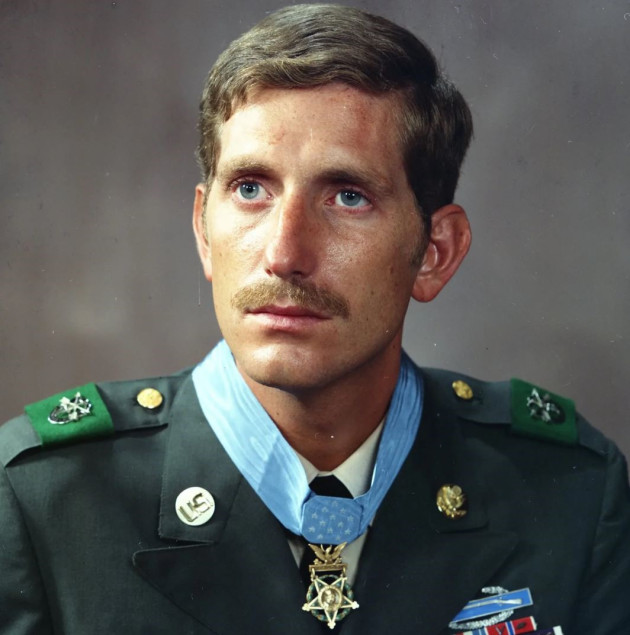
For his conspicuous gallantry and intrepidity at the risk of his life above and beyond the call of duty, Miller was awarded the Medal of Honor. The citation captures only a fraction of what those moments demanded: physical courage, mental clarity under chaos, and the kind of loyalty that refuses to leave a teammate behind.
The Citation
Command Sergeant Major Franklin D. Miller
United States Army
Medal of Honor
For conspicuous gallantry and intrepidity at the risk of his life above and beyond the call of duty while serving as a team member with a reconnaissance patrol during combat operations on 5 January 1970, in Kontum Province, Republic of Vietnam. Sergeant Miller was serving as a team member with a long-range reconnaissance patrol operating deep within enemy-held territory. Shortly after insertion, the patrol was ambushed by a numerically superior hostile force. During the initial contact, several members of the patrol were wounded, and the team’s position became precarious. With complete disregard for his own safety, Sergeant Miller exposed himself to intense hostile fire to retrieve ammunition and redistribute it to his comrades. Although wounded himself, he repeatedly moved through the fire-swept area to aid the wounded and provide covering fire, enabling the patrol to maneuver and establish a defensive perimeter. When the patrol attempted to break contact, Sergeant Miller again exposed himself to heavy enemy fire to draw attention away from his wounded teammates and assist in their movement. Throughout the engagement, he displayed extraordinary heroism and unwavering devotion to his fellow soldiers, actions which were instrumental in preventing the patrol from being overrun. Sergeant Miller’s conspicuous gallantry and intrepidity at the risk of his life above and beyond the call of duty were in keeping with the highest traditions of military service and reflect great credit upon himself, his unit, and the United States Army.
Already have an account? Sign In
Two ways to continue to read this article.
Subscribe
$1.99
every 4 weeks
- Unlimited access to all articles
- Support independent journalism
- Ad-free reading experience
Subscribe Now
Recurring Monthly. Cancel Anytime.
General Orders:
Department of the Army, General Orders No. 24
15 June 1971
Presented by: President Richard Nixon
Date of action: 5 January 1970
Service After the Medal
Miller continued serving after the action that earned him the nation’s highest award. Like many Special Forces soldiers of that era, he did not seek the spotlight. He remained a professional first, a symbol second. His Medal of Honor ceremony took place at the White House, where he stood in dress uniform before the president, representing not just himself but the small teams who fought unseen in the border wars of Southeast Asia. Those ceremonies are formal, almost restrained, but they carry the weight of the battlefield into a quiet room. The medal recognized a single day’s actions, but it also honored the broader culture of men who fought in obscurity.
Life After Service and Legacy
After leaving active service, Miller lived a relatively private life. He carried the distinction of the Medal of Honor without turning it into spectacle. His legacy is rooted less in public speaking circuits and more in the example he set: competence, humility, and unwavering commitment to those beside him. Among Special Forces and reconnaissance veterans, his name carries weight because it reflects the kind of soldier others wanted at their side when everything went wrong.
The Lesson
The lesson from Franklin D. Miller’s story is not about medals. It is about responsibility. In the worst moment of that mission, he did not wait for orders, recognition, or rescue. He acted. He moved toward danger to protect others. That kind of leadership does not appear overnight. It is built in ordinary years, in small habits of discipline, and in the decision to put the team first long before anyone is watching.
Most of us will never face a firefight in dense jungle under enemy assault. But we all face moments when people depend on us, when the easy option is to step back and the right option is to step forward.
Miller’s example is simple and hard at the same time: prepare yourself, take care of your people, and when things fall apart, do the work in front of you without hesitation.
Courage is not a single act. It is a pattern.










COMMENTS