

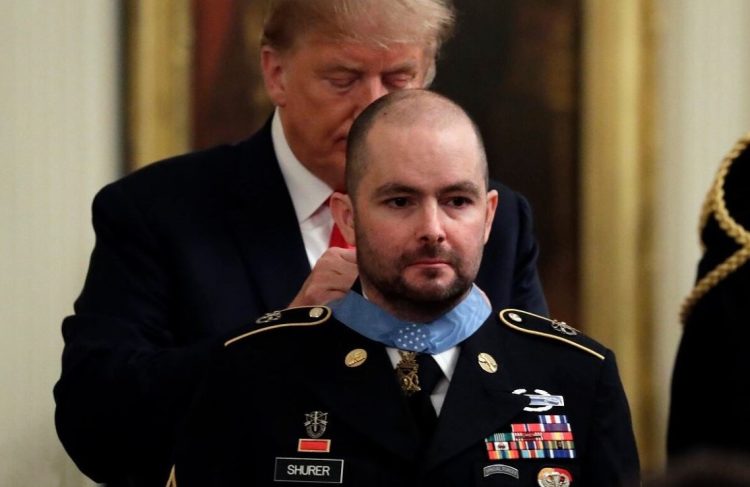
Not long after insertion, more than 200 enemy fighters opened up on the team with everything they had—machine guns, RPGs, and sniper fire. The lead element, which included the ground commander, got hammered immediately and was pinned down. Getting to them was almost suicidal. That’s when Staff Sergeant Ronald J. Shurer II made a decision that would define his legacy. As the only medic on the team, he didn’t hesitate. He sprang into action.
Shurer started by treating an Afghan commando who had taken a bullet. Then he moved to a fellow Green Beret wounded by shrapnel from an RPG. But the fight was far from over. To reach the guys who were in the worst shape, Shurer had to claw his way up the side of that mountain, straight into a hailstorm of enemy fire. He stopped along the way to treat two more wounded men, all while rounds cracked past him. At one point, a sniper’s bullet slammed into his helmet. It should’ve killed him. It didn’t. It didn’t even stop him. Shurer kept moving forward, ever forward.
One of the Green Berets had nearly lost his leg to a sniper round. Shurer got to him, treated him, and shielded the man with his own body as bullets and shrapnel flew around them. He patched up four of his teammates and another ten Afghan soldiers during the battle, staying focused even as the situation spiraled into chaos. The situation quickly became about more than stopping the bleeding—Shurer helped invent a way to get the wounded off the mountain. Using tubular nylon, he and two others rigged a harness system to lower the injured down a 60-foot cliff. Not exactly standard procedure, but it worked.
At the bottom, Shurer didn’t stop. He set up a casualty collection point, kept treating the wounded, and helped load them onto the medevac bird—again, while enemy fire rained down on them. Most men would’ve collapsed right then and there. Shurer didn’t. Once the wounded were safe, he picked his rifle back up, rejoined the fight, helped secure the landing zone, and made sure every man made it out alive.
What Ronald Shurer did that day wasn’t typical, even for a Green Beret medic—it was beyond anything that could be reasonably expected of one man. But he did it anyway. That’s what separates a hero from everyone else. And that’s why his name is remembered with reverence across the Special Forces community and beyond. He was a great man.
🟩 Green Beret Icon
This week we honor SSG Ronald J. Shurer II—Medal of Honor recipient, SF medic, and true warrior.In Shok Valley, he risked everything to save his team under relentless fire. His courage lives on.
🔗 https://t.co/8SgcOFkawi#GreenBeretIcon #RonShurer #sff pic.twitter.com/0uS8KjmMSl
— The Special Forces Foundation (@TheSFF_) May 21, 2025
Recognition and Legacy
Ronald J. Shurer II was first awarded the Silver Star for what he did that day in Shok Valley, but as more details came to light and a Pentagon review took place, the military came to a unanimous conclusion—this wasn’t just Silver Star-level bravery. In 2018, his award was rightfully upgraded to the Medal of Honor. That medal doesn’t get handed out lightly. His official citation said it all: “conspicuous gallantry and intrepidity at the risk of his life above and beyond the call of duty.”
In plain English, Shurer did what most men couldn’t or wouldn’t even attempt, and because of him, every American on that mountainside made it out alive.
Let that sink in—zero American casualties in a seven-hour firefight against over 200 enemy fighters, all because one medic refused to back down. His quick thinking, steady hands, and sheer guts turned what could’ve been a catastrophic loss into one of the most remarkable missions in modern Special Forces history.
The Army made it clear that what Shurer did reflected the absolute best of what military service stands for. He brought honor not only to himself, but to the Combined Joint Special Operations Task Force-Afghanistan, Special Operations Command Central, and the entire United States Army. His name now stands shoulder to shoulder with some of the most legendary warriors in our history.
Ronald Shurer’s heroism in the Shok Valley is one of the most celebrated acts of valor in recent memory. The kind of story that gets passed down, not just because it’s incredible, but because it reminds us of what real courage looks like when everything’s on the line.
In his acceptance, Shurer humbly stated, “This award is not mine. This award wouldn’t exist without the team. If they weren’t doing their job, I wouldn’t have been able to do my job.”
After his military service, Shurer joined the U.S. Secret Service in 2009, serving with distinction until his untimely death from lung cancer on May 14, 2020, at the age of 41. He was laid to rest at Arlington National Cemetery, leaving behind a legacy of courage, compassion, and unwavering dedication to his comrades and country.
Looking Forward
Staff Sergeant Ronald J. Shurer II exemplified the highest ideals of military service. His bravery under fire and commitment to saving lives serve as a testament to the extraordinary capabilities and selflessness of our nation’s Special Forces.
His story continues to inspire and remind us of the profound impact one individual can have in the face of overwhelming adversity.
It shows what one man is capable of when he refuses to quit.
-DOL








COMMENTS