

Guts and Ingenuity Under Fire
Williams was more than brave—he was tactical. At one point, he spotted smoke rising from a ventilation pipe on a pillbox. Instead of going head-on, he climbed on top of it, shoved his flamethrower nozzle down the pipe, and let it rip. No more gunfire from that nest. In another encounter, Japanese soldiers came charging at him with bayonets. He didn’t blink. He turned the flamethrower on them before they could reach him.
By the end of it, Woody Williams had personally neutralized seven enemy pillboxes. Seven. That’s not just bravery—that’s battlefield calculus at work. His actions opened up the terrain so his company could finally push forward. The Medal of Honor citation would later say he showed “conspicuous gallantry and intrepidity at the risk of his life above and beyond the call of duty.” No exaggeration. That wasn’t a flourish from a Pentagon PR writer—that was cold, hard fact.
Legacy Forged in Fire
Woody Williams didn’t fight for glory. He fought for the men beside him—many of whom didn’t make it off that island. His courage, his refusal to give up, and his tactical genius in the heat of the moment directly contributed to one of the hardest-fought victories of the Pacific War. The man not only survived Iwo Jima. He shaped it.
Years later, Woody would reflect on the psychological burden of using a weapon as brutal as a flamethrower. But in the moment, he understood what needed to be done. That’s what made him different. And that’s why we remember him—not just for the flames he unleashed on the enemy, but for the fire that burned in him to see the job through when others couldn’t.
Medal of Honor
After the dust settled on Iwo Jima, the wheels of military recognition began turning. But getting a Medal of Honor doesn’t happen with a handshake and a pat on the back. It’s a process—and a serious one. Detailed reports were written up. Witness statements were gathered from the few men who saw what Woody Williams had done that day amid the chaos and fire. His chain of command took those accounts, reviewed them carefully, and pushed the nomination up the chain of command through Marine Corps channels.
At each level, officers had to sign off, confirming that what Williams had done wasn’t simply brave—it was something rare, something beyond what duty demands. Eventually, the nomination reached the top brass. And from there, it landed on the desk of the Commander-in-Chief himself.
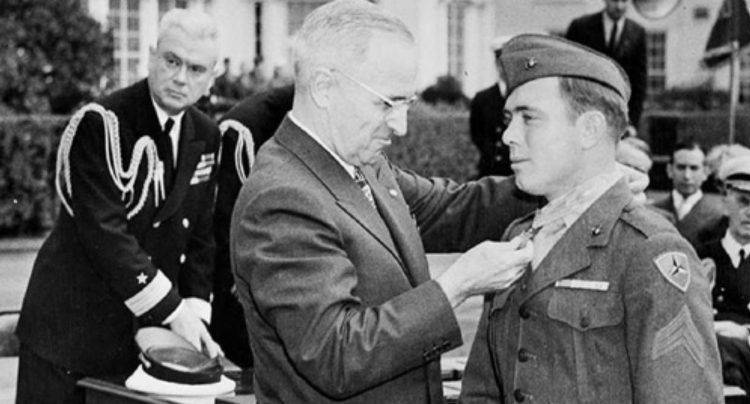
Williams came home to the United States on September 5, 1945. One month later, on October 5, he was standing in the White House. President Harry S. Truman handed him the Medal of Honor in person, reading a citation that spelled it out clearly: Woody had shown “conspicuous gallantry and intrepidity at the risk of his life above and beyond the call of duty.” Every word of that sentence was earned in blood, fire, and grit on the sands of Iwo Jima.
The Long Battles After the War
After the war, Williams returned to West Virginia, but the battle didn’t end. He struggled with the psychological toll of his actions, particularly the use of the flamethrower. “I had a tremendous amount of difficulty because I couldn’t forgive myself for having to take so many lives in such a horrible, horrible way,” he later said.
For years, he coped by drinking heavily at his local VFW. It wasn’t until the 1960s that he found solace in his faith, becoming a lay speaker for the Methodist Church and serving as the national chaplain of the Congressional Medal of Honor Society.
A Legacy of Service
Williams continued to serve in the Marine Corps Reserve, retiring as a Chief Warrant Officer 4 in 1969. He worked for the Veterans Administration for over three decades, helping fellow veterans navigate the complexities of post-service life.
In 2010, he founded the Woody Williams Foundation, dedicated to honoring Gold Star Families—those who have lost a loved one in military service. The foundation has established over 100 Gold Star Families Memorial Monuments across the United States.
His legacy is also etched in steel and stone: the USS Hershel “Woody” Williams, an expeditionary sea base ship, was commissioned in 2020. The Huntington VA Medical Center was renamed in his honor in 2018.
CWO4 Hershel Woodrow “Woody” Williams, the last living World War II Medal of Honor recipient, passed away early this morning, June 29, 2022. Woody received the Medal of Honor for his heroic actions at Iwo Jima. pic.twitter.com/yLqKUmAGDp
— U.S. Marines (@USMC) June 29, 2022
Lessons from a Life of Valor
Williams passed away on June 29, 2022, at the age of 98, the last surviving Medal of Honor recipient from World War II . His life teaches us that heroism doesn’t end on the battlefield. It’s in the ongoing fight for peace within oneself, the dedication to helping others, and the commitment to honoring those who made the ultimate sacrifice.
In a world that often forgets its heroes, Hershel “Woody” Williams stands as a beacon—a reminder that courage, humility, and service are timeless virtues.








COMMENTS