

The Camp Starts to Collapse
The North Vietnamese didn’t simply probe A Shau. They hit it with the intent to take it.
Mortars came in first, then the ground assault. Next, Heavy weapons and coordinated movement, with numbers that kept building. The camp started taking hits immediately, and positions began to fail.
Adkins moved to a mortar pit and got to work, returning fire while the perimeter tightened.
The pit took direct hits. He was wounded.
He stayed in the fight.
When he learned Americans were down outside the wire, he didn’t hesitate. He went immediately out into the impact area, under fire, and started bringing them back.
Not once.
Again and again.
Dragging wounded men through mud, through explosions, through a fight that was already slipping out of control. Every trip outside of cover was a calculated risk, and he kept doing it anyway.
Holding the Line Alone
At one point, Adkins was the only man left operating his mortar position.
One man, wounded, trying to keep a volume of fire on an advancing force that outnumbered him and was closing distance.
When ammunition ran low, he went back out to get more.
That detail gets glossed over if you’re not paying attention. He didn’t just fight with what he had. He exposed himself again to keep the gun running.
That’s not instinct. That’s a life and death decision.
Repeated over and over, under pressure.
Breaking Contact to Stay Alive
Eventually, he realized that the camp could not be held.
Adkins helped organize what was left, destroyed sensitive equipment, and moved survivors out before the position was overrun. The withdrawal wasn’t clean. It turned into a fight for survival in the jungle.
They evaded the enemy for days.
Wounded, hunted, exhausted, moving through terrain that belonged to the enemy until they could be extracted.
Most people don’t think about that phase. The fight after the fight. When there’s no perimeter, no structure, just movement and sheer willpower.
He made it out.
Recognition, Delayed
For his actions at A Shau, Adkins received the Distinguished Service Cross.
That’s where it sat for decades.
A lot of what Special Forces did in Vietnam stayed buried, classified, or simply overlooked in the churn of a long war. Stories like his didn’t always get a full accounting the first time around.
In 2014, that changed.
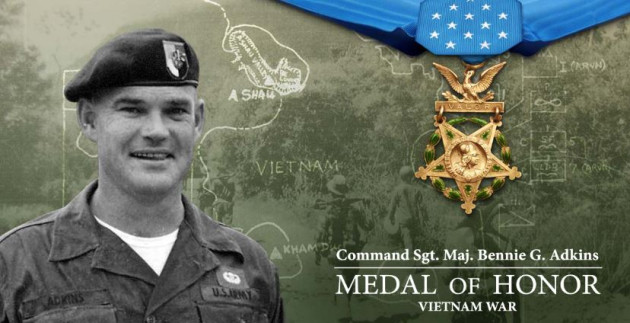
At the White House, President Barack Obama awarded him the Medal of Honor, nearly fifty years after the fight.
It was a long delay, but the record was finally set straight.
September 15, 2014
Sgt. Major Bennie G. Adkins receives the Medal of Honor for his actions in the A Shau Valley from March 9, 1966 to March 12, 1966. pic.twitter.com/vizQM2FtMB
— CSM Bennie G. Adkins (Ret.) (@BennieGAdkins) March 12, 2021
His Career Didn’t End There
Adkins didn’t walk away from the Army after Vietnam.
He stayed in uniform, rising through the ranks and eventually retiring as a Command Sergeant Major. That’s no ceremonial title. It’s the senior enlisted backbone of a unit, the one who enforces standards and carries hard-earned experience forward.
He trained soldiers who would fight in future wars, passing along lessons that weren’t theoretical.
After retirement, he stayed connected to the Special Forces community, a steady presence rather than a loud one.
Final Years
Adkins died in April 2020 at 86 years old, after complications from COVID-19.
Fellow Green Berets carried him to rest.
Quietly. Properly. With dignity.
What We Can Learn From His Life
There’s a tendency to package stories like this into something clean and distant. That misses the point and does a disservice to the men who endured a living hell in Vietnam.
At A Shau, nothing was clean.
Positions were failing. Men were down. Blood flowed. The enemy kept coming.
And in that environment, Bennie Adkins kept making the same call, over and over. Training and muscle memory kicked in.
Move toward the problem.
Pick someone up.
Keep the gun running.
Help the next man.
That’s the through-line. Not a single moment of valor, not one dramatic act, but a chain of decisions made when backing off would have been easier and safer.
That’s the Special Forces standard.
DOL








COMMENTS