

Israel-Hamas War: Hostage Crisis and Intense Fighting
In a surprising turn of events, Hamas and the smaller Islamic Jihad group claimed to have taken more than 130 people captive from inside Israel and transported them to Gaza. They stated that these captives would be exchanged for the release of thousands of Palestinians imprisoned by Israel.
While unconfirmed, this announcement marked the scope of the abductions, which included soldiers and civilians, including women, children, and older adults.
The Israeli military estimated that around 1,000 Hamas fighters participated in Saturday’s initial incursion. This figure highlighted the level of planning by the militant group, which cited mounting Palestinian suffering under Israeli occupation and blockade as the motive for its attack.
During the initial incursion, Hamas militants unleashed violence across various locations, targeting civilians and abducting people in towns, along highways, and even at a techno music festival in the desert.
The rescue service Zaka reported the removal of approximately 260 bodies from the festival site, with expectations of the number rising.
Massacre of innocent Israeli citizens by Hamas terrorists.
Only people with a terrorist mindset would support this heinous crime committed by Palestinian terrorists.#IsraelUnderAttack pic.twitter.com/rOJmPpg5iZ
— BALA (@erbmjha) October 9, 2023
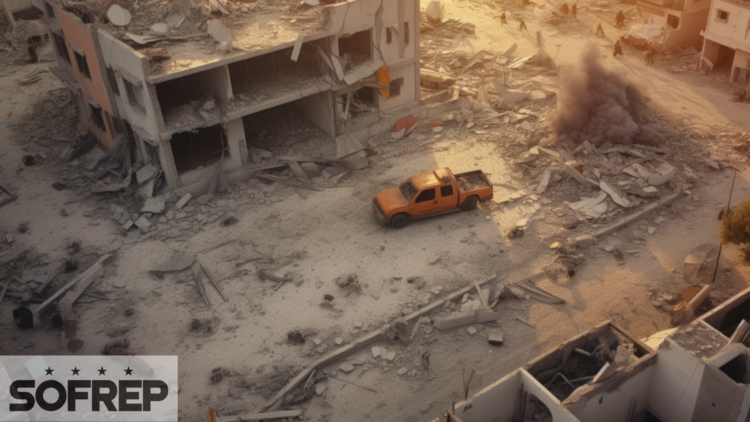
In response, Israel has conducted more than 800 airstrikes in Gaza, including ones that devastated the town of Beit Hanoun in the enclave’s northeast corner.
Israeli Rear Adm. Daniel Hagari stated that Hamas had been using Beit Hanoun as a staging ground for attacks. There was no immediate information regarding casualties, but most of the town’s population likely evacuated beforehand.
“We will continue to attack in this way, with this force, continuously, on all gathering places and routes used by Hamas,” Hagari said.
Civilian Toll Rises Amidst Intense Conflict
Civilians on both sides have already paid a steep price.
The Israeli military has evacuated at least five towns near Gaza. Families in central Israel have been providing DNA samples and other means to identify missing family members.
In Gaza, residents are fearing further escalation as Israeli strikes have flattened residential buildings. Reports of civilian casualties are emerging, with one resident, Nasser Abu Quta, stating that an airstrike killed 19 members of his family in the southern Gaza city of Rafah. He maintained that there were no militants in his building, emphasizing that it was a safe house with women and children.
Gaza this morning after overnight Airstrikes on Hamas terror hideouts! pic.twitter.com/bnokkp3RsN
— Aditya Raj Kaul (@AdityaRajKaul) October 9, 2023
As of late Sunday, Israeli retaliatory airstrikes have destroyed 159 housing units across Gaza and severely damaged 1,210 others, according to the United Nations.
The number of displaced Gazans has risen to over 123,000. A school sheltering more than 225 people also took a direct hit, as reported by the United Nations Relief and Works Agency (UNRWA).
The death toll stands at over 700 in Israel, including 44 soldiers, and 413 in Gaza, including 78 children and 41 women, with around 2,000 people wounded on each side.
Regional Escalation Worries
In northern Israel, a brief exchange of strikes with Lebanon’s Hezbollah militant group has raised concerns about the conflict expanding into a wider regional war. After Hezbollah fired rockets and shells at Israeli positions in a disputed area along the border, Israel responded with armed drones.
The declaration of war by Israel’s Security Cabinet, while largely symbolic, suggests that the country anticipates a more protracted and significant period of conflict. Israel has carried out major military campaigns in Lebanon and Gaza without a formal declaration in the past.
The Security Cabinet’s approval of “significant military steps” grants the military and Prime Minister Benjamin Netanyahu broad authority to address the situation. Netanyahu’s office stated that the aim is to disable Hamas’ military and governing capabilities to ensure Israeli security for years to come.
The surprise attack by Hamas has caught Israel off guard and revealed intelligence gaps. The presence of hostages in Gaza further complicates Israel’s response, as it has a history of making lopsided exchanges to secure the release of captive Israelis.
Russia’s Geopolitical Maneuvering in the Wake of Middle East Conflict
The Institute of War’s assessment of Russia’s offensive campaign, released in the aftermath of the Hamas attack in Israel, sheds light on the Kremlin’s potential strategy to exploit the situation for its own geopolitical gains.
By framing the conflict in the Middle East as a distraction from the Ukraine crisis, Russia aims to divert Western attention and support away from Ukraine.
Deputy Chairman Dmitry Medvedev’s remarks and the Russian Ministry of Foreign Affairs accusations suggest a deliberate effort to shift blame onto the West, portraying them as responsible for the escalation in violence.
Prominent propagandist Sergei Mardan’s statement underscores Russia’s intent to capitalize on the Middle East turmoil to redirect global focus, thereby diminishing international backing for Ukraine.
These narratives are crafted to drive a wedge in Western support for Ukraine, sow doubt within Ukrainian society, and reassure Russian audiences that their country’s actions in Ukraine will go unnoticed on the global stage.
~
Efforts for a ceasefire and negotiations are underway, with Egypt involved in mediating discussions. However, Israel has not yet agreed to a truce, indicating a potential continuation of the conflict.
The ongoing crisis has raised concerns about the stability of the region and the potential for further escalation. The international community is closely monitoring the situation as it unfolds.








COMMENTS