

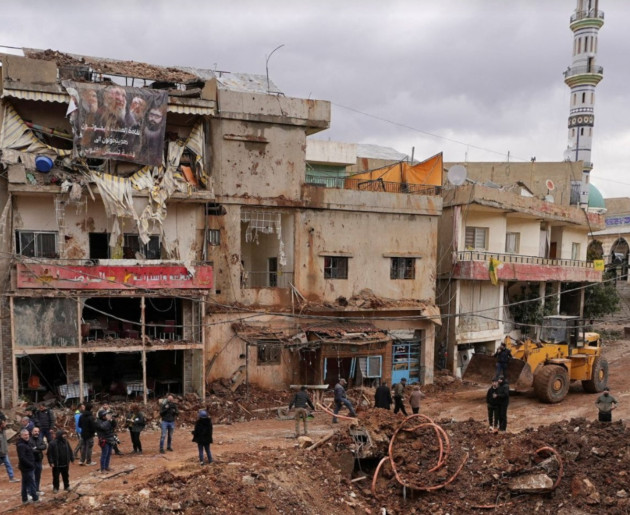
The strikes also come as international oil prices have surged amid fears that the conflict could disrupt shipping through the Strait of Hormuz, the narrow maritime corridor through which roughly one-fifth of the world’s oil supply passes.
Israeli officials have not publicly detailed the operational rationale behind the attacks but have emphasized their broader objective of weakening Iran’s military and economic capacity to sustain the conflict.
The episode highlights the complex coordination required between allies during a rapidly expanding regional war. While the United States and Israel share strategic goals in confronting Iran’s military capabilities, differences over targeting priorities could influence how the campaign evolves in the weeks ahead.
War With Iran Jolts Global Commodity Markets
The conflict is already producing sharp reactions across global financial markets, particularly in energy and commodities.
Oil prices surged as traders weighed the risk that fighting could disrupt shipping through the Strait of Hormuz, the narrow maritime corridor linking the Persian Gulf to global markets. Brent crude jumped roughly 25 percent in early trading before stabilizing above $110 per barrel, while U.S. benchmark West Texas Intermediate climbed above $100.
The surge reflects fears that Iranian retaliation or military escalation could threaten tanker traffic through the waterway, which normally carries roughly one-fifth of the world’s oil supply.
Commodity markets reacted unevenly to the shock. While oil prices surged, gold fell after an initial spike as investors moved into the U.S. dollar. Analysts say the market response reflects uncertainty about whether the conflict will remain geographically limited or evolve into a wider regional disruption.
Energy traders remain focused on the Strait of Hormuz. Any sustained disruption to tanker traffic there could quickly translate into further price spikes and broader inflation pressure across global markets.
Strike on Minab School Raises Questions About Targeting
A missile strike destroyed a girls’ elementary school in Minab, southern Iran, in what has become the deadliest civilian incident of the early phase of the U.S.–Iran conflict. Iranian authorities report that between 160 and 180 people died, most of them girls aged seven to twelve. Dozens more suffered injuries when the Shajareh Tayyebeh school collapsed during the blast.
The strike occurred on February 28 during a wave of attacks against Iranian military infrastructure. The school stands near a compound linked to the Islamic Revolutionary Guard Corps Navy. Investigators believe the military site may have been the intended target.
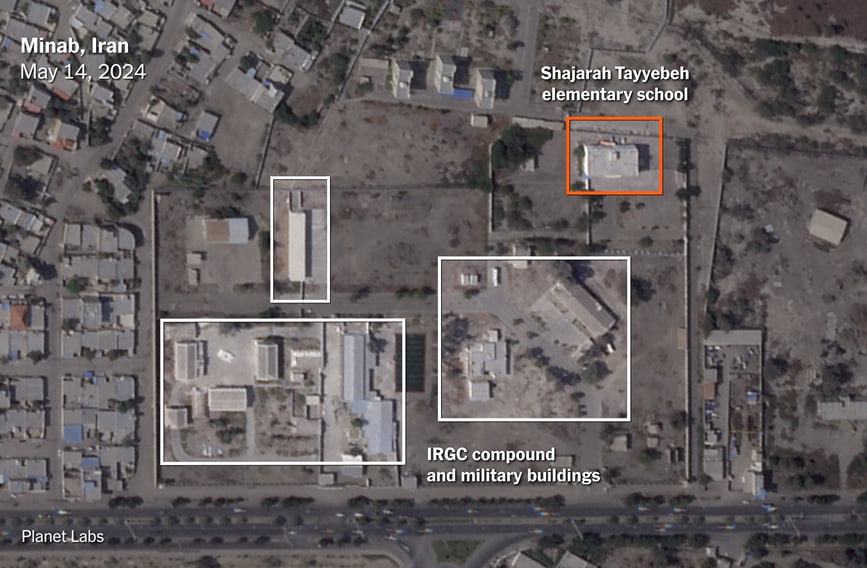
Video circulated by Iranian state media appears to show a cruise missile striking a building inside the nearby compound shortly after the school was hit. Independent analysts have not verified the footage.
U.S. officials have not confirmed responsibility. Defense authorities say American forces do not deliberately target civilian facilities. The Pentagon has opened an investigation to determine whether intelligence failures, targeting errors, or other factors contributed to the incident.
If a Tomahawk cruise missile struck the area, the damage would align with the weapon’s design. Conventional Tomahawk variants carry a roughly 1,000-pound-class high-explosive warhead intended to destroy buildings and hardened targets.
When such a warhead detonates near a structure, the blast can collapse walls and roofs. Concrete, steel, and glass often become high-velocity debris. In a crowded building such as a school, those effects can produce mass casualties even when the intended target lies nearby.
Ukraine’s Drone War Experience Moves Into the Middle East
Iran’s growing use of Shahed attack drones across the Persian Gulf has drawn an unexpected source of expertise: Ukraine. After four years defending its cities from Iranian-designed drones deployed by Russia, Kyiv has become one of the world’s most experienced operators in countering the systems now appearing in the Middle East.
President Volodymyr Zelensky said Ukrainian drone specialists will travel to the region in the coming days to help the United States and its partners defend against Iranian drone attacks. The move reflects how tactics developed during the war in Ukraine are beginning to shape air defense strategies in a second conflict zone.
Iran has relied heavily on the Shahed-series loitering munitions during its response to U.S. and Israeli strikes. These drones are relatively cheap, long-range weapons designed to overwhelm air defenses through volume. The same systems became a defining feature of Russia’s air campaign against Ukrainian infrastructure, where Moscow launched thousands of them against cities and energy facilities.
Ukrainian forces responded by developing a layered defense built around radar detection, mobile anti-aircraft teams, electronic warfare, and increasingly low-cost interceptor drones. Those tactics allowed Ukrainian air defenses to shoot down large numbers of incoming drones while conserving expensive missile systems.
Now Washington and several Gulf states are studying that battlefield experience as Iranian drone attacks expand across the region. Ukrainian officials say the country can provide both technical expertise and trained personnel familiar with the specific threat posed by Shahed-type drones.
The arrangement highlights a broader shift in modern warfare: lessons learned in one theater are moving quickly into another, as drone technology spreads and militaries adapt to a new class of low-cost, long-range strike weapons.
Kurdish Leaders Warn Against Aligning With Washington
Kurdish leaders across the region are urging caution as speculation grows over whether Kurdish groups could open a new front against Iran.
Officials from the Kurdish-led administration in northeast Syria warned Iranian Kurdish factions not to align too closely with Washington in a campaign against Tehran. Their message draws directly from the Kurdish experience in Syria, where U.S. support proved temporary once American strategic priorities changed.
During the war against the Islamic State, the United States partnered closely with the Syrian Democratic Forces, a Kurdish-led militia that helped dismantle ISIS’s territorial control in eastern Syria. Kurdish fighters carried much of the ground combat, while the United States provided airpower, training, and logistical support.
That partnership began to unravel in 2019 when Washington withdrew troops from parts of northern Syria. The decision allowed Turkish forces and allied Syrian militias to launch an offensive into Kurdish-held territory along the border. Kurdish units lost control of several towns and later turned to the Syrian government and Russian forces to stabilize the front line.
Kurdish officials now point to that episode as a cautionary example for Iranian Kurdish groups considering cooperation with Washington.
Several Iranian Kurdish opposition organizations operate from bases in Iraq’s Kurdistan Region and have long opposed Tehran. Some leaders say they would support military pressure on Iran. Kurdish authorities in Iraq, however, have emphasized that they do not want their territory used to launch cross-border attacks.
In Washington, some policymakers have discussed supporting Kurdish fighters inside Iran. Proposals have included some form of air protection similar to the no-fly zones that shielded Iraqi Kurdish territory after the 1991 Gulf War.
For now, Kurdish leaders across the region appear reluctant to escalate the conflict. Many see the Syrian experience as a reminder of how quickly external alliances can shift.
Kharg Island Emerges as Possible Strategic Target
Analysts are increasingly focused on Kharg Island, Iran’s primary oil export terminal in the Persian Gulf, as the conflict with Israel expands. The facility handles the majority of Iran’s crude exports and represents a critical source of government revenue.
Energy analysts and regional security experts say the island could become a strategic target if Israel seeks to escalate economic pressure on Tehran. Disrupting exports from Kharg would strike directly at Iran’s ability to finance military operations and stabilize its domestic economy.
Oil markets are already reacting to the possibility. Prices have climbed sharply amid fears that the conflict could begin to affect energy infrastructure or shipping routes across the Gulf.
At the same time, many analysts view a direct strike on Kharg Island as a high-risk escalation. The terminal sits near the Strait of Hormuz, the narrow maritime corridor through which roughly one-fifth of the world’s oil supply passes. Any sustained disruption there could trigger a global energy shock and draw wider international involvement in the conflict.
For that reason, some officials and market observers see the discussion of Kharg Island less as an immediate operational plan and more as a measure of how far the conflict could escalate if current strikes fail to shift Iran’s strategic posture.
Trump Pushes Latin America Alliance Against Cartels and China
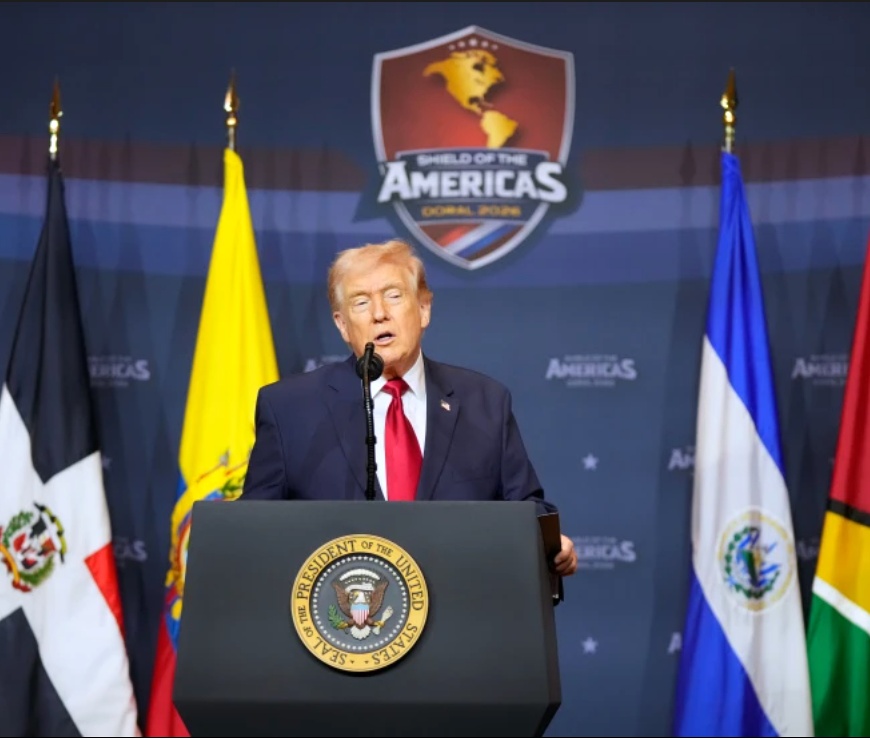
President Donald Trump hosted a group of Latin American leaders in Florida over the weekend for talks focused on security cooperation, drug trafficking, and China’s growing influence in the Western Hemisphere.
The meeting at Trump National Doral near Miami launched what the administration calls the “Shield of the Americas,” a regional initiative aimed at coordinating intelligence sharing and security operations against transnational criminal networks, particularly drug cartels.
Trump urged participating governments to consider using their armed forces against cartel organizations, arguing that criminal groups now operate with the scale and firepower of insurgent forces. He compared the proposal to past multinational coalitions formed to combat terrorist networks.
Leaders from roughly a dozen countries attended the summit, including representatives from Argentina, Ecuador, El Salvador, and Paraguay. Major regional powers such as Brazil, Mexico, and Colombia did not participate.
Cuba and Regional Pressure
Trump also used the gathering to issue warnings aimed at Cuba, saying Havana was under increasing pressure and suggesting its government was seeking negotiations with Washington. U.S. officials say talks with Cuban authorities are already underway as the administration reviews sanctions and diplomatic channels.
Administration officials framed the summit as part of a broader effort to counter China’s economic presence across Latin America, where Chinese investment in infrastructure, telecommunications, and energy projects has expanded significantly over the past two decades.
The summit marks one of the first major foreign policy initiatives of Trump’s second term focused on Latin America.








COMMENTS