


Expanded Aviation Footprint and Operational Flexibility
Beyond carrier aviation, the U.S. has forward deployed additional fifth-generation fighters to regional bases. These aircraft provide enhanced survivability in contested airspace and support suppression of enemy air defenses.
Aerial refueling tankers extend range and increase time on station for both carrier-based and land-based aircraft. Intelligence, surveillance, and reconnaissance platforms operate alongside combat aircraft to support targeting and battle management.
The combination of carrier air wings, bombers, stealth fighters, and support aircraft creates a layered aviation posture capable of sustained high-tempo operations.
At the same time, attack submarines and guided-missile destroyers operating in the region provide additional land-attack and defensive capability. Missile defense systems remain deployed to protect U.S. bases and regional partners from ballistic missile and drone threats.
Together, these assets reduce the time required to initiate operations if directed.
A large group of US Air Force aerial refueling tankers just took off from Florida, bound for the Middle East via Bulgaria.
U.S. forces continue a massive buildup to support actions against Iran. pic.twitter.com/weLkhIX0rU
— OSINTtechnical (@Osinttechnical) February 18, 2026
Nuclear Negotiations Under Pressure
The military buildup coincides with renewed diplomatic pressure on Tehran regarding its nuclear program.
President Donald Trump has publicly stated that military action remains possible if negotiations fail. In recent remarks, he declined to rule out airstrikes and indicated that the decision timeline could compress if talks stall.
Secretary of State Marco Rubio has emphasized that the administration seeks a binding framework that permanently restricts Iran’s ability to develop nuclear weapons capability.
Iran has continued uranium enrichment beyond levels established under the 2015 nuclear agreement. Western governments have expressed concern about enrichment percentages and stockpile size. Tehran maintains that its nuclear activities serve peaceful purposes.
No formal agreement has been announced.
Iranian Military Drills and Regional Risk
Meanwhile, Iran has announced military exercises that include rocket and missile drills. Notices issued ahead of planned launches signal readiness demonstrations amid rising tension.
Iranian officials have warned that any U.S. or Israeli strike would prompt retaliation. Tehran maintains a substantial inventory of ballistic missiles, cruise missiles, and armed unmanned aerial systems.
In addition, Iran maintains relationships with armed groups operating in Iraq, Syria, Lebanon, and Yemen. As a result, escalation could unfold across multiple fronts rather than in a single bilateral exchange.
Israel has raised its alert level amid concerns that a joint U.S.-Israeli strike could occur if talks collapse. Israeli officials have long argued that Iran’s nuclear trajectory presents a significant security threat.
Oil markets have reacted cautiously. Prices dipped this week as traders assessed whether the buildup represents negotiating pressure rather than imminent conflict. Nevertheless, markets remain sensitive to potential disruption in the Strait of Hormuz, a critical maritime chokepoint for global energy flows.
Despite the visible buildup, U.S. defense officials continue to describe the posture as defensive. No strike order has been issued.
For now, the force concentration serves as deterrence backed by capability. Diplomatic channels remain open, but the military architecture is already in place.
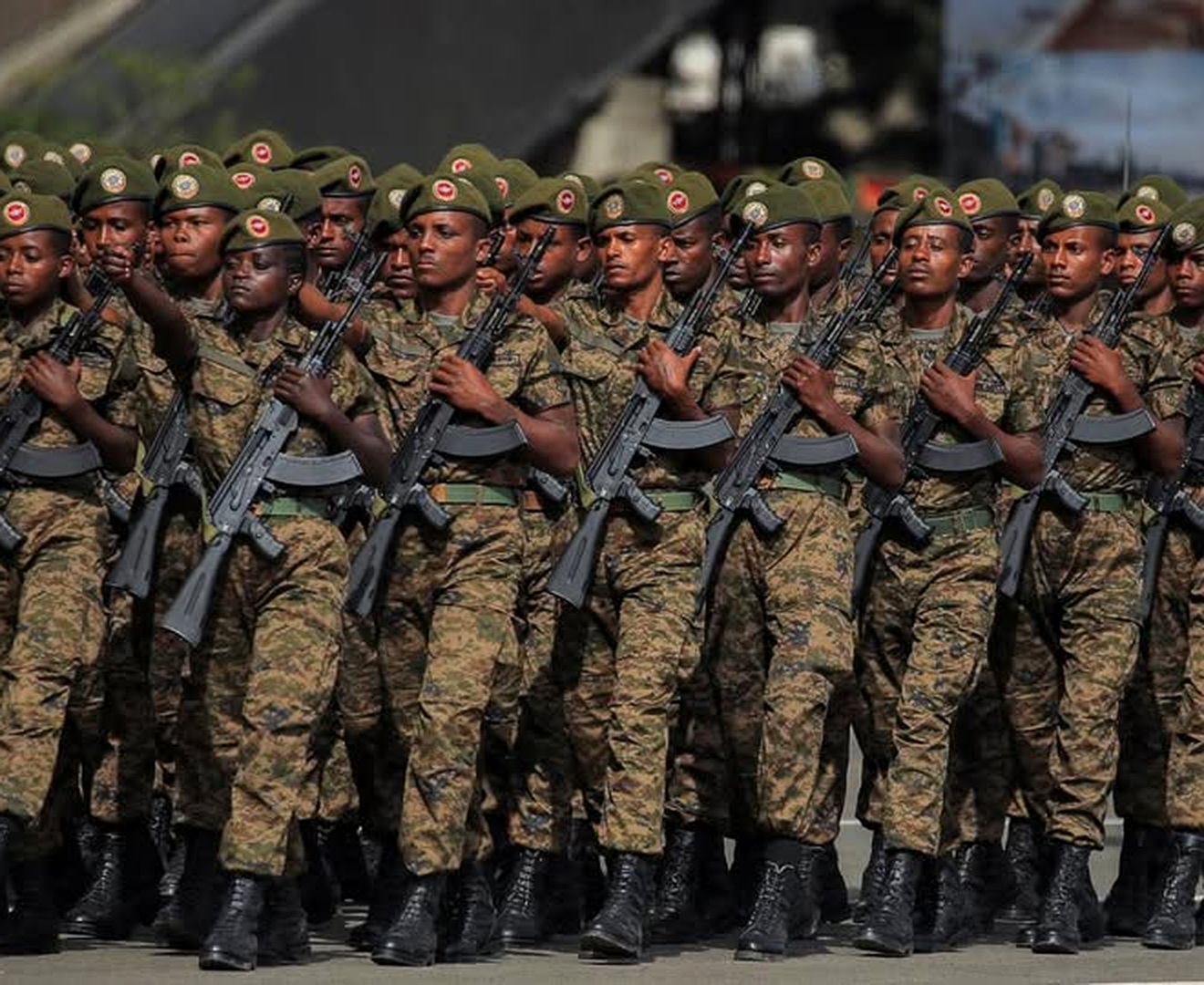
Ethiopian Troop Movements Raise Concerns Over Tigray Ceasefire Stability
Ethiopian federal forces have mobilized near the Tigray regional border, prompting concern about the durability of the 2022 Pretoria peace agreement that ended two years of war in northern Ethiopia.
Local and regional reporting indicates troop movements along key access corridors leading into Tigray. Federal authorities have not announced a renewed offensive. However, the positioning of forces near contested areas has heightened tension in a region that remains politically and militarily fragile.
The Pretoria agreement halted large-scale combat between the Ethiopian National Defense Force (ENDF) and Tigrayan forces aligned with the Tigray People’s Liberation Front (TPLF). The war displaced millions and severely damaged infrastructure across Tigray and neighboring regions.
Although open warfare subsided, implementation of the agreement has proceeded unevenly. Disarmament of Tigrayan forces has progressed in phases, yet disputes over territorial administration and security arrangements remain unresolved.
“Conflict and civil war have made us zombies rather than citizens.”
As tensions escalate between Ethiopia and Eritrea, would a new conflict position Addis Ababa against the leadership in northern Tigray yet again?
🔗: https://t.co/NUJHfCIoJ0 pic.twitter.com/tPCK8ptwpi
— Al Jazeera English (@AJEnglish) February 18, 2026
Eritrea Factor and Regional Friction
At the same time, relations between Ethiopia and Eritrea have shown signs of strain.
Eritrean forces played a significant role during earlier phases of the conflict, operating alongside Ethiopian federal troops against Tigrayan fighters. Since the ceasefire, however, political alignment between Addis Ababa and Asmara has appeared less certain.
Analysts note that Eritrea maintains a heavily militarized posture along its southern border. Any breakdown in coordination between the two governments could shift the regional security balance.
Recent reporting has suggested that Eritrean units remain active near border areas, although neither government has confirmed new joint operations.
Humanitarian and Political Sensitivities
Humanitarian conditions inside Tigray remain fragile despite improvements since the height of the conflict. Aid deliveries continue, but access remains vulnerable to security disruptions.
A renewed escalation would likely affect supply routes and increase displacement in a region still recovering from war.
Political tensions within Tigray also remain unresolved. Leadership divisions within the TPLF have complicated local governance and negotiations with federal authorities. As a result, security developments carry both military and political implications.
No formal declaration of renewed hostilities has occurred. However, troop concentrations along the frontier reduce the margin for miscalculation and increase the risk of localized clashes if tensions continue to rise.
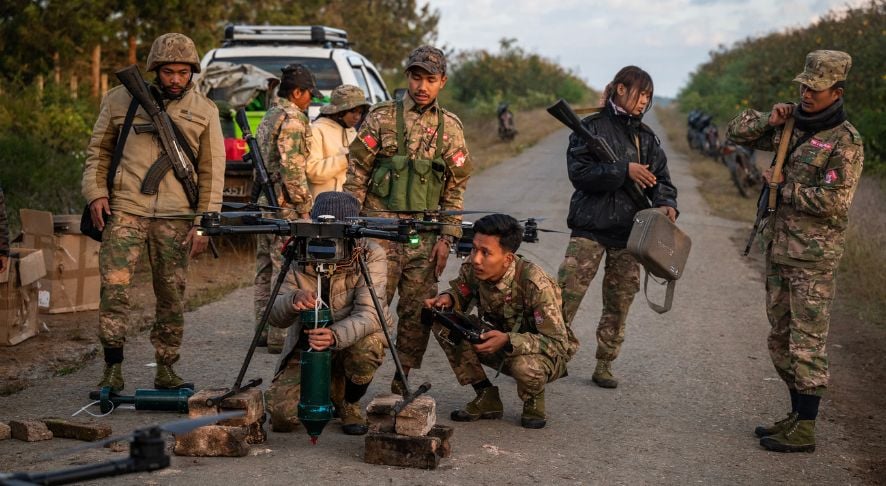
Burma War Update: Border Fighting Persists as Resistance Fragmentation Deepens
Fighting continues in southeastern Myanmar near the Thai border as junta forces press operations against Karen resistance groups along strategic trade routes.
Clashes remain active along the Asia Highway corridor near Myawaddy and Kawkareik, a key commercial link between Myanmar and Thailand. Control of this corridor affects cross-border trade, refugee movement, and revenue flows.
Myanmar’s military, known as the Tatmadaw, has operated alongside allied militia groups in the region. These include elements of the Border Guard Force (BGF), a pro-junta militia integrated into the military’s command structure, and factions of the Democratic Karen Buddhist Army (DKBA), an ethnic Karen armed group that has splintered over time.
Some BGF-aligned units have historically overseen security around large scam compounds operating in Myawaddy and surrounding border areas. These compounds, often linked to transnational fraud networks, generated significant revenue. Under pressure from China and regional governments in late 2025, authorities dismantled or relocated several prominent scam operations. However, armed elements associated with these networks remain active in pro-junta security roles.
Because these militias control terrain and local infrastructure, their participation reinforces junta efforts to maintain influence along the border.
Regime-aligned militias are reinforcing push to recapture Hpapun from the Karen National Liberation Army.#WhatsHappeningInMyanmar
——————-
Help The Irrawaddy Report the Truth from Myanmarhttps://t.co/3StkYCheeRhttps://t.co/ZChkFgZwnp— The Irrawaddy (Eng) (@IrrawaddyNews) February 18, 2026
Resistance Infighting in Sagaing Region
Meanwhile, infighting has erupted among anti-junta forces in Sagaing Region, one of the country’s main resistance strongholds.
People’s Defense Force (PDF) units aligned with the National Unity Government (NUG), the shadow administration formed after the 2021 coup, clashed with members of the Burma National Revolutionary Army (BNRA), an independent anti-junta formation operating outside the NUG’s centralized command structure.
Reports indicate casualties on both sides. Disputes over territorial authority, checkpoints, and weapons access contributed to the confrontation. Some BNRA fighters reportedly defected, while others withdrew from contested positions.
Although both formations oppose military rule, fragmentation remains a persistent feature of the resistance landscape. Coordination challenges continue to complicate efforts to unify command structures across regions.
Broader Conflict Dynamics
Since the 2021 coup, Myanmar has fractured into overlapping zones of control. The Tatmadaw retains authority over major cities and key infrastructure nodes. Ethnic armed organizations and resistance groups contest significant rural territory across several states and regions.
The military continues to rely on airstrikes and artillery in contested areas. Civilian displacement remains widespread, and humanitarian access remains restricted in many conflict zones.
No comprehensive nationwide ceasefire talks are underway. Instead, fighting persists in multiple regions, including Karen, Karenni, Sagaing, and Rakhine states.
As border fighting continues and resistance fragmentation deepens, the conflict shows no immediate sign of consolidation or negotiated settlement.

Ukraine Foreign Legion Faces Renewed Scrutiny Over Torture Allegations
An investigation alleges that a Brazilian volunteer who died while serving in Ukraine was subjected to abuse, coercion, and possible torture within a foreign fighter unit operating alongside Ukrainian forces.
The report cites interviews, internal communications, and supporting material. Former members of the unit alleged that commanders used beatings, threats, and coercive disciplinary measures to maintain control. The Brazilian national’s death reportedly followed internal actions that fellow volunteers characterized as abusive.
Ukrainian authorities have not publicly confirmed the torture allegations. No criminal charges have been announced, and officials have not issued final findings regarding the circumstances of the volunteer’s death.
The case adds to prior scrutiny involving foreign volunteer formations. Earlier investigative reporting examined internal divisions within a U.S.-led unit following killings of unarmed Russian prisoners, raising questions about discipline and oversight. Other reports have highlighted challenges integrating semi-autonomous foreign formations into formal command structures.
If substantiated, the latest allegations would raise accountability concerns regarding recruitment screening and enforcement of military law. Ukrainian authorities have not issued a comprehensive response, and the case remains under review.
⚡️Investigation: Brazilian recruit’s death in Ukraine points to abuse, torture in foreign fighter unit.
A 28-year-old Brazilian recruit died after a brutal punishment handed out in a unit that regularly used discipline practices described as “torture” by those who both…
— The Kyiv Independent (@KyivIndependent) February 18, 2026








COMMENTS