

A long stretch at sea is an excellent time to get to know yourself. My dad and I split the night watch between us. I would take over from my mom and sister at midnight, watch from then till 4:00 A.M., and then hand it off to my father, who took it till sunrise. The night sky over the South Pacific was amazing. There were times when the sky was so clear and filled with stars that it felt like we were floating in space. Every ten minutes or so, I would see a shooting star.
These interludes of solitude, with the heavens, opened up like the pages of a book before me, began working on my mind. During those long hours, I started reflecting on my life, on all the experiences I’d had, and could not help but think about the future and where it might be going.
I think this is something most kids never have the chance to experience, this kind of break in the day when there is nothing to think about but the expanse of time and the possibilities it holds. While my family and I were crossing the South Pacific, all my friends back home were back at school, running around, going to class, chasing girls, going to bed, and then waking up and doing it all over again the next day.
Distractions and commotion, and little time for genuine introspection. As an adult, I have met people who grew up on ranches and found they had experiences similar to my ocean transit at sixteen.
I can’t say I came to any startling new self-knowledge during that time, but in some way that I couldn’t have articulated. It felt like my thinking sank a little deeper and maybe grew bigger. I began getting a sense that I wanted to do something different, something special, with my life. I didn’t exactly know what that might be, but I knew that as much as I loved the life of a dive boat captain, which is what Bill Magee and Captain Mike had been grooming me for during the last few years, I would never be content with the harbor. Despite the incredible tranquility of the ocean, there was an impatience growing inside me, an urge that was starting to whisper: Wherever my life is heading, let’s get on with it!
Those thirty days at sea also provided the time to accomplish a lot. I finished my entire school year (months ahead of schedule), taught myself how to juggle and read a ton of books. I went through the entire Lord of the Rings series and a carton full of classic novels. Steinbeck was one of my favorites. I liked his direct, in-your-face style, and I identified with his strong connection to California.
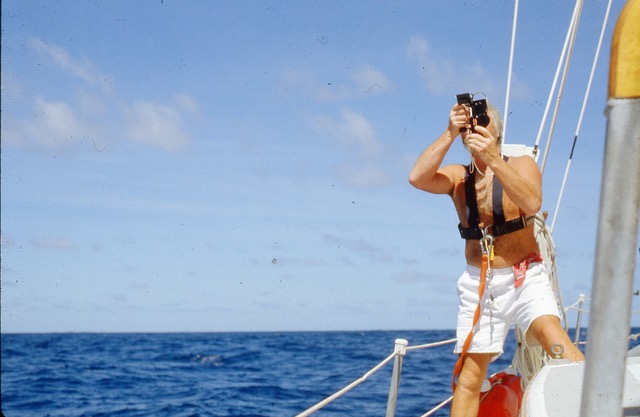
I also practiced celestial navigation with my dad. This was in the days before GPS. We had a sat nav (satellite navigation) unit, a precursor to today’s GPS devices, but it would take a wait of twelve hours for a satellite to get overhead for us to fix our position that way. So we did a lot of our navigation the old-fashioned way: celestial observation and dead reckoning.
After thirty days at sea, we made landfall at Hiva Oa, one of the larger (that is, least tiny) remote Marquesas Islands. Shrouded in a nearly constant cloud cover, the Marquesas rise majestically out of the Pacific, with an appearance similar to the north shore of the Hawaiian chain. The local harbor was a thing of beauty with its gorgeous black sand beaches and, high up on the distant cliffs, a panorama of waterfalls. Gauguin spent his last years here, as did the Belgian singer-songwriter Jacques Brel. Both Herman Melville and Robert Louis Stevenson wrote books inspired by visits to Hiva Oa.
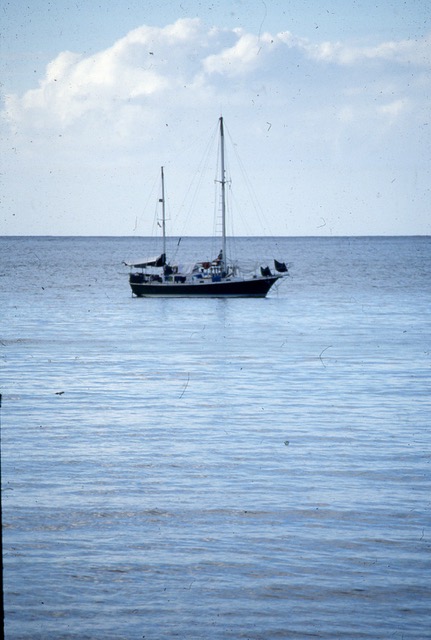
We anchored the Agio in a cove and took a small boat ashore. The lifestyle of the people we encountered was both amazing and hilarious to me: They lived in fairly primitive, thatched-roof huts—and drove brand-new Toyota four-wheel drives subsidized by the French government.
On Hiva Oa, I met a girl I will never forget. I never knew her name; there was a complete language barrier between us. Somehow, though, we just clicked. We took long walks through the most stunning tropical scenery, past the most amazing waterfalls, and as beautiful as our surroundings were, she was even more so. She was something out of a dream. I never tried anything with her, never even kissed her, but after we left, I missed her badly. Of course, I knew we couldn’t stay there, and that it wasn’t my dad’s fault we had to leave, but still, I hated it. This added fuel to the coals of resentment that were already burning.
Rising Tension
Up to this point in our trip, my dad and I had been having a steadily escalating series of disagreements on points of seamanship. So far, these had been relatively minor—but things were about to change.
On the open ocean, it wasn’t that bad. When you’re sailing straight in one direction, all you’re really doing is taking fixes and monitoring your course. Every time we’d get closer to land, though, and especially when it came to navigating the coastal waterways, the two of us would start to butt heads. I wanted more of a say in how we managed the boat. I felt like I should be consulted. By this time, I’d had a lot of experience in coastal waterway navigation. “Look,” I’d say, “I’m no slouch. I know what I’m doing here.”
In the South Pacific, because of the nature of the deepwater reefs, it’s common to set two anchors. First, you set a bow (front) hook, then throw a stern anchor off the back and snug the boat up, tight. For both anchors, my father was using a type of anchor called a CQR, which he’d used for most of his cruising life in Seattle, California, and Mexico. A CQR is a plow type of anchor that does an excellent job of holding in sand, clay, or mud bottoms, but it’s not the best choice to hold in rocks or coral reefs.
We also had on board a multipurpose Bruce anchor I had salvaged from my time on the dive boat, and this was the anchor I favored. The Bruce is designed to function in a wide range of seafloor compositions. Because of its fierce reliability, it is the choice of most commercial boats. The Bruce and I knew each other well, going back to my early days working on the dive boat; in fact, it was the reason for many of those 2:00 A.M. wake-up calls. That frigging Bruce anchor would hold fast in anything.
“Look,” I said, “we’re in a coral reef. I get what the underwater topography looks like here, Dad. I’m a diver. Do you have any idea how many stuck anchors I’ve dealt with? Trust me, we need the Bruce on the bow.”
But my father didn’t see it that way. “There’s only one captain on this boat,” was all he’d say, “and you know who that is.”
I was so frustrated. At the same time, I was being a cocky smart-ass about the whole thing. I was well aware that my own attitude was not going a long way toward selling the idea, but my heels were dug in. My parents couldn’t stop me from screaming my head off when I was two weeks old, and at sixteen, I guess I hadn’t gotten much easier to persuade.
That first night in port, we set our bow and rear anchors, again both CQRs. Of the two, the bow is the more important—and when we awoke the next morning, I was delighted to see that we had dragged the bow anchor right along the ocean floor and nearly grounded our boat. I couldn’t wait to give my dad an earful about what a useless piece of crap that damn CQR was. Equally well spelled out was this ancillary point: What an obnoxious prick I was being.
Every time we argued, my sister would go to her room to get away from the tension while my mom would try to be the peacemaker. Of course, she would side with my dad, but then, later on, she would come to my stateroom privately, sit down with me, and say, “Brandon, you have to chill out. I know you have a lot of experience, but this is your dad’s boat.” I would vent my frustration to her, and she would be understanding and try to keep the situation from spiraling out of control. For a while, she succeeded.
Our trip continued through the rest of the island chain to the Marquesas’ main northern island, Nuka Hiva, and then to the Tuamotu Archipelago, a series of coral atolls that comprise the largest atoll chain in the world. All the while, my father and I continued arguing. By the time we pulled into Papeete, the capital of Tahiti, the situation had severely deteriorated.
Off The Boat
I don’t remember what I said that finally set him off, but whatever it was, it brought to an end not only my trip with my family but also my life with my family. Suddenly, my dad had me by the scruff of the neck, his fist curled and ready to lash out, both of us screaming at each other. My God, my mother thought, he’s going to kick the crap out of Brandon. He didn’t hit me, but we both knew we were going to a place that neither of us wanted to. We’d reached a point of no return. One of us had to go—and it wasn’t going to be him. With my mom and sister wailing in grief and disbelief, my father threw me off the boat.
He didn’t actually hurl me off physically. He just told me that I should take a pack with me and find passage aboard another boat to my destination of choice. He said it like he meant it.
Before I knew it, I was off the Agio for good—and on my own in the middle of the South Pacific.








COMMENTS