

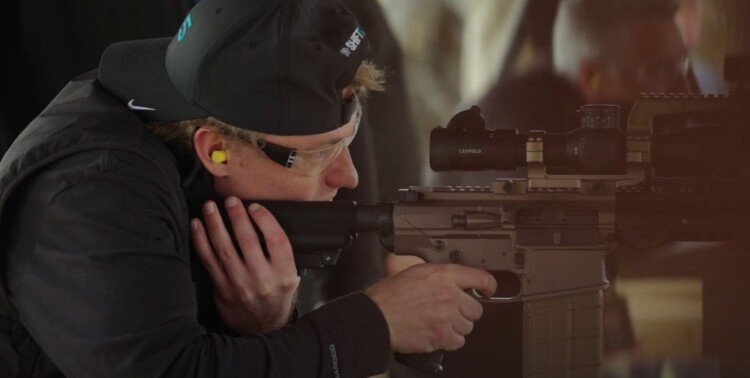
During a recent Thursday showcase, Maxim Suppressors’ President and CEO, Michael Windfeldt, unveiled a selection of the company’s suppressors. Windfeldt shared his vision for the future, predicting a trend where suppressors become as standard in military weaponry as mufflers are in automobiles.
He emphasized how these devices are instrumental in reducing gunfire noise. This is particularly important considering the past instances of hearing impairment among service members caused by loud firearm discharges.
Modular Munition Systems
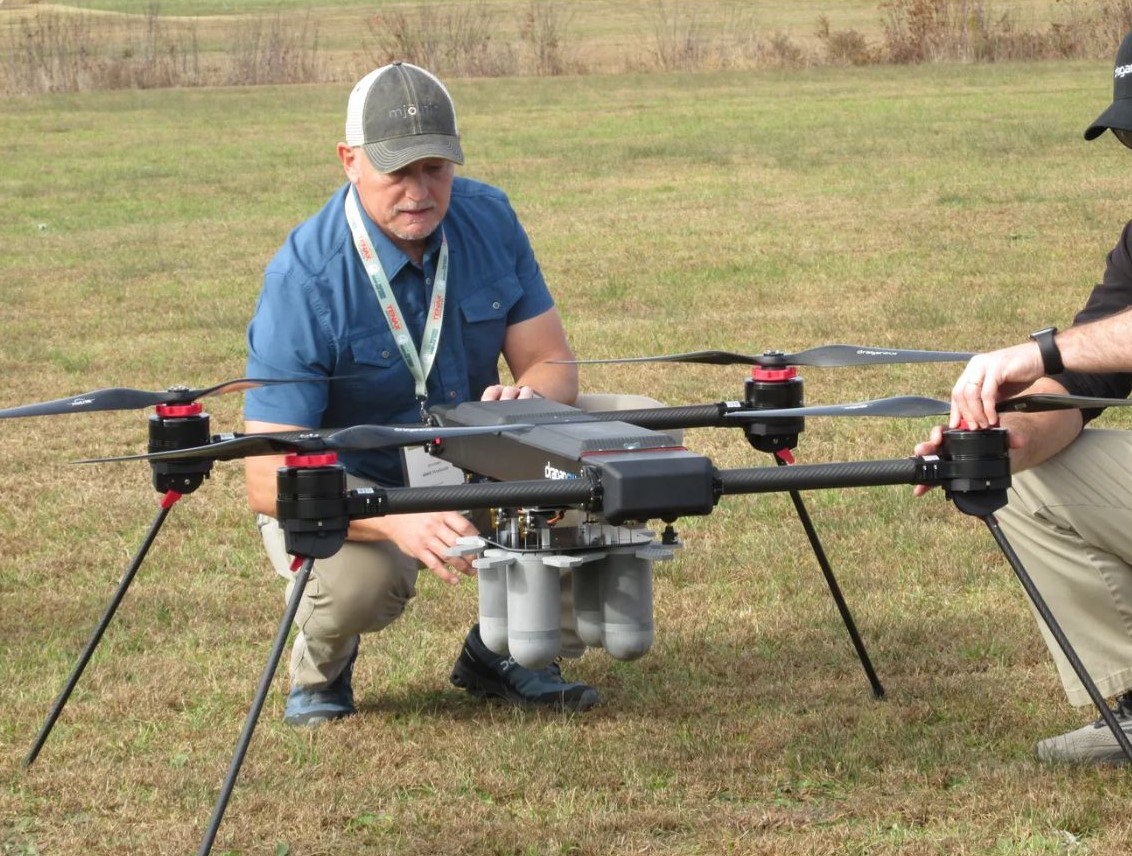
MMS Products Inc. has developed an innovative modular munition system known as Mjölnir, which, according to the company’s CEO and retired Army infantry officer Tim Dunnigan, has versatile functions. This system was conceived following several visits to Ukraine.
Dunnigan explains that Mjölnir serves a dual purpose: it aids in humanitarian de-mining efforts when paired with drones and also has potential applications in combat.
One of the key features of this system is its compatibility with various drone models, as it is designed to be drone-agnostic. The munition system is engineered to either explode three meters above ground or upon direct contact with a surface.
A significant aspect of Mjölnir is its flexibility in terms of explosives. The system is supplied without any explosives, allowing operators to select the type that best suits their needs, be it plastic, general-purpose, or liquid explosives. Additionally, its canister can carry medical supplies.
Thermal Optics
The U.S. Army has been incorporating thermal weapon sights into its arsenal for some time, leveraging technology that utilizes uncooled, forward-looking infrared systems. These devices enable soldiers to identify targets in various conditions, including in poor weather or limited visibility.
Leonardo DRS, Inc. recently secured a significant contract to enhance the Army’s capabilities in this area. They were awarded a $579 million contract for producing advanced thermal weapon sights, spanning five years.
At a recent demonstration, Travis Mitchell, a former Marine and now the Vice President of Development at Pixels on Target, showcased their latest innovation in this field – the VooDoo multi-mission thermal sights. These sights, which have garnered subcontracts from the Defense Logistics Agency, represent a significant advancement in thermal imaging technology.
Mitchell highlighted the effectiveness of the VooDoo sights in various conditions. He pointed out their ability to detect heat signatures from a considerable distance, functioning day and night without a laser. This feature is particularly advantageous as it eliminates the risk of soldiers being detected by adversaries, a common issue with night vision equipment that requires illumination in low-light situations.
Additionally, Mitchell noted that the Army is moving away from laser-based systems on the battlefield to avoid detection. The VooDoo thermal sights offer a strategic advantage in this regard. These versatile sights can be mounted on weapons or helmets and boast impressive zoom capabilities, allowing target detection up to 2,500 meters away.
Munitions Launchers
In 2021, Nammo Defense Systems Inc. secured a half-billion dollar contract to provide the U.S. Army with M72 light anti-armor weapons and equipment for training in shoulder-fired munitions systems. Recently, an exhibition showcased the M72, notably integrated with Alare Tech’s BLADE, a compact unmanned aerial system.
Alare Tech’s CEO, Carlos Miralles, highlighted the innovative combination, describing the setup as effectively transforming into a “rocket launcher.”
The BLADE system, primarily developed for prolonged intelligence, surveillance, and reconnaissance operations, now also supports precise strike capabilities, according to Miralles.
A November 16, 2023 demonstration revealed that the M72 light anti-armor weapon, when mounted on the BLADE system, can effectively function as a rocket launcher. Miralles mentioned that this system could be operated using any radio system within a 6-9 mile radius, boasting a flight duration of 40 minutes when armed and up to 80 minutes for reconnaissance missions.
Miralles emphasized the ease of operation, stating that the user doesn’t need to aim precisely but can simply target the area of interest for effective engagement.
Video Recap of Last Year’s Event








COMMENTS