

The man who had been waiting for the “all clear” walked into the cabin. I noticed at least three or four men behind him who all dispersed once he entered the cabin.
He was of average height and build, but had an air of awareness and intelligence about him. He carried only a small leather bag and placed it almost right above my head on the luggage rack. As for his ethnicity, I would only guess Egyptian. He must have been in his late thirties or early forties. His clothing was plain and unremarkable, but still somehow elegant.
He sat down very politely, excusing himself to me and the Italian man. Only after he sat down did the burly Egyptian sit down across from him; the weathered, stoic expression on his face revealed nothing but attentiveness to the man sitting next to me. I noticed at this point that the man sitting next to me was clearly the “leader” of this group of men.
As everyone was getting settled, the train staff came through and asked for everyone’s tickets/passports. I produced them when asked and put them back into my cargo pocket, but I wasn’t careful enough.
“American, what brings you to Italy?” the leader asked in soft, perfect English. I was surprised at his question for three reasons: number one, he was aware enough to see my passport and what country I was from. Two, he had no noticeable accent to his English. Three, he had already greeted everyone else on the train in their respective languages. Now, alone, each of these things isn’t too much of a big deal, but all three together? That got my attention.
“Just on a vacation. Yourself?” I responded coolly. With a very sincere smile and eyes that displayed intelligence, he said “Ah, yes, well I am on a trip to visit some family.” While I continued to engage in small talk with the leader, the stoic man across from him never took his gaze off of me.
Soon enough, the leader was asking me about who I was and what I did for a career. “I am just a student right now,” I assured him, though that wasn’t entirely true at the time.
It is difficult to put into words exactly how this man spoke and portrayed himself. Using words like professional and intelligent and sincere seem not to do justice to the conversation.
Unfortunately, the subject of the conversation shifted towards current events and politics. He soon gently placed his hand on my forearm, and spoke to me with a fiery look in his eye. “I must warn you, my friend, blood is coming to your doorstep.” He spoke these words articulately and with extreme confidence. It was very concerning. He removed his hand and said in an almost pleading voice, “America will pay for everything it has done, and everything it hasn’t done, with the blood of its citizens.” At this point, I was not happy with the way the conversation was going and was acutely aware of the many “red flags” waving around in my face.
I was on the Night Train and the Jihadist was making me nervous. I started to run through my options mentally and figured that getting off the train or changing cabins might mean more trouble than it was worth. Additionally, I was curious to find out more about this guy and his friends. Something told me to keep engaging this guy, keep getting him to talk to me. Something in my gut said, “This guy is important—pay attention and see what happens.”
Our conversation soon became a pseudo chess match. I would say things like, “Tell me more about yourself,” and “How did you learn English so well?” He would counter with, “Enough about me, tell me about what you do in the U.S. Tell me about life in the U.S.”
I was able to attain a significant amount of information, but only through providing some information to him. For example, he learned English at the American University in Cairo, where he earned a bachelor’s and a few master’s degrees in fields like language and political science. He was Egyptian by birth, but had traveled all over the world. He could speak at least five languages, maybe more, fluently. He was also extremely Islamic.
In order to keep the conversation about him, I would say things like, “I don’t understand Islam very well, could you tell me more about it?” Even questions as silly as “Why don’t you eat pork?” Each time he would answer the question and then ask me something like, “Your bag, is that a military bag?” And, “Your haircut, are you in the military?” And, “Tell me about your hometown, your family, your way of life.”
Most of my answers I kept simple and vague enough to get by without pressing the issue further. I’d say things like, “I’m from Chicago,” and, “I have an average American family, nothing crazy,” and “No, I’m a student, I just like to keep my hair this way.” Truth enough to let it roll off the tongue, vague enough to prevent identifiable information from being revealed.
However, I must admit that this guy was winning the game of chess. If you have ever met someone who has been trained in the art of interrogation, you’ll know what I am talking about. Information gathering is not just pulling fingernails and acid drips, it’s also about knowing how to talk to someone. Knowing what makes them tick and pulling from similarities.
About 30 or 40 minutes into the trip, the train stopped at a station in northern Italy. Another round of I.D. and ticket checks. However, this time, it was by the Italian police. When the officer came to our cabin, he asked for two forms of I.D. for foreigners. Shit. I only had my CAC card and my passport. I gave him my IDs and he looked at them, truly studying them, before handing them back. As he gave me my CAC card back first, I pretty much fumbled it around when he gave my passport back next. I quickly put them back into my pocket in hopes that the man sitting next to me didn’t get a chance to look at it closely. As the policeman closed the door and walked to the next cabin, the leader turned to me and said, “So, you are military.”
Again, a few choice curse words flew through my head. But what quickly followed was the realization that this guy knew what a CAC card looked like. I say this because he was not close enough to read it, but close enough to catch a glimpse, I’m sure, especially if he was paying particular attention.
“No, no, just a student,” I reassured him. His expression was obvious. He knew.
After the police were done checking everyone’s IDs, the conductor came over the loudspeaker and explained that everyone had about 10 minutes to get off the train and stretch their legs, grab some smokes, use the bathroom, etc. I got up to at least get some distance between my new “friend” and myself.
“Would you be so kind as to join me while I smoke?” the leader asked. I noticed that, while everyone was getting up to exit the train, the men who had traveled with the leader were now crowding around our cabin waiting for him to leave. The burly Egyptian, clearly the leader’s lieutenant, was staring at me and waiting for a response.
“Of course. After you,” I replied politely. At this point, I didn’t feel that I had much of a choice.
We sat down together on a bench on the station platform. The station was closed, hence the ID checks before we were allowed to exit the train. Since my understanding of the announcement was rudimentary at best, I wasn’t certain if the “break” was scheduled or if some type of maintenance or checkup was required for the train.
After the leader and I sat down, the lieutenant sat next to me. Only then did I notice that five or six other Arab/Egyptian men had established a perimeter around us. They were watching the other passengers and essentially preventing anyone from joining us. The lieutenant was watching me.
The leader, to my surprise, offered me a cigarette and explained how he thought I was a good man. He said he, “wished all Americans were like me.” I responded that most of them are. He shook his head in an almost pitying manner.
He went on to explain to me that America, despite having some good in its intentions, was doomed. He told me that, “It may not be in five, ten, twenty, or even one hundred years, but one day Islam will reign and America will be defeated and destroyed.” When he said this, he smiled—not in an intimidating way, but in a way that said, “I am at peace with this ‘reality’.”
He then offered to buy me something to drink or eat from the vending machines. I said, “No, thank you,” but he had one of his men buy me a Coke and some mint gum, anyway. Our entire interaction was completely respectful and polite. At no point did I actually feel like physical danger was present. Despite his warnings about the destruction of the West and that America would pay, he was one of the most mannerly and civil people I have ever talked to. On top of this, he was very gracious for my interactions with him and made sure to thank me for answering each of his questions.
Just before we got back on the train, he suggested that we should share email addresses as he wanted to provide me better education regarding the “Jihad.” He said that my understanding of it was incorrect and didn’t provide it proper justice. Part of me wanted to, so that I could have some tangible evidence of my interaction with him, and most importantly, offer it to whatever agency would want it whenever I returned home. However, I decided against it, with the opinion that I would end up on some list and be forever banned from traveling in the U.S.
We returned to our cabin and departed the station. Within an hour or so, we were at the border with Switzerland. We were cruising along when, all of a sudden, the train came to an abrupt halt. I looked out the window and saw that we had not stopped at a station.
The leader and his lieutenant shared a look of concern. I heard heavy footsteps coming down the hallway and gruff voices in a few different languages.
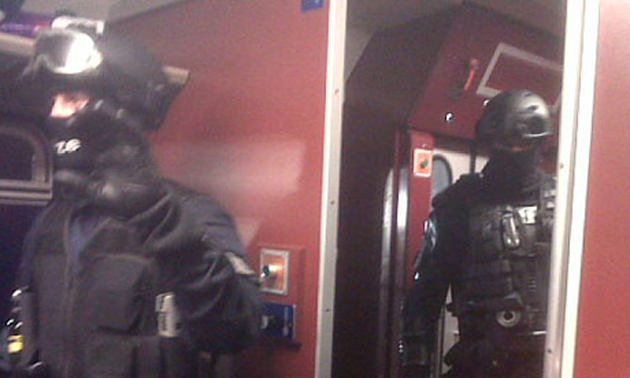
Suddenly a man in all black, with a plate carrier and an MP5 submachine gun, followed by similarly equipped men, appeared in our hallway. They had a dog with them as well. A policeman, not tactically dressed, accompanied them and pointed at us through the glass while talking to the group of armed men. They opened our door and asked for identification from all of us—using each of our respective languages. When the armed man in black turned to me, he said, “I need to see your passport, sir.” I immediately gave it to him and he barely glanced at it before handing it back.
He then asked the leader in a different language (not sure, but wasn’t German, Italian, or English). The leader’s lieutenant abruptly sat up, as if to stand. The leader snapped a command at him, glaring at him. The lieutenant sat back in his seat, never moving his gaze from the armed men—stoic as ever.
The leader responded in German/Swiss-German and handed his passport to the armed man. The man reviewed the documents the policeman provided him, looked at the passport and then gave both the passport and the documents to another one of the armed men in black. He gave the leader and his lieutenant a command in German/Swiss-German.
Again the lieutenant’s eyes darted to the leader, as if to say, “Let me do something.” Again, the leader glared back and motioned for the lieutenant to comply. The leader stood up and gracefully gathered his things. The armed men in black escorted the leader, his lieutenant, and the other Arab/Egyptian men off of the train.
As soon as they were off, the train started moving again. I processed what I had seen, and reached a chilling conclusion. The enemy is real. He is prepared. And he is educated.
(Featured Image Courtesy: The Guardian)








COMMENTS