

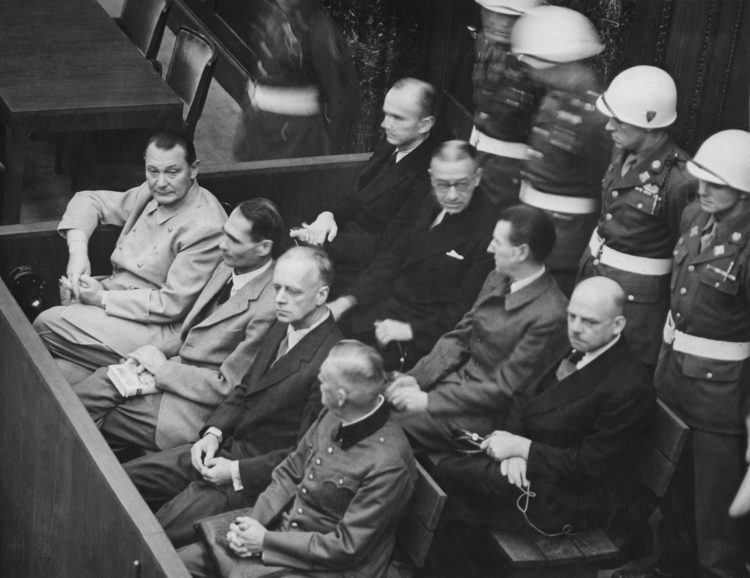
The initial trial began on Nov. 20, 1945. 24 suspected major war criminals were to be tried, along with seven organizations including the leadership of the Nazi party. These were the Reich Cabinet, the Schutzstaffel (SS), Sicherheitsdienst (SD), the Gestapo, the Sturmabteilung (SA) and the “General Staff and High Command.” They comprised several categories of senior military officers. These organizations were to be declared “criminal” if found guilty.
The four major indictments against the defendants were for:
- Participation in a common plan or conspiracy for the accomplishment of a crime against peace
- Planning, initiating and waging wars of aggression and other crimes against peace
- Participating in War crimes
- Crimes against humanity
Because the defendants, judges, and prosecutors spoke different languages, the trial saw the introduction of instantaneous translation. All of the court members were issued headphones while translators provided on-the-spot translations in English, French, German and Russian.
Robert Jackson, the American prosecutor gave the opening statement, which has since become famous and encapsulates what the Allies were trying the Germans for. This was followed by Albert Speer’s opening remarks, which lasted two hours. In his remarks Speer said: “The trial began with the grand, devastating opening address by the Chief American Prosecutor, Justice Robert H. Jackson. But I took comfort from one sentence in it which accused the defendants of guilt for the regime’s crimes, but not the German people.”
Part of Jackson’s opening remarks:
What makes this inquest significant is that these prisoners represent sinister influences that will lurk in the world long after their bodies have returned to dust. We will show them to be living symbols of racial hatreds, of terrorism and violence, and of the arrogance and cruelty of power. They are symbols of fierce nationalisms and of militarism, of intrigue and war-making which have embroiled Europe generation after generation, crushing its manhood, destroying its homes, and impoverishing its life…. Civilization can afford no compromise with the social forces which would gain renewed strength if we deal ambiguously or indecisively with the men in whom those forces now precariously survive.
Here is a list of the defendants and the outcomes of their trial.
Hermann Göring – Reichsmarschall and Hitler’s deputy – Sentenced to death – Committed suicide the night before his execution.
Joachim von Ribbentrop – Foreign Minister – Sentenced to death – Hanged October 16, 1946.
Wilhelm Keitel – Chief of the Armed Forces High Command – Sentenced to death – Hanged October 16, 1946.
Ernst Kaltenbrunner – Chief of the Reich Main Security Office – Sentenced to death – Hanged October 16, 1946.
Alfred Rosenberg – Reich Minister for the Occupied Eastern Territories and Leader of the Foreign Policy Office – Sentenced to death – Hanged October 16, 1946.
Hans Frank – Governor-General of Occupied Poland – Sentenced to death – Hanged October 16, 1946.
Wilhelm Frick – Minister of the Interior – Sentenced to death – Hanged October 16, 1946.
Julius Streicher – Founder and publisher of the anti-Semitic newspaper “Der Stürmer”- Sentenced to death – Hanged October 16, 1946.
Fritz Sauckel – General Plenipotentiary for Labour Deployment – Sentenced to death – Hanged October 16, 1946.
Alfred Jodl – Chief of the Operations Staff of the Armed Forces High Command – Sentenced to Death – Hanged October 16, 1946.
Arthur Seyss-Inquart – Reichskommissar for the Occupied Dutch Territories – Sentenced to death – Hanged October 16, 1946.
Martin Bormann – Chief of the Nazi Party Chancellery – Sentenced to death in absentia – Later his bones were found in Berlin. He died in May 1945 while trying to escape Berlin.
Rudolf Hess – Deputy Führer of the Nazi Party – Sentenced to Life Imprisonment – Committed suicide in prison in 1987.
Walther Funk – Reich Minister of Economics – – Sentenced to Life Imprisonment – Released because of ill health, May 16, 1957.
Erich Raeder – Grand Admiral – Sentenced to Life Imprisonment – Released because of ill health, September 26, 1957.
Karl Doenitz – Raeder’s successor and briefly President of the German Reich – Sentenced to 10 years – Released October 1, 1956.
Baldur von Schirach – National Youth Leader (Hitler Youth) – Sentenced to 20 years – Released September 30, 1966.
Albert Speer – Minister of Armaments and War Production – Sentenced to 20 years – Released October 1, 1966.
Konstantin von Neurath – Protector of Bohemia and Moravia Sentenced to 15 years – Released because of ill health (heart attack) November 6, 1954.
Hjalmar Schacht -Reich Minister of Economics – Acquitted.
Franz von Papen – Chancellor of Germany – Acquitted.
Hans Fritzche – Ministerialdirektor in the Ministry for Popular Enlightenment and Propaganda – Acquitted.
Robert Ley – Head of DAF, German Labor Front – No Decision – Committed suicide on October 26, 1945 prior to the trial starting.
Gustav Krupp von Bohlen und Halbach – German Industrialist – No Decision – Medically unfit for trial. Due to an error, Gustav, instead of his son Alfried (who ran Krupp for his father during most of the war), was selected for indictment.
Photo: Wikipedia








COMMENTS