

Despite heavy casualties, the Ukrainian counteroffensive did well. The Russians staged an organized retreat to more defensible positions. But – it looked like the Russian forces might not be able to stop the Ukrainian attack.
Enter the Tyulpan
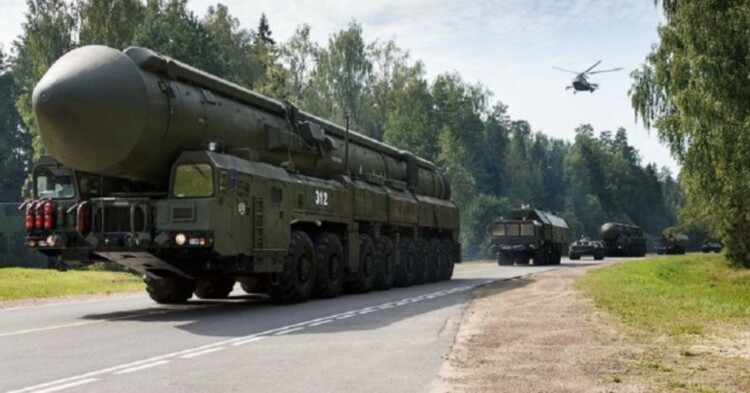
Enter the Tyulpan, Russia’s heavy 240mm mortar. We covered this bunker-buster in a previous post here: https://sofrep.com/news/siege-artillery-the-flowers-of-spring/
What we did not mention is that the Tyulpan is capable of firing nuclear ammunition. Specifically, the Tyulpan is capable of firing the RD-14 nuclear mortar bomb. The following video shows American nuclear artillery:
Figure 3 shows the American nuclear howitzer in action.
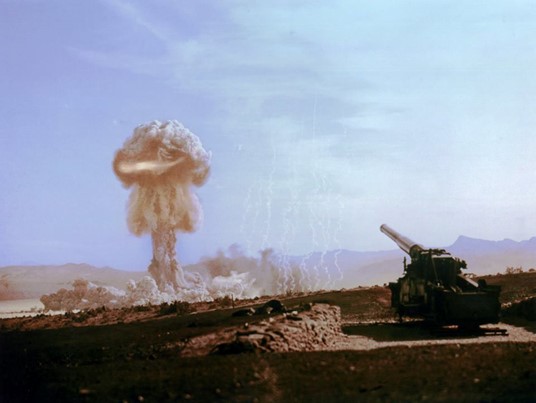
The American howitzer is 280mm and fires a 15-kiloton shell. Note that this shell has the same yield as the Hiroshima bomb. It is “non-strategic” but larger than most would consider “tactical.” Both Russia and the United States have nuclear artillery in calibers ranging from 152mm to 405mm. 152mm shells tend to be fractional kiloton weapons. The 240mm RD-14 fired by the Tyulpan is a mid-range shell that balances mobility and yield.
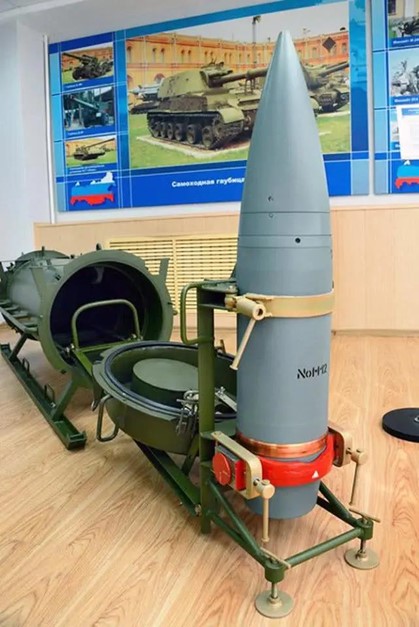
Russian nuclear doctrine specifies that should the integrity of Russian territory be threatened, the first use of nuclear weapons is authorized.
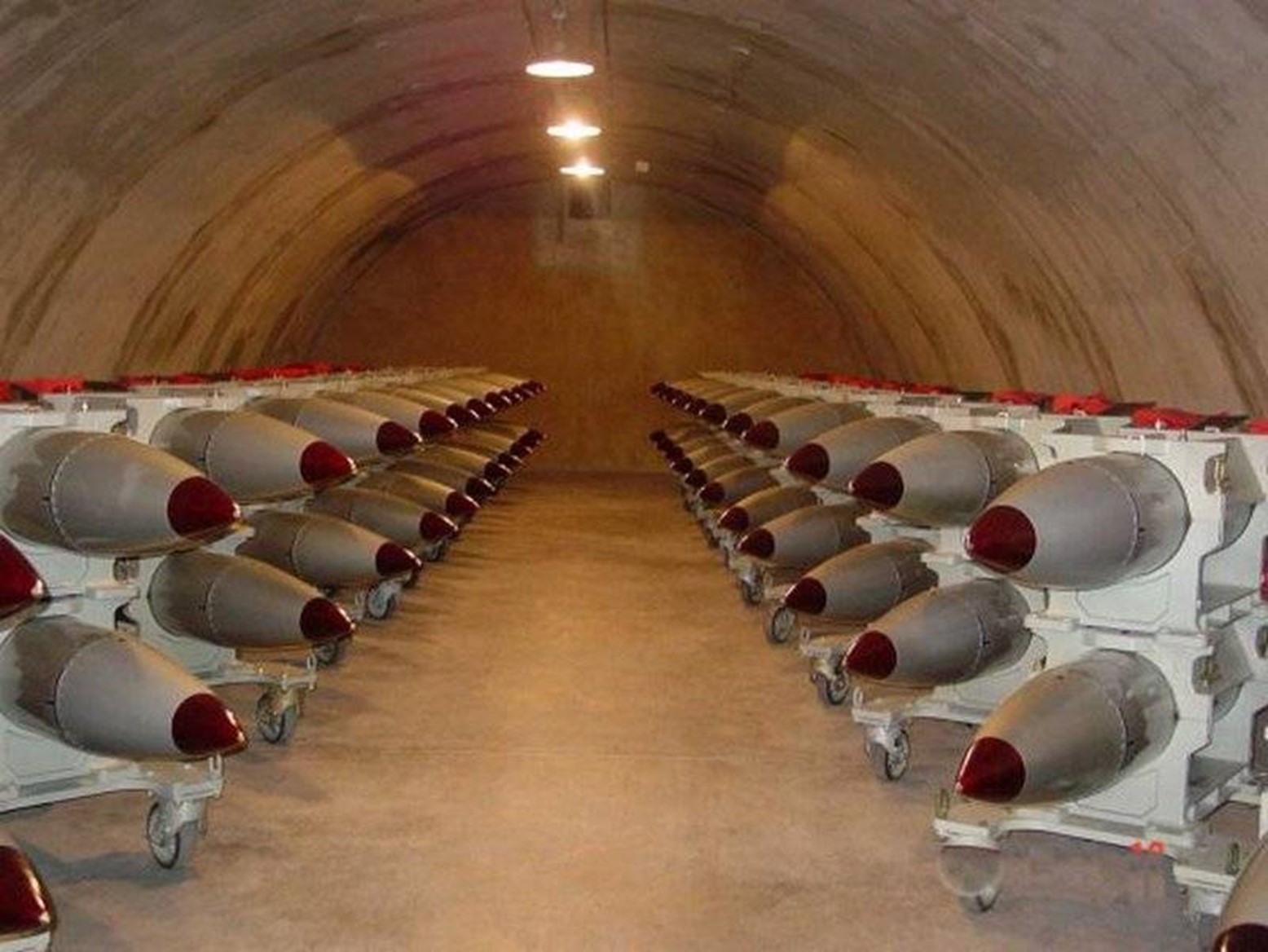
In the face of the Ukrainian offensive, Russia deployed RD-14s and Tyulpan mortars to the theatre. The RD-14s were stored in Belgorod-22.
Similar measures were taken in the Kherson theatre of operations.
The United States became aware of Russia’s preparations to escalate to nuclear first use. They are well aware that the Russian escalatory ladder is shorter than that of the United States. Frantic back-channel communications were conducted in an effort to head off escalation to nuclear war.
In the event, conventional artillery and air power was sufficient to halt the Ukrainian counteroffensive. The Ukrainians suffered such heavy losses that their attacks ran out of steam. The RD-14s were not used, and remained locked away at Belgorod-22.
Ukrainian Raids, 2023
The Ukrainian counteroffensives of 2022 seized ground, but suffered heavy losses of men and materiel. The Russians withdrew to defensible positions and stabilized the lines.
Ukraine had to rebuild its army before renewing offensive action in 2023. While gathering its strength, it conducted harassing raids across the border. Some were launched across the Dniepr in Kherson oblast, others were launched in the Kharkov sector. Russian defenses were robust, and none of the raids penetrated very far.
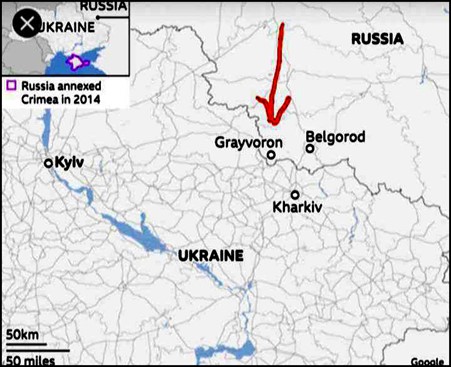
The map in Figure 1, however, shows that the Kharkov sector raids struck uncomfortably close to Belgorod-22. Anecdotal information suggests that at least one of the raids was launched to seize Belgorod-22.
Belgorod-22’s nuclear inventory is secret, but the Russians became concerned by its proximity to the fighting. By this time, Russian reinforcements were strengthening their defenses across the entire line of contact. The Russians were becoming more confident that a Ukrainian offensive could be repelled with conventional forces.
In the spring of 2023, Russia withdrew its entire nuclear weapons inventory from Belgorod-22.
About the Author:
Cameron Curtis

Cameron Curtis has spent thirty years on trade floors as a trader and risk manager. He was on the trade floor when Saddam’s tanks rolled into Kuwait, when the air wars opened over Baghdad and Belgrade, and when the financial crisis swallowed the world. Having written fiction as a child, he is the author of the Breed action thriller series, available on Amazon.
Check out his new Breed thriller, BLOOD SPORT, here:
https://www.amazon.com/dp/B0D6RC5V4V

And visit the Breed series page here:
—
Disclaimer: SOFREP utilizes AI for image generation and article research. Occasionally, it’s like handing a chimpanzee the keys to your liquor cabinet. It’s not always perfect and if a mistake is made, we own up to it full stop. In a world where information comes at us in tidal waves, it is an important tool that helps us sift through the brass for live rounds.








COMMENTS