

Cavalry charges were still very much in fashion and made the difference in many battles, but it was nothing like the medieval times where infantry were simply there to add numbers in a fight and to act as a human wall to knights and their lances.
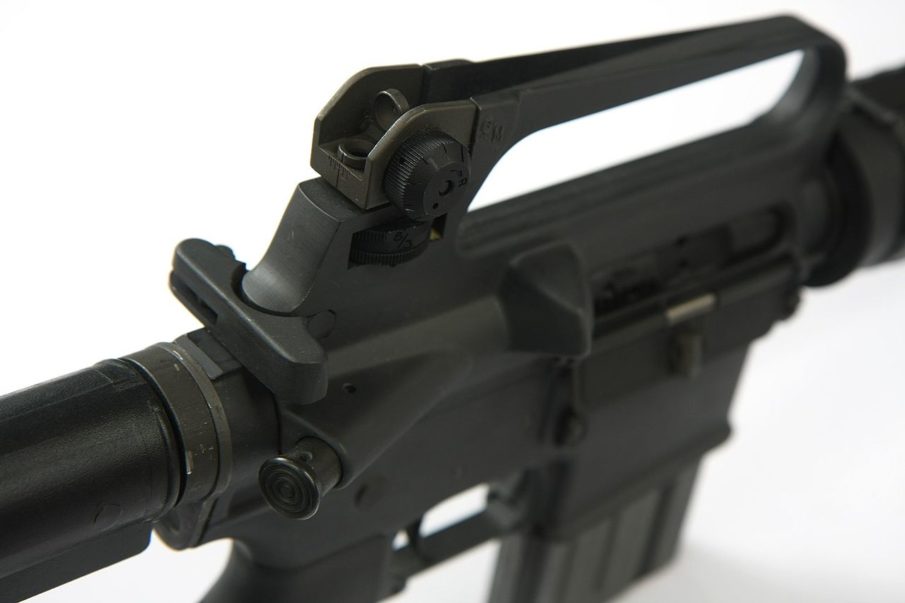
The role of the infantry as the decisive factor in a battle and the branch that produced the most casualties ended around after the end of the U.S. Civil War. Ironically, the time of the infantry “ended” right about when its main weapon at the time, the rifle, reached almost the form it has today.
From around that time, is also the source of many myths and legends and one of my pet peeves.
The Hague Conventions of 1899, the infamous convention that according to some “made illegal for military forces to deliberately kill” or in which “Full metal jacket was adopted because it was designed to wound,” also gave rise to another old wive’s tale, that “wounded soldiers are more of a burden to a force since people needed to tend to them.” In one word, BULLSHIT.
While I agree that the people who signed the treaty probably banned expanding ammo for its obvious entry wound damage and FMJ was considered less brutal (to the eye at least), FMJ became the standard for various other reasons. Newer propellants send bullets out in unheard-of speeds; using lead for a bullet could cause disintegration and fouling of the barrel with lead. Jacketed rounds have a whole cartridge that’s more rugged, and of course the aerodynamic properties of the new at the time design of the bullet called spitzer were better.
Round nosed bullets were inferior both in terms of external ballistics due to increased drag, and in terms of terminal ballistic effectiveness, because the center of mass was located closer to the nose of the bullet, thus making them less prone to yaw upon impact.
With the dawn of the 20th century, the stage was set for the protagonists of WWI. Artillery and machine guns would change the face of warfare. The firepower that was thrown at them made the infantry go underground for protection and made large formations obsolete. Trench raids were common, clubs, bayonets (plain, no chainsaw), pistols and grenades, were the main weapons in those small vicious fights. The Germans acknowledged as early as 1915 that a weapon with full auto fire capability was needed for fighting in the trenches. At first they tried to convert Lugers and c96 Mausers to full auto weapons, but the light weight of those semi-auto pistols made them impractical and uncontrollable in full-auto. It was decided that a new weapon was needed. In the early 1918, the MP18 came into being and brought a revolution as the first submachine gun (SMG). Technically, the Italian Villar-Perosa was the first, but it was used as defensive armament for planes and not ground warfare. With the success of the MP18, the importance of a hand-held full-auto capable weapon became evident to everyone.
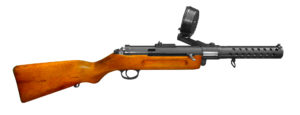
After WWI, everyone in the western world created their own SMG or bought designs from other countries.
With the lessons learned from WWI and many years before the beginning of WWII, weapon designers and military men understood that a rifle with 2000 yard range was overkill for battles that were fought in ranges of 500 hundred meters and less.
Rifles of the time and, most importantly, the calibers they used, were impractical for full auto.
The belligerents of WWII had different concepts for achieving fire superiority over their opponent. For the Germans, the weapon for the task was the machine gun; for the U.S. it was the M1 Garand and good comms with organic support elements like mortars; the Brits trained their people to use their Enfield’s at supernatural speeds.
Every country still relied on the SMG for the up-close and personal stuff.
Everyone knew and they were experimenting with box magazines, intermediate cartridges and other stuff like manufacturing techniques. As per usual, the first to come up with a working and fielded product of those innovative ideas were the Germans. The STG 44 or Sturmgewehr (assault rifle) came into being and it was an instant hit with semi and automatic firing.
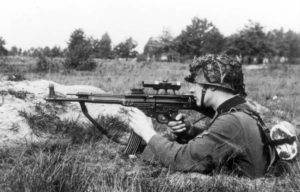
A weapon like that increased the volume of fire a squad or a team could send in the opposite direction tenfold. By gaining fire superiority and suppressing the enemy and rendering him unable to change positions, you make him vulnerable to support weapons or an infantry assault.
Ironically, the capability that gave this class of rifles its name, the full auto fire that supposedly is what a unit would use in an assault as the idea was in WWI, is rarely if ever used at all today. No soldier trained by a Western army today would use full auto as a standard, outside of very close engagements.
5.56 is not a “high power” cartridge by any stretch of the imagination; it is a fast round and indeed that contributes to its damaging potential, but that is all. There are heavier and way more damaging calibers out there. Case in point, the regular complaints about its lethality from the U.S. Army.
The high number of casualties in some the events where an AR or similar rifle was used, had more to do with the conditions of the shootings than with the gun itself.
In Orlando, the perpetrator was shooting at stationary targets, trapped people with no way out of that nightmarish situation.
In Las Vegas, given the conditions and the mass of people, 58 dead and 120 treated for gunshot wounds means that the round used actually performed poorly.
In the 2012 Aurora cinema shooting, where people tried to escape and didn’t become easy targets, the shooter, killed only 12 people and injured 70. If the butcher round hypothesis had any merit, the AR-15s should constantly produce high numbers of dead regardless of the conditions.
Final point: claims that the deranged idiots that used AR-15 styled rifles to commit murders did it because of knowledge of the terminal ballistics of 5.56 are absurd. If the idiots that committed those atrocities had any sense of the capabilities of the weapons they were using, they would have chosen differently on some occasions. If anything, portrayals of the AR platform as the “ultimate killing machine” from the mainstream media, probably played a more important role.
Author’s Note
I have no intent of sounding callous; the subject is grim and any attempt to address it on the technical/tactical level might sound as indifferent to the victims, but that is not the case.








COMMENTS