

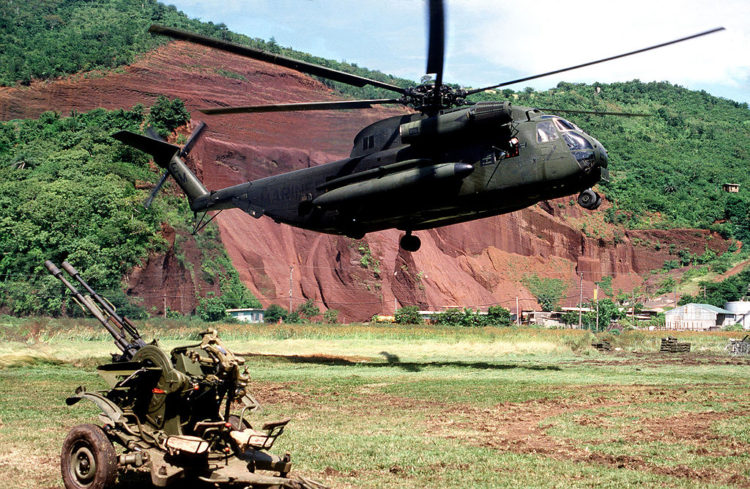
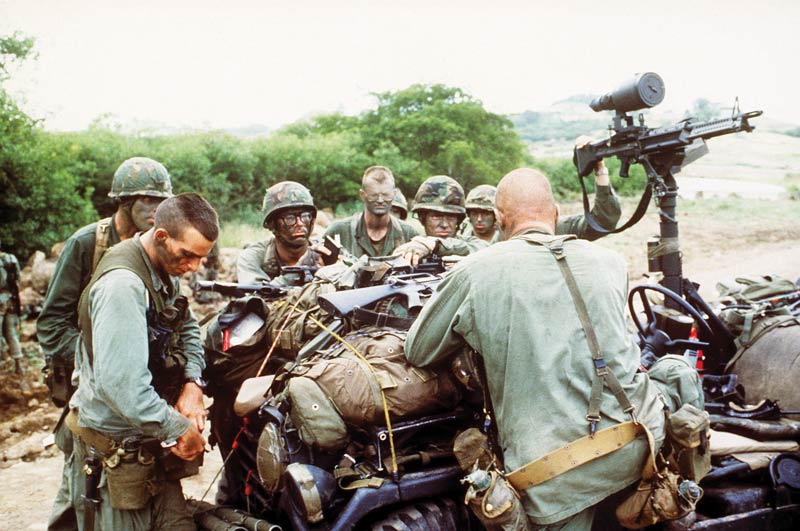
The Rangers began their assault at 0530. They received antiaircraft fire from Russian-made ZSU 23-2 as well as BTR-60 Armored Personnel Carriers (APCs). Accurate fire from the Rangers’ 90mm Recoilless Rifles and AC-130s suppressed the antiaircraft fire and knocked out the APCs. After securing the airfield, the Rangers took the surrounding heights.
By 1000 the obstacles were removed, Caribbean Peace Force reinforcements began unloading, and other aircraft began to land on the strip. Beginning at 1400, elements of the 82nd Airborne Division (325th Abn Infantry) began to arrive and spread out.
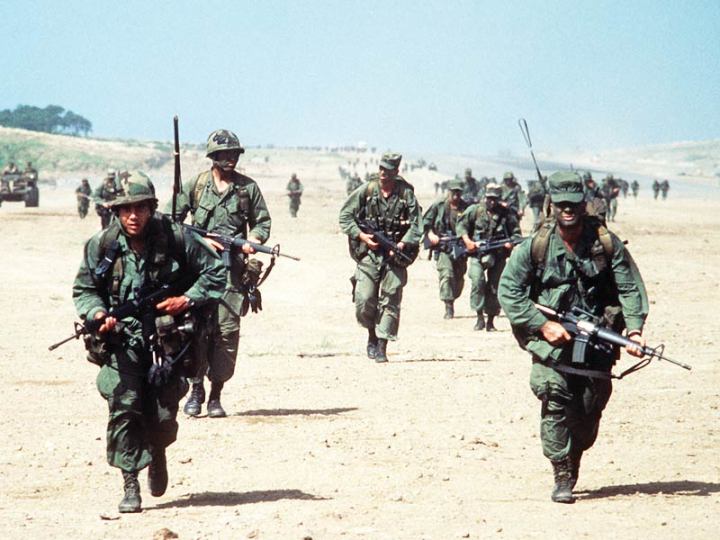
Landing in the aircraft was a bitter pill to swallow for the 82nd as they pride themselves on being airborne. But when the U.S. next seized a major airfield, in Panama in 1989, the 82nd would not be denied a second time. Even though the Rangers seized the airfield again, the 82nd would not air land. And although some of their heavy drops ended up in the ocean, they would get their combat jump.
Four Rangers, looking for the medical students got disoriented and were killed in an ambush.
A Number of Objectives to Secure the Island
Meanwhile, the Pearls Airport was captured by SEALs from SEAL Team Four, who had come ashore just after midnight, and Marines from the 2 Bn., 8th Marine Regiment who had flown in on CH-46s and CH-53s. They encountered light resistance and swept it aside easily.
Elements of SEAL Team Six captured Radio Free Grenada unopposed. However, soon after, they were attacked by Grenadians in APCs. The frogmen were forced to evade by cutting a hole in the chain-link fence and swimming out to the U.S. ships. Two SEALs were seriously wounded in the action and were medevaced by helicopter to the USS Independence.
SEALs then conducted a rescue operation for Governor-General Paul Scoon who was held in his mansion in Saint George. They entered the area unopposed but a counterattack by Grenadian forces, supported by BTR-60 APCs, trapped the SEALs inside. The SEALs were forced to stand pat inside the mansion for 24 hours.
The next morning 250 Marine reinforcements with M-60 tanks relieved the SEALs and were able to bring Paul Scoon safely out. The Marines then overwhelmed the enemy opposition.
Delta Force and C Co. of the 1st Ranger Bn, with helicopters from Task Force 160, now known as the 160th Special Operations Aviation Regiment, were tasked with capturing Fort Rupert and Richmond Hill prison.
The raid on Fort Rupert was very successful and several members of the military junta were captured.
But, due to the lack of good intelligence, the raid on the Richmond Hill prison, where political prisoners were held, nearly turned into a disaster. The ground was too steep for the helicopters to land and there were also several anti-aircraft guns on site. One helicopter was shot down and the pilot killed. Several of the Delta operators were wounded. The Rangers had to send reinforcements to assist the Delta Force troops in safely exfilling the area.
The fighting on the island continued through the next day as the 82nd Airborne pushed out the perimeter around the Salinas airfield. They got into a huge firefight with the Cubans and suffering two dead and six wounded. The Cubans were pounded with airstrikes and artillery and their resistance quickly faded. By day three, the major fighting was over and the island secure.
Reactions to the Invasion Differ Widely
As president Reagan had stated, the purpose of Operation Urgent Fury was to protect American citizens living on the island, the reaction in the U.S. was that the operation was justified. Given that the Iran hostage fiasco had been resolved less than two years before, this was an expected reaction.
In the UN, however, the situation was very different. The UN General Assembly adopted, by a wide margin, Resolution 38/7. According to the resolution, “[The UN] deeply deplores the armed intervention in Grenada, which constitutes a flagrant violation of international law and of the independence, sovereignty and territorial integrity of that State.”
However, free elections in Grenada were held less than 14 months later. The vast majority of Grenadians voted for the Grenada National Party and a government was formed led by Prime Minister Herbert Blaize.
Interestingly enough, the Grenadian people supported the U.S. invasion. The government of Austin was ousted and replaced with a democratic one. The date of the invasion, October 25, is now a national holiday in Grenada.
The majority of U.S. troops would be pulled from Grenada by December.
But the bitter issues with Operation Urgent Fury, specifically the lack of usable intelligence and problematic communications, pointed to massive changes that needed to be made.
Enter the Goldwater-Nichols Act
The writing had been on the wall. In Vietnam, inter-service rivalries had created many problems for the troops on the ground. The catastrophic failure at Desert One and the shortcomings of Operation Urgent Fury only drove home the point.
The solution was the Goldwater-Nichols Act.
The act reworked the command structure of the United States military, marking the most sweeping changes to the Department of Defense since the department was established with the National Security Act of 1947.
The act increased the powers of the Chairman of the Joint Chiefs of Staff and created the concept of truly unified joint U.S. forces organized under one command.
One of the first offsprings of the act was the formation of the U.S. Special Operations Command (USSOCOM) in 1987.
Just three years later in December 1989, the new command structure was put to the test in Operation Just Cause in Panama. And the results then and thereafter were a tremendous success.








COMMENTS