

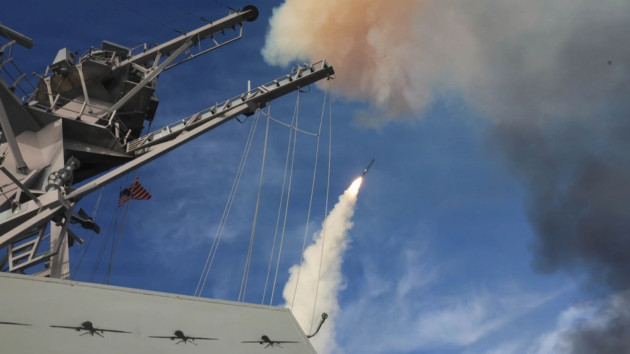
For decades, Iranian naval vessels have threatened and harassed global shipping in regional waters, but those days are over. pic.twitter.com/J4WUwpfU24
— U.S. Central Command (@CENTCOM) March 28, 2026
Long-Term Demand Signals
The agreement is part of the Pentagon’s Acquisition Transformation Strategy, which seeks to provide private industry with clear, long-term demand signals. By guaranteeing production requirements over multiple years, the Defense Department is incentivizing Honeywell and other suppliers to invest in capacity, modernize facilities, and adopt new manufacturing processes.
Michael Duffey, Pentagon Undersecretary for Acquisition and Sustainment, described the move as essential to building a “deep and dominant Arsenal of Freedom.”
“We are ensuring that our entire industrial base can deliver at speed and scale,” he said. “This $500-million commitment from Honeywell demonstrates that the strategy works.”
Unlike conventional procurement models, the strategy is proactive. It doesn’t just place orders for weapons; it invests in the supply chain itself, from prime contractors to specialized component manufacturers.
Analysts see this as a crucial step in preventing bottlenecks in components like missile actuators, navigation systems, and electronic warfare electronics, which are difficult to source quickly under crisis conditions.
Strategic Implications for Iran
The practical effect is immediate. Navigation and guidance systems determine the accuracy of precision munitions; actuators affect missile maneuverability and survivability; electronic warfare systems dominate contested airspace.
In Iran’s theater, where missiles and drones can appear with little warning, the US military’s ability to replace, repair, and enhance its assets is critical.
Defense experts say the agreement signals more than readiness, it signals deterrence. A robust, responsive industrial base allows the US to maintain operational tempo, launch precision strikes, and sustain pressure on Iranian forces without delay.
U.S. forces continue to eliminate threats presented by the Iranian regime, striking over 10,000 targets since the start of Operation Epic Fury. pic.twitter.com/6rTIWG9NBC
— U.S. Central Command (@CENTCOM) March 26, 2026
The message is clear: escalation can be met with resilience, and attrition will not undermine capability.
Industrial Base as Strategic Asset
The Department of Defense’s Munitions Acceleration Council has coordinated this effort with primes such as Lockheed Martin and RTX to ensure investment flows to critical suppliers like Honeywell.
The result is a more resilient ecosystem, capable of scaling production across multiple platforms simultaneously.
Industrial capacity is a strategic weapon in its own right.
In high-intensity operations, limited supply can constrain tactical options. A well-funded and flexible industrial base, by contrast, ensures US forces can maintain operational dominance and adapt quickly to changing battlefield conditions.
USS Abraham Lincoln continues flight operations against military targets in Iran while sailing in regional waters. pic.twitter.com/GsLQKNaTbN
— U.S. Central Command (@CENTCOM) March 26, 2026
Preparing for the Next Phase
While the investment is long-term, its immediate relevance is tied to Iran. The ability to sustain munitions production, maintain electronic warfare superiority, and ensure guidance systems remain operational under threat directly supports deterrence and combat readiness.
Analysts note that every component produced today increases the Pentagon’s options tomorrow, allowing commanders to act decisively in an unpredictable environment.
Honeywell Aerospace is building the capacity. The Pentagon is providing the framework. And in the balance between readiness and uncertainty, this agreement is the kind of industrial leverage that can tip the scales.
In a theater defined by rapid escalation, speed, precision, and technological superiority are not optional. They are essential.








COMMENTS