
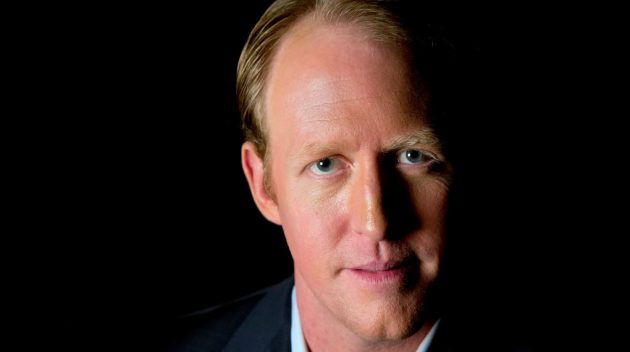
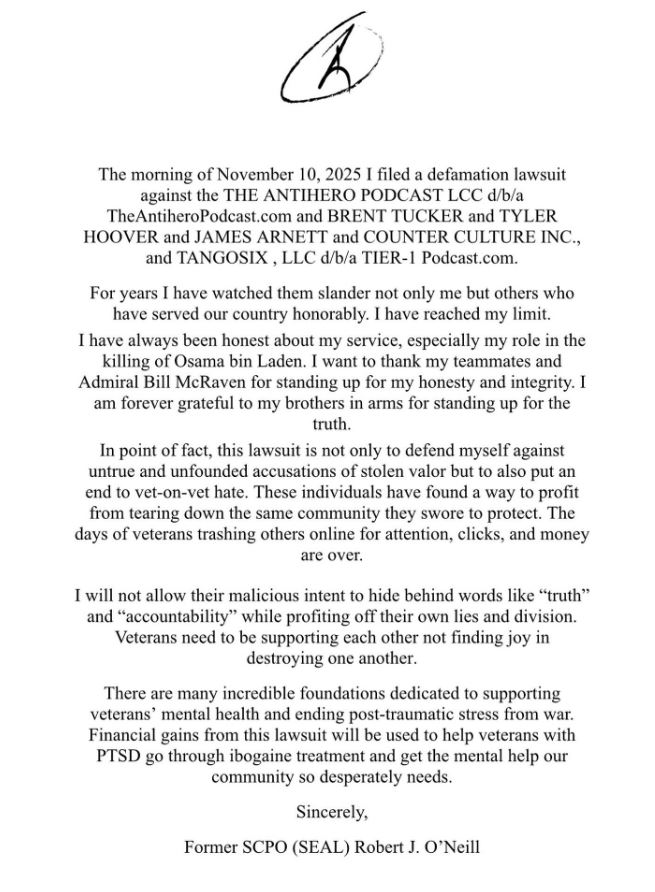
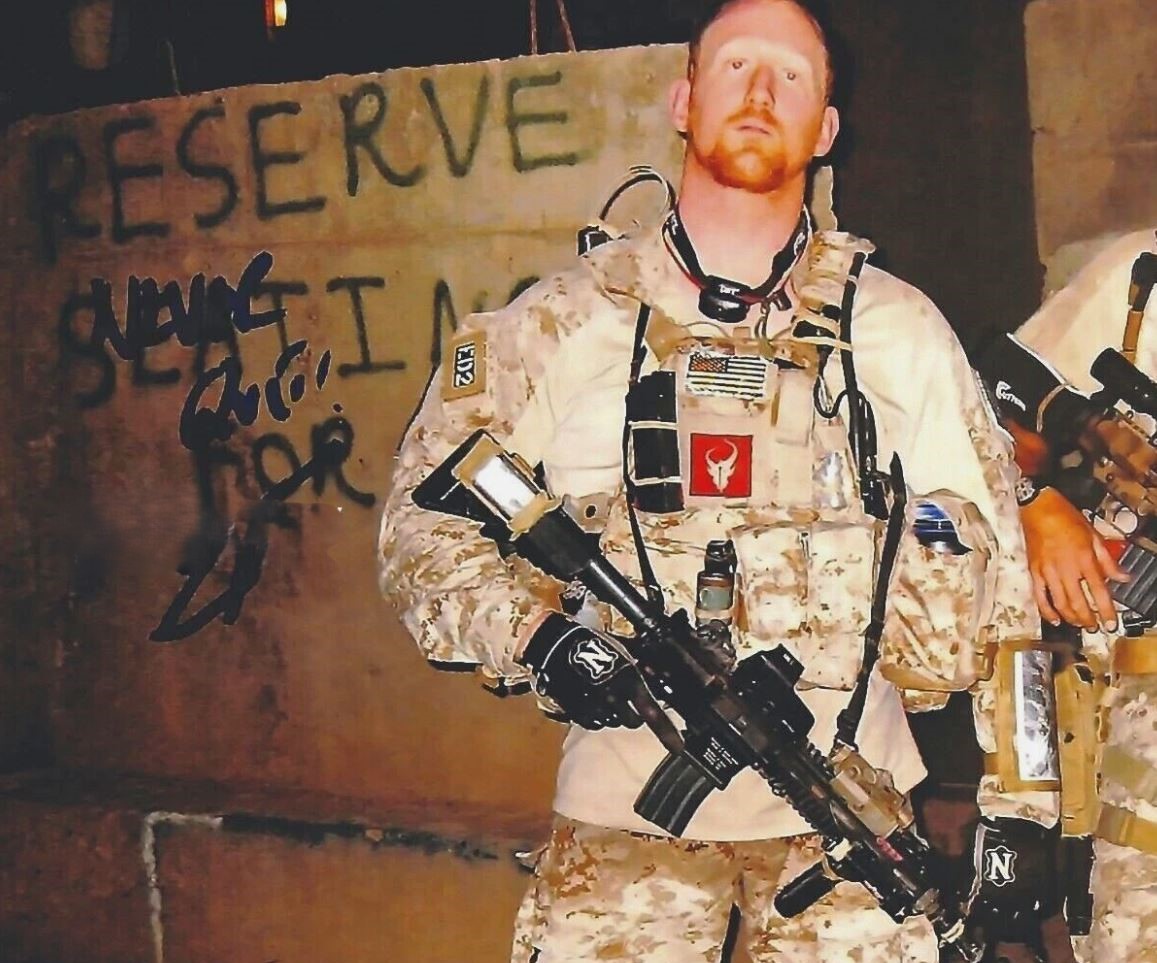
Rob O’Neill, the former SEAL Team Six operator who pumped three rounds into the noggin of Osama bin Laden at close range, much to the delight of most of his fellow Americans, has officially had enough. On November 10, 2025, O’Neill filed a $25 million defamation suit in Westchester County Supreme Court against Tyler Hoover and Brent Tucker, the hosts of the Antihero podcast, accusing the duo of a years-long campaign to publicly cast doubt on his role in Operation Neptune Spear. The filing paints the attacks as deliberate, monetized smears designed to drive clicks and YouTube views, and it arrived, perhaps not ironically, on the doorstep of Veterans Day.
I view it as his way of stepping in for all of us and saying the veteran against veteran trolling/bashing has to stop immediately.
The claim, the cash, the timing
According to court papers reported by multiple outlets, O’Neill charges that Hoover and Tucker began publicly asserting in 2023 that O’Neill lied about firing the fatal shots — a narrative the podcasters repeatedly aired on episodes and social clips. The lawsuit says those repeated insinuations have damaged O’Neill’s reputation, cost him speaking engagements, and caused emotional harm. The $25 million headline figure is not theatrical padding; it is the legal stake O’Neill is putting down to force an accounting for what his lawyers call a campaign of falsehoods. The suit’s timing , filed on the eve of Veterans Day, underlines the symbolic stakes: this is a veteran taking legal action to defend not only his name but a code of honor among those who served.
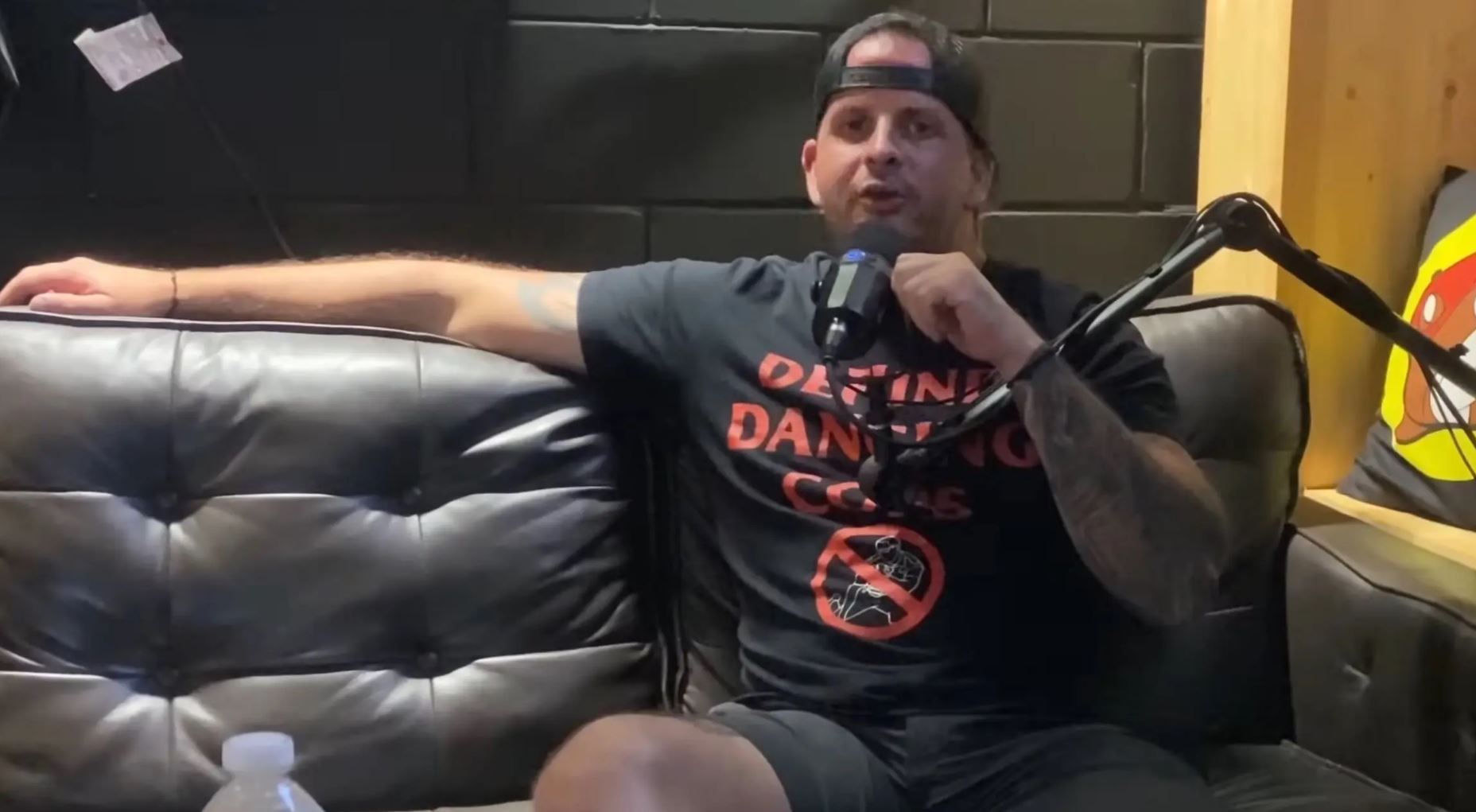
Who are Hoover and Tucker — and why this stings
Hoover and Tucker are not random YouTube trolls. Both are veterans and figures in the “bro-vet” media sphere: Tyler Hoover, an Army airborne infantry veteran and former sheriff’s deputy, built an audience around first-responder and veteran storytelling; Brent Tucker went from high school to the 75th Ranger Regiment, then 5th Special Forces Group (Airborne), and spent the rest of his career in Delta Force. That pedigree adds sting to O’Neill’s complaint: these are fellow former servicemen, using the trappings of brotherhood to sell skepticism about another veteran’s story. Their platform — a podcast with an engaged audience and monetized video channels — is exactly the kind of place where repeatable allegations can turn into ad dollars.
Corroboration vs. conspiracy
The central factual battlefield is familiar: who fired the shots that ended Osama bin Laden? O’Neill has long told the same story in interviews, at memorial events, and in his memoir, The Operator: Firing the Shots That Killed Osama Bin Laden and My Years as a SEAL Team Warrior.
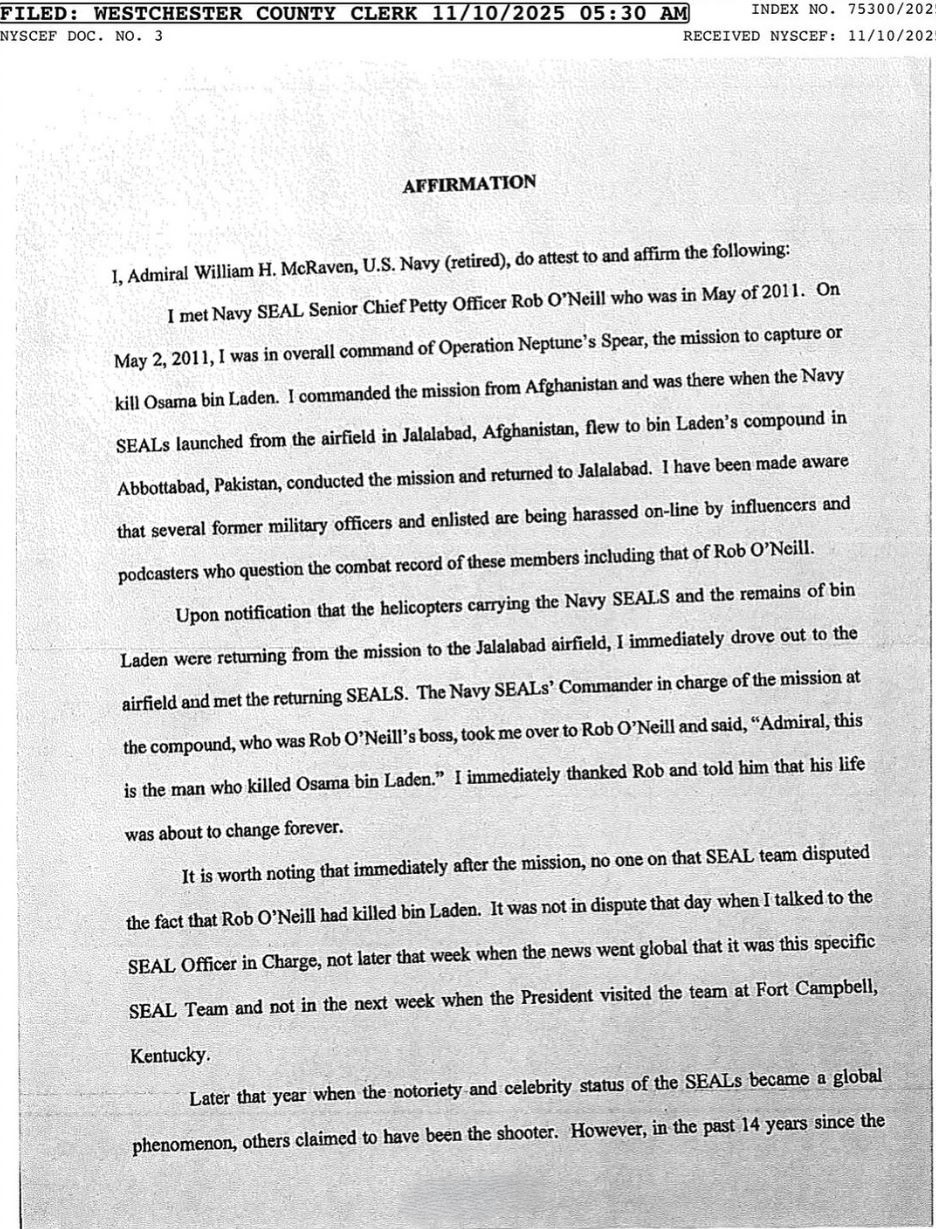
His account, that he encountered bin Laden at close range and fired repeatedly, has been supported publicly by Admiral William H. McRaven, the officer who oversaw Neptune Spear, in past media interviews. While other former operators and memoirs have offered differing accounts, the official and widely reported timelines and after-action accounts align most closely with O’Neill’s public version. The new suit underscores that O’Neill’s claims are not made in a vacuum and that high-level commanders have publicly referred to him as the SEAL who shot bin Laden.
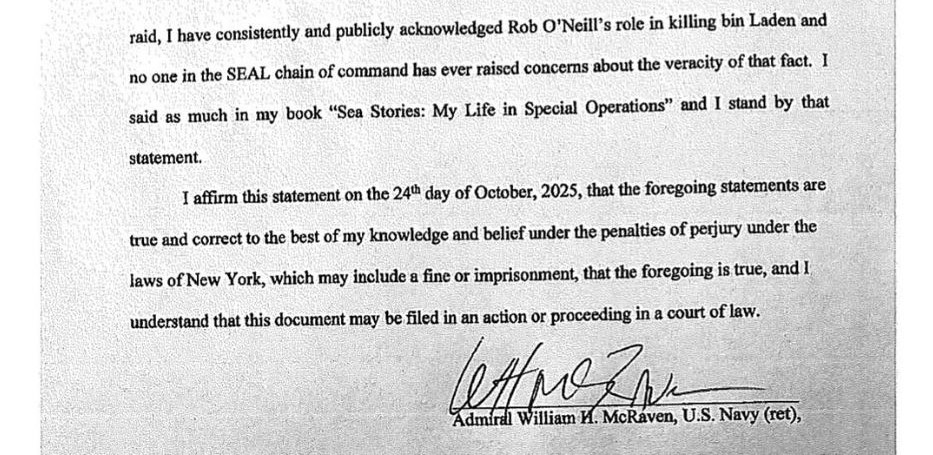
And think about this for a moment, O’Neill has either participated in or led over 400 combat missions as a Navy SEAL. Let that number sink in for a second. Is anyone calling Rob a liar about his role in those other missions? No. Why on Earth would he start to make things up when it came to Nepune Spear? He wouldn’t.
But it is human nature for people to question, dispute, or revisit major moments in history, especially those involving controversial details, secrecy, or profound national impact. The JFK assassination, the moon landings, and rumors of advanced warnings of the attacks on Pearl Harbor and 9/11 come to mind. For whatever reason, some people will always refuse to believe the truth.
What O’Neill is doing now — and why this matters
Rob O’Neill is far from retired from the public stage. He’s a paid keynote speaker, a bestselling author, a podcast host, and a public figure who runs a speaking business and associated ventures that trade on — and could be hurt by — his reputation. His website and speaker pages advertise corporate keynotes, consulting, and media appearances; those income streams can be fragile when a client is faced with a swirl of doubt. The lawsuit states that lost bookings and reputational harm are real, concrete damages. If you make your living branding yourself as a warrior-leader, persistent public questions about your central claim strike at the wallet as well as the honor.
But more importantly, Rob O’Neill is a loving father. Almost no one remembers that. He’s a tough guy; he can handle people talking smack about him, but his college-aged kids and his wife have been going through this turmoil for years now. And in this age of YouTube, TikTok, and other social media, the negative bombardment is constant. Imagine if there were people out there constantly calling one of your parents a liar and a swindler, you’d want the slander to end, too.
Rob candidly told SOFREP: “It is completely unnecessary for my college-aged kids to be harassed and told that their dad is a liar and a fraud. They had to deal with me going to war over and over, and I have never lied about my actions in combat.”
I wholeheartedly believe him.
The ugly new economy of “vet-on-vet” clicks
There’s a nastier cultural pattern here: veterans and first-responder personalities publicly savaging other veterans for content and clicks. Right off the top of my head, I think of how Marcus Luttrell, Jocko Willink, Dakota Meyer, Tim Kennedy, and SOFREP’s very own Brandon Webb have been targeted. There are a lot of jealous, bitter people out there who would like nothing more than to smear their names to make a buck or get a click or two. It’s flat-out wrong and disturbing.
O’Neill’s complaint laments exactly that trend — the weaponization of comradeship into content. The Antihero hosts, the suit argues, repeatedly dangled insinuations and then used the controversy to promote their channel, a classic engagement loop: controversy → clips → subscribers → monetization.
O’Neill’s legal move is framed as a plea to set a precedent: call your brother out in private if you must, but don’t build a business model on tearing other vets down in public.
What to watch next
This lawsuit is a test case in reputational defense in the era of influencer vs operator warfare. It will force the podcasters to answer under oath about their sourcing, their intent, and — crucially — whether they profited from the pattern of repeated allegations. For those of us who care about special-ops lore and the ethics of veteran media, the case asks whether the marketplace of ideas has become a market for vendettas.
Rob O’Neill has staked his public identity — and a legal claim — on stopping a narrative he says is false and corrosive.
If nothing else, this fight ought to remind the veteran community that the bonds that mattered under fire still matter now: don’t cheapen them by trading insults for views.








COMMENTS