

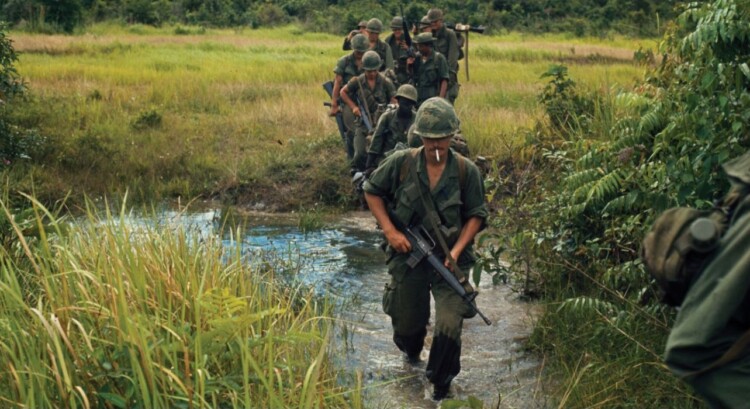
After consulting the map, I realized that we had completed our assigned sector of the circle around the base of the hill. It was time to head back up to the company CP with about a half click to go. It was then that I decided it was time to walk point. I told my platoon sergeant to come up and take over my position. My platoon sergeant immediately voiced his objection to the idea, saying that the platoon leader was never to walk point. He did not approve of my idea at all. But I insisted that I wanted to give it a try. We only had another half kilometer to go, and we were headed back uphill to the CP. We had not encountered any sign of enemy all day. What could possibly go wrong? After a short rest, I grabbed the cover man, and we walked out in front of the platoon by about fifty meters.
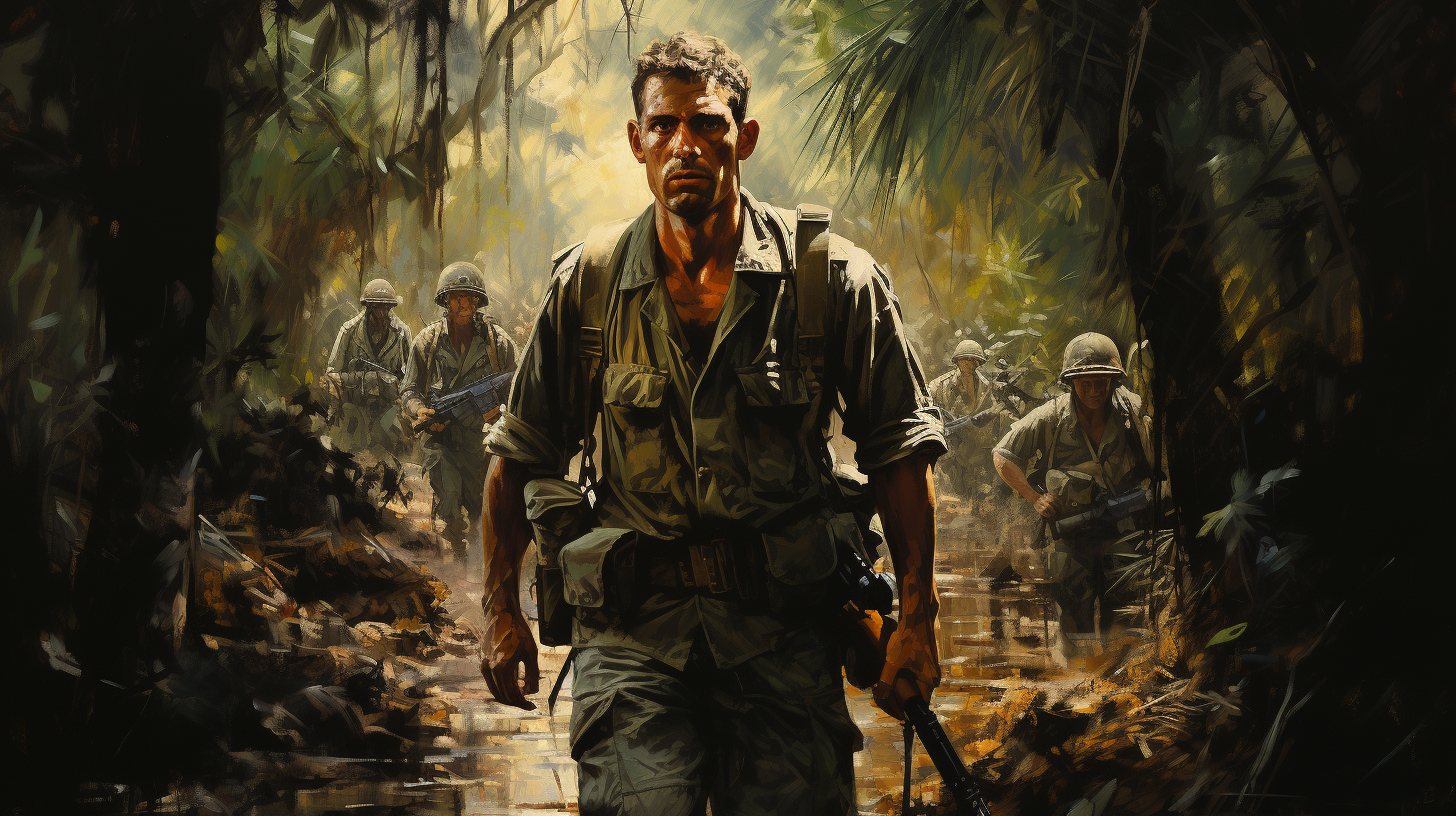
Very soon I became aware of the stress and fear the point man experiences. I was all alone out in front of the unit. I had a man about five meters behind me, but there was nothing but jungle in front of me. There was no security that I was very used to when walking fourth or fifth in line. From that position, I could always see men in front of me and my RTO was always within a few feet ready to hand me the handset if I needed to make a call. But now there was no one to my front. I was walking all alone and vulnerable. I experienced the same feelings that my point men felt. The fear and anxiety washed over me. I felt as if there were hundreds of eyes staring at me all at once. I tried to focus, move cautiously, observe any signs to the front, but found it extremely difficult to get control of my heart rate and control the thoughts running through my mind.
I carried my M16 on full automatic, safety off and at port arms, ready to bring it into a firing position. In fact, I jumped several times hearing the sound of birds and monkeys screeching to my front or side. I tried to walk slowly. In my mind all I wanted to do was climb to the top of that hill and reach the security of the company perimeter. I could not get there fast enough.
For several hundred meters, I dealt with this fear and anxiety not knowing what was in front of me. I alternated between walking too fast and too slow, following that little green trail. The sweat dripped off my face and hands. I repeatedly swabbed my face with the towel wrapped around my neck and dried my hands so that my rifle would not slip.
My cover man hissed at me from time to time telling me to move faster or slow down. He was far more experienced at this work than I. I obeyed his instructions and kept climbing up the hill. The trail took a sharp turn. I realized that we were getting close to the top of the hill – and the security of the CP. I turned to start a zig zag up a steep slope. It was hard going because I had to look down to make sure I did not slip. I alternated my gaze looking down and then to the front.
So many thoughts flashed through my mind. How easy it would be for a few enemy soldiers to ambush the front of the line and then disappear into the surrounding jungle. I tried to look for tripwires and C-ration cans, but it was impossible. There were simply too many things to do and remember all at the same time. Something had to be overlooked; tripwires was the item I had to ignore and hope for the best. Later, I realized that this was why so many point men were injured by booby traps. It was extremely difficult to scout to the front and at the same time be alert to something immediately under your nose.
I climbed the steep slope crisscrossing back and forth to make it easier to gradually move up the steep slope. It was slow going. I was breathing heavily, pushing myself up the hill. I stopped for a minute and took a quick drink from the canteen I kept in my thigh pocket. I pushed on. My hands were so slippery with sweat that I was afraid that I might drop my rifle at any moment. I thought about clicking the safety to the off position but decided against it. All the point men kept their weapons set to full automatic with safeties off. Occasionally they would trip or fall and fire off a burst or pull the trigger by mistake. This would cause everyone to drop and take up firing positions. I had found it annoying when this happened, but now I gained a new respect for what the point man was going through. You always thought the worst when a rifle was fired.
Then, without warning, I heard and saw a man coming down the trail in front of me. He was moving fast and was coming straight toward me. “Holy shit.” I said to myself, “There’s a man coming down the hill.” I backpedaled and jumped behind a tree while bringing up my M16, finger tightening on the trigger. But something told me not to pull the trigger. It was the speed that the man was traveling downhill; perhaps it was his uniform, or his steel helmet with camouflage cover that registered in my brain. In any case the soldier was one of ours and he was just as surprised to see me as I was to see him.
“What the fuck are you doing?” I screamed. “What the fuck are YOU doing?” the man yelled back. I realized that this was another patrol coming down the hill from the basecamp conducting reconnaissance for a night ambush. He didn’t expect to see me coming up the hill just as I didn’t expect to see him coming down.
“I almost shot you! Why didn’t you radio that your patrol was coming down?” I screamed at the man. He screamed back: “Why didn’t you radio that you were coming up?” I realized that we both had been wrong. I should have called the company CP to alert them that my patrol was moving uphill and heading to the CP. I would always do this from my usual position in line, but now my radio operator was fifty meters behind me. The company commander’s radio operator should have radioed that a patrol was coming down, but it was overlooked.
I found out later that this radio communication did take place. My radio operator had received and acknowledged the call, but as I was fifty meters to his front and there was no way to alert me that the other patrol was on its way down the hill.
The other point man and I were both fortunate that day to have our brains recognize we were both GIs before we pulled the trigger. It could have been a disastrous moment for both of us. To this day I thank God that we recognized each other in that critical second of hesitation.
It was then I realized I did not have the skill to walk point. My platoon sergeant had been right. It had been a dangerous move on my part, and I never tried it again. I did gain some creds within my platoon and the company as the only officer to ever walk point, but that notoriety was foolishly and dangerously gained. I did come away with a new respect and appreciation for my men who walked point – and the courage it took to do so. I realized we placed our lives and security in their hands. It was a formidable responsibility.
I had learned firsthand what it felt like to walk point. I often think about that day and how close I came to pulling the trigger. I remember how scared I was and how I acted. It’s a memory and feeling I will never forget.
….
The Point Man is an excerpt from Vietnam Combat: Firefights and Writing History by Robin Bartlett. At 22, 1st Lt. Bartlett was a combat infantry platoon leader with A Company, 1st Battalion, 5 Cavalry Regiment, 1st Air Cavalry Division (Airmobile). His book, is available at a discounted price, autographed with free shipping at www.RobinBartlettAuthor.com. [email protected]








COMMENTS