

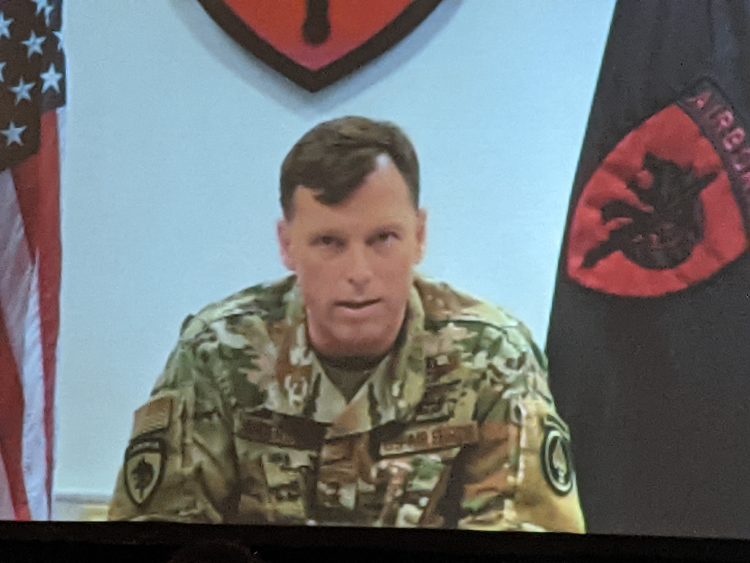
General Anderson pointed out in his discussion that while Russia and China are quick to try to build their influence in several African countries. Nevertheless, when a humanitarian catastrophe or a spread of terrorism occurs, African countries don’t call those Russia or Chine, they call the United States.
“The U.S. remains the gold standard in counter-terrorism training and operations,” General Anderson added.
While most Americans believe that the al-Shabaab terrorist group is not a threat to U.S. interests outside of Africa, Anderson said that the group was already planning on executing another terrorist attack, similar to 9/11, in the continental U.S.
Anderson cited the recent arrest and extradition of Cholo Abdi Abdullah, as part of a terrorist plot directed by senior al-Shabaab leaders. Abdullah obtained pilot training in the Philippines in preparation for seeking to hijack a commercial aircraft and crash it into a building in the United States.
“We knew nothing of this plot until our strategic partners alerted us,” Anderson said.
The terrorist group is aligned with al-Qaeda, and it raises hundreds of millions of dollars annually in Somalia by, among other means, levying taxes and committing extortion and kidnappings. Many Somalis are forced to pay taxes to al-Shabaab or risk being killed. It is estimated that al-Shabaab raises as much in tax revenue as the Somali government.
The threat of Islamic jihadism has spread through North Africa to the sub-Saharan Sahel and continues to move south and west.
The French have taken the lead in the Sahel but even with 5,100 troops in the region, they are spread very thin trying to cover an area as expansive as the western United States, Anderson said.
Furthermore, counter-terrorism forces face a multitude of other challenges in the continent. One of them is the weather which ranges widely affecting vehicles, equipment, and aircraft. Additionally, they have to face Africa’s extreme distances, which limits mobility in all operations, including air movement and airstrikes.
General Anderson added that American ODAs (Operational Detachment Alpha, or Special Forces A-Teams) were working in conjunction with Civil Affairs teams and building trust not just with the host nations’ military units but also between these units and the civilian population. The lack of trust of the local population in the military has been a problem in many areas.
The U.S. Special Operations Command (USSOCOM) continues to engage our host nation allies where it has been asked to help, but also where the U.S. gets the highest return.
Some of the top priorities for the U.S. in the short term are to continue to disrupt the terrorist threat on the continent, Anderson said, and to also make American and EU efforts more effective.
A Marshall Plan for Africa
The feeling at the Global SOF Symposium was that the U.S. needs to re-engage more in the political as well as economic arenas of the continent. For example, the predatory loan schemes of the Chinese can easily be thwarted with a Marshall Plan for Africa.
The basic tenets of the Marshall Plan, which was instituted for Europe after World War II, consisted of supporting the stability and security of the European nations.
SOCOM’s efforts in the theater are already helping in providing stability and security but an African Marshall Plan would be a major boost to them.
Further, the economies of Africa need to be built, while simultaneously promoting local employment and financing civic projects which will improve the daily lives of the people. Currently, the peoples’ destitution allows jihadists and separatists to flourish, especially in the lesser populated areas where host-nation governance and presence are low.
The U.S. State Department needs to work with the countries to promote democracy, human rights, the rule of law and to stamp out corruption, which is another common complaint among the people. Further, these countries should be strictly monitored to observe compliance with stated goals.
In his closing remarks, General Anderson said that SOCAFRICA is very pleased with the engagements with our allies. He spoke about how so many misconceptions exist about the continent. “Many people believe that most Africans are illiterate. Our ‘illiterate’ African allies frequently speak five languages,” he pointed out.
“Some of the partnerships that we have in Africa are some of the best we have in the world,” he said, adding that “we treat our partners, not as second-class citizens but as equal partners, we don’t talk down to them,” as the U.S. continues to build lasting relationships.
Operation Flintlock, which was canceled a year ago due to the COVID-19 pandemic, is an example of pulling countries together, General Anderson said. The operation involves 30 African countries and 30 partner ones and aims at creating rapport and international cooperation.
While Russia, China, and others can try to build their influence across Africa, the U.S. could easily outdo them by bringing, not just military force, but also political and economic clout to the table.








COMMENTS