

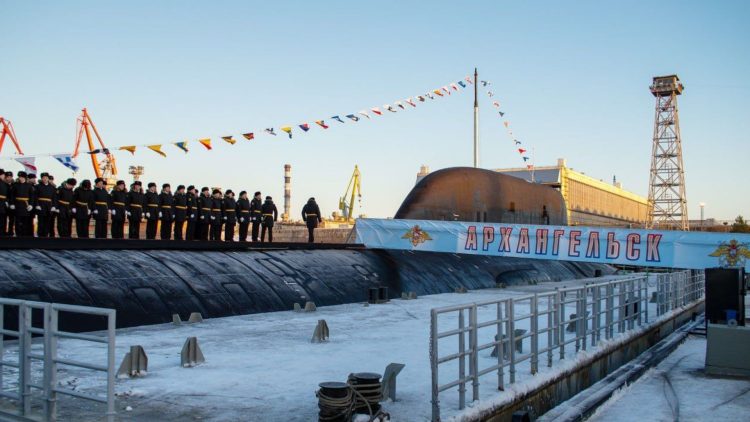
The submarine’s deployment expands Russia’s ability to:
Defend Arctic Interests: With the Arctic emerging as a critical region for natural resources and strategic shipping lanes, the Arkhangelsk bolsters Russia’s ability to project power and deter adversaries in the region.
Ensure Nuclear Deterrence: The submarine plays a crucial role in safeguarding Russia’s ballistic missile submarines, a cornerstone of its second-strike nuclear capability.
Enhance Global Reach: The Yasen-M class’s versatility allows it to operate far beyond the Arctic, with Admiral Aleksandr Moiseev highlighting plans for deployments in the Atlantic and Pacific Oceans.
The new nuclear submarine Arkhangelsk will significantly increase the military potential of the Northern Fleet and the Navy as a whole, said Commander-in-Chief Alexander Moiseyev.
The Arkhangelsk and other ships of the Yasen-M project are capable of solving almost any task… pic.twitter.com/mixVJhChzj
— East_Calling (@East_Calling) December 27, 2024
Implications for the US and NATO Allies
The acceptance of the Arkhangelsk signals a clear intent by Russia to modernize and expand its naval capabilities, posing significant challenges to the United States and NATO:
Increased Threat to NATO Waters: Armed with long-range missiles like the Kalibr and Tsirkon, the Yasen-M class submarines can hold European capitals and naval assets at risk from strategic positions in the North Sea and Arctic waters.
Escalation of the Naval Arms Race: The inclusion of hypersonic weapons like the Tsirkon introduces a new level of threat, as these missiles are designed to evade modern air defenses, potentially overwhelming NATO’s current systems.
Heightened Tensions in the Arctic: The submarine’s deployment near NATO-aligned Norway and its ability to strike targets across the Arctic and Norwegian Seas exacerbate existing geopolitical frictions in the region.
Russian Navy heralds the arrival of the ‘Arkhangelsk’ nuclear submarine. In a ceremony at shipbuilder Sevmash, this state of the art sub was introduced to the Navy’s existing fleet, with four more currently under construction. pic.twitter.com/Ha1dtjTZLq
— RT (@RT_com) December 27, 2024
A Maritime Force to Watch
The Arkhangelsk and its sister submarines are part of Russia’s broader plan to field a total of 12 Yasen-M class vessels, with half slated for the Northern Fleet.
Future additions like the Perm, Ulyanovsk, Voronezh, and Vladivostok will continue to bolster Russia’s undersea warfare capabilities.
For the United States and NATO, this development necessitates a reassessment of naval strategies, particularly in the Arctic.
Enhanced surveillance, improved anti-submarine warfare capabilities, and a focus on next-generation missile defense systems will be critical to countering the growing threat posed by Russia’s advanced submarine fleet.
Conclusion
The commissioning of the Arkhangelsk marks a significant leap forward in Russia’s naval modernization efforts.
As a versatile and heavily armed platform, it strengthens Russia’s position in the Arctic and beyond, while challenging NATO’s dominance in these waters.
For both Russia and its adversaries, the deployment of the Yasen-M class submarines sets the stage for a new era of naval strategy, one defined by advanced technology, heightened tensions, and a focus on securing maritime dominance in an increasingly contested world.








COMMENTS