

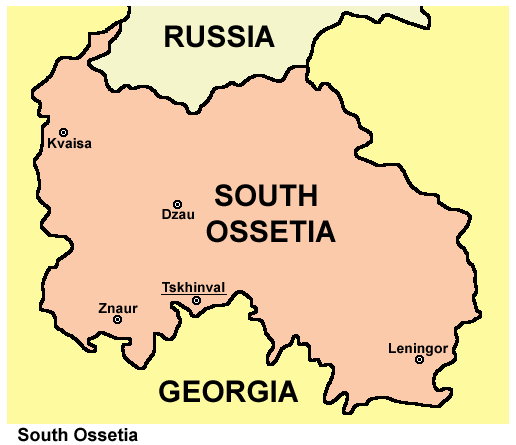
Construction of the fence has accelerated over the last twelve months, as Georgia moved towards signing a free trade deal with the European Union.
The fence divides villages, and in some cases houses, separating families from their livelihoods and neighbours. (Katie Stallard, Sky News, July 29)
Since the end of the Cold War and the fracturing of former Soviet Union, the Caucasus has experienced almost persistent conflict derived from ethnic strife. The states that emerged from the post-Soviet environment (Azerbaijan, Armenia, and Georgia) have fought wars among one another (Armenia and Azerbaijan for control of Nagorno-Karabakh) and inside their own borders (Georgia with the breakaway and ethnic majority regions of South Ossetia and Abkahzia). Specifically, South Ossetia has been the location of high-profile attacks, skirmishes, battles, and wars for over a decade.
For our purposes here, we will confine our analysis to the most recent evolution of the secessionist movement in South Ossetia. While the issues dividing Georgians and Ossetians date back centuries. The dynamic of ethnic strife is found largely unrivaled in the last few hundred years of history in the Caucasus. For modern reading you can find two of the best books on the subject here:
The Ghost of Freedom: A History of the Caucasus by Charles King
The Caucasus: An Introduction by Thomas de Waal (Mr. de Waal’s book focuses primarily on the South Caucasus nations of Armenia, Azerbaijan, and Georgia)
Placing the issue of South Ossetian secession and the geopolitical games that culminated in the war of August 2008, it was the modern-day rule and collapse of the Soviet Union that truly catalyzed the current state of conflict between South Ossetia, Russia, and Georgia.The modern secessionist movement in South Ossetia dates back decades, most accurately to the last years of the Soviet Union’s existence. As BBC lays out in a comprehensive profile of the conflict, Georgia has managed only tenuously to hold its official government authority over the breakaway region:
In the twilight of the Soviet Union, as Georgian nationalist Zviad Gamsakhurdia came to prominence in Tbilisi, separatist sentiment burgeoned in South Ossetia.
After several outbreaks of violence between Georgians and Ossetians, the region declared its intention to secede from Georgia in 1990 and, the following year, declared de facto independence.
The collapse of the USSR and Georgian independence in 1991 only strengthened South Ossetia’s determination to break with Tbilisi.
Sporadic violence involving Georgian irregular forces and Ossetian fighters continued until the summer of 1992 when agreement on the deployment of Georgian, Ossetian and Russian peacekeepers was reached.
Political stalemate followed. Separatist voices became less strident during President Shevardnadze’s rule in Georgia, but the issues returned to the foreground when Mikhail Saakashvili replaced him as president.
Making clear his intention to bring the breakaway regions to heel, Mr Saakashvili offered South Ossetia dialogue and autonomy within the Georgian state.
But his offer fell far short of separatist demands, and in 2006 South Ossetians overwhelmingly voted to restate their demand for independence in a referendum that Georgia did not recognise.
Tensions came to head in early August 2008, when, after nearly a week of clashes between Georgian troops and separatist forces, Georgia launched a concerted air and ground assault attack on South Ossetia, briefly gaining control of Tskhinvali.
Declaring its citizens to be under under attack, as most South Ossetians have Russian passports, Moscow sent in troops and launched air attacks on the Georgian forces.
Within days Russian forces had swept the Georgians out of both South Ossetia and Abkhazia, and then proceeded to occupy parts of Georgia, causing panic in Tbilisi. (BBC Profile, October 17, 2013)
Following the Russo-Georgian war of August 2008, South Ossetia, along with the now-breakaway region of Abkhazia, was dislodged from the control of the government in Tbilisi. As the diplomatic row increased in tonal ferocity and escalated in the number of violent attacks carried out by the ethnically Russian (and Kremlin-supported) South Ossetian separatists, the tense diplomatic exchange that followed between the Kremlin and the government of Mikheil Saakashvili in Tbilisi erupted in open warfare on August 1 when the separatists began shelling Georgian military positions with mortar and RPG fire., the Russians carried out an invasion and occupation of the two separatist regions under the auspices of a peacekeeping mission.
The geopolitical gaming continued in the years following the end of open hostilities and warfare between the Georgians, the Ossetians of South Ossetia, and the Russian military. Predictably, Western powers sought to leverage the vulnerable position of the Georgian government in the wake of the war by investing heavily in the reconstruction efforts that sought to rebuild the damaged infrastructure of the Georgian state. Almost immediately after the cessation of warfare, investments were promised and funding committed:
Georgia was pledged an unexpectedly generous amount of 4.5 billion dollars by some 40 countries and 15 international organizations attending a donors’ conference in Brussels on Wednesday.
The amount, which is to be paid over a three year period, is to help Georgia recover from its 5-day war with Russia.
The total amount far exceeded the 3.2 billion dollars that the World Bank had estimated Georgia would need to rebuild its infrastructure, settle its refugees and get its economy back on track.
“We are deeply moved and humbled by the demonstration of solidarity and support that we have received,” said Georgian Prime Minister Lado Gurgenidze, noting that the pledges were being made as governments around the world were struggling to contain the effects of a global financial crisis.
The Georgian leader also moved to reassure foreign taxpayers that the aid would not be misspent.
“Every single, euro, dollar and pound will make Georgia stronger, more prosperous, freer, more democratic and more genuinely and thoroughly European,” said Gurgenidze. “(It) will alleviate, to a significant degree, the human suffering that has resulted in the aftermath of the Aug. 7 conflict.” (Expatica.com, October 23, 2008)
The reconstruction of Georgia has once again placed the government in Tbilisi in a position where it has requested consideration for admission to the Atlantic Alliance. While Russian military aggression has destabilized a large swath of territory in Georgia and essentially surgically removed two key regions in South Ossetia and Abkhazia, Georgia is once again seeking the protective umbrella of the European community as it pursues acceptance to the European community. With recent events in Eastern Ukraine, the political tenability of admitting new Eastern European states such as Ukraine, Georgia, and Moldova remains a significant impediment. This is not to say, however, that the enlargement of NATO faces insurmountable obstacles in the months and years ahead. If NATO is to enlarge, the alliance will ostensibly seek to do so with much attention paid to the long-term geostrategic significance of the states it next makes members. Further, the enlargement of the Atlantic Alliance could be the way in which the EU and the U.S. respond to continued provocation; Russia has recently test-fired medium-range ballistic missiles in violation of a nearly three-decades old agreement between the U.S. and the Soviet Union:
It is the most serious allegation of an arms control treaty violation that the Obama administration has leveled against Russia and adds another dispute to a relationship already burdened by tensions over the Kremlin’s support for separatists in Ukraine and its decision to grant asylum to Edward J. Snowden, the former National Security Agency contractor.
At the heart of the issue is the 1987 treaty that bans American and Russian ground-launched ballistic or cruise missiles capable of flying 300 to 3,400 miles. That accord, which was signed by President Ronald Reagan and Mikhail S. Gorbachev, the Soviet leader, helped seal the end of the Cold War and has been regarded as a cornerstone of American-Russian arms control efforts.
Russia first began testing the cruise missiles as early as 2008, according to American officials, and the Obama administration concluded by the end of 2011 that they were a compliance concern. In May 2013, Rose Gottemoeller, the State Department’s senior arms control official, first raised the possibility of a violation with Russian officials.
The New York Times reported in January that American officials had informed the NATO allies that Russia had tested a ground-launched cruise missile, raising serious concerns about Russia’s compliance with the Intermediate-range Nuclear Forces Treaty, or I.N.F. Treaty as it is commonly called. The State Department said at the time that the issue was under review and that the Obama administration was not yet ready to formally declare it to be a treaty violation. (Michael R. Gordon, New York Times, July 28)
With the ongoing conflict in Ukraine, the tenability of Georgia’s border with Russia and the value of the country as a throughway for the South Stream Pipeline make it the obvious choice for NATO policymakers. However, the benefits of admitting the once-Soviet republic could be far outweighed by the geopolitical consequences for making another Russian near abroad state, one in a resource-rich region (Caspian Sea Basin), a permanent member of the Western-dominated military alliance. However unlikely Georgia is as a candidate for member-state status in NATO in the near-term, it becomes more and more likely that the South Caucasus state is increasingly more attractive to NATO policymakers as the conflict in Ukraine drones on and the fissure between Russia and the West widens and festers.
As the Kremlin seeks to spread the battlefield and garner strategic depth, both Abkhazia and South Ossetia will become important pieces in the geopolitical tug-of-war between the European Union and the United States in the West and Russia. We will examine more fracture points in the coming weeks both here at SOFREP and at Foreign Intrigue.
In future articles, watch for similar examination of the ongoing conflicts in Abkhazia and Nagorno-Karabakh in the South Caucasus impact regional security and American policy. I will also explain how the conflicts in the federal subjects of Dagestan and Chechnya both feed into the aforementioned regions in the South Caucasus and catalyze strife inside the Russian state.
(Featured photo courtesy of Wikimedia Commons)








COMMENTS