

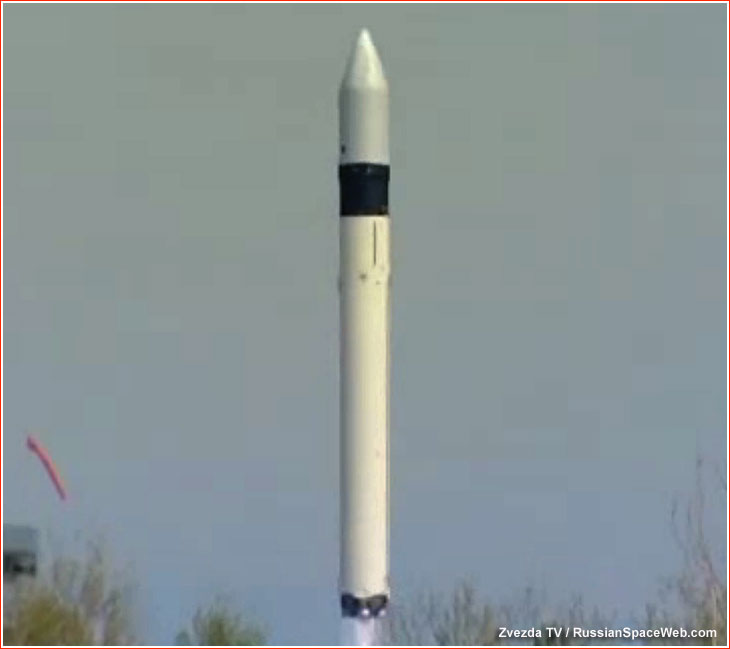
Zak’s investigation of orbital elements reveals that Kosmos 2499 came within 0.47 miles (0.76 km) of Briz-M on Nov. 9, 2014. Subsequently, the spacecraft distanced itself, yet on Nov. 25Nov. 25, it came even nearer, 0.33 miles (0.53 km) away from the rocket body.
Rumors circulated that Kosmos 2499 and Kosmos 2491, a pair of objects shot into Earth orbit in 2013, might be technology trials that could pursue and potentially disable other satellites. In December 2014, Oleg Ostapenko, leader of Roscosmos at the time, confronted such theories during a news conference.
Oleg Ostapenko, then the head of Russia’s federal space agency Roscosmos reported that the satellites were manufactured through a joint effort between Roscosmos and the Russian Academy of Sciences. Their application was exclusively for peaceful objectives, including research conducted by educational organizations, Zak mentioned. Without giving any more details, Ostapenko said, “‘They completed their mission.'”
Despite what Ostapenko stated, Kosmos 2499 remained active occasionally for some years. For instance, visual observations indicate that the satellite was approximately 0.3 meters long. Additionally, Zak reported that some actions were taken by it at the beginning of 2017.
Kosmos 2499 has reached the end of its life, leaving behind a pile of debris in a space already crowded with it.
The European Space Agency has reported that more than 36,500 objects in Earth’s orbit are at least 10 cm wide, which are just the ones that can be monitored. In addition, over 130 million pieces of space debris are estimated to be at least 1 mm in size.
The smallest pieces of debris can be hazardous to satellites and other spacecraft due to the tremendous velocity of orbiting objects. For example, the International Space Station circles the Earth at an altitude of approximately 250 miles (400 km) and moves around the planet at an astonishing speed of 17,500 mph (28,000 kph).
Russian Satellites for Intelligence Gathering
Since the launch of Sputnik 1 in 1957, Russia has been a major player in the space race. The country’s first satellite to be sent into orbit was a significant milestone. Moreover, it marked the beginning of a long history of Russian satellites being used for military intelligence and modern warfare.
The most recent example is the mysterious Russian satellite Kosmos 2499, which broke apart in early January 2021. This satellite was speculated to be either a spy satellite or an experimental weapon test, and its disintegration has caused concern among space agencies around the world.
Russia has also recently threatened to target commercial satellites in its ongoing conflict with Ukraine. In October 2022, a senior Russian foreign ministry official warned that commercial satellites “may become a legitimate target for retaliation.” This threat could have profound implications for both countries’ ability to use satellites for military intelligence and modern warfare.
In addition to targeting commercial satellites, Russia has also launched its killer satellite, Kosmos-2558. This satellite is designed to trigger Article 5 of the Outer Space Treaty, which states that all nations must refrain from placing weapons of mass destruction in outer space. While this satellite is not intended to be used as a weapon itself, it could be used as part of a larger strategy by Russia to gain control over certain areas in outer space.
As someone who works in the field of aerospace engineering, we find these developments concerning but also fascinating at the same time. It’s incredible how far technology has come since Sputnik 1 was launched more than 60 years ago and how much progress we’ve made since then. SOFREP will continue to monitor these developments closely to ensure that our use of satellites remains peaceful and beneficial for everyone involved.
Stay tuned at SOFREP for more!








COMMENTS