

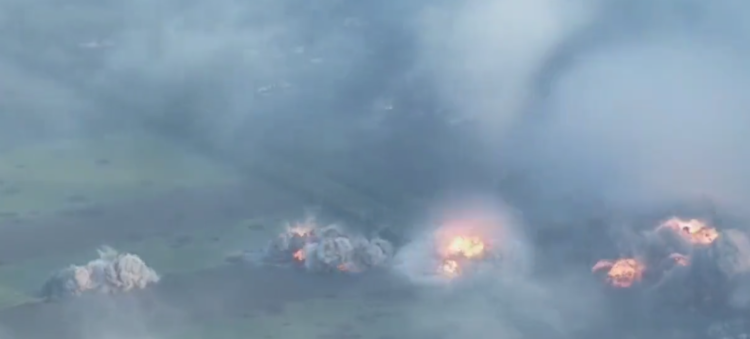
A common misconception about the weapon is that it is a flamethrower because of its nickname, but in reality, it has nothing in common with flamethrowers. It is strictly a thermobaric/fuel-air explosive (FAE) weapon. It is also not the Russian “Father of all Bombs,” although that is a real (and huge) air-dropped thermobaric weapon.
A video of Russian TOS-1A thermobaric MRLS strikes hitting Lyman in the Luhansk Oblast.
According to reports, the Russian assault on the city is underway. pic.twitter.com/ULPYFcFWI0
— Status-6 (Military & Conflict News) (@Archer83Able) May 23, 2022
So what makes it all that scary? These thermobaric missiles (commonly known as vacuum bombs) are known to obliterate humans in a very literal sense. It uses oxygen around it to amplify its temperature, making it rise to have a very powerful explosion.
What happens is that when a thermobaric weapon is fired, the first of two charges blow up and releases fuel into the air. The released fuel then forms a cloud. Once the cloud is large enough, the second charge blows up, detonating the fuel and ultimately creating a devastating fireball (hence the nickname “flamethrower”) that engulfs those around the blast area. In anything that has fire in it, the more oxygen there is, the larger and the hotter the blast will be. The resulting fire is reported to be around 3,632 Fahrenheit to 6,332 Fahrenheit (2,500C to 3,000C), about as hot as volcanic lava that just happens to also be capable of rupturing human internal organs.
“Those at the fringe are likely to suffer many internal, thus invisible injuries, including burst eardrums and crushed inner ear organs, severe concussions, ruptured lungs, and internal organs, and possibly blindness,” US intel finds.
In 1993, the US Defense Intelligence Agency found that the blast was “unique” in the sense that the vacuum caused by the weapon ruptures the lungs. More so, if the fuel fails to be detonated but is deflagrated, those who inhale the fuel-infused oxygen will inhale toxic fumes that can burn their lungs.
Thermobaric weapons are especially devastating in confined spaces as the blast will be concentrated in a small space. The pressure created by the blast is around 427 lbs per square inch, which can rip lung tissue. Individuals exposed to the weapon also aren’t safe hiding behind walls or surfaces as these will amplify the pressure waves, which cause more damage instead of protecting the person when compared to conventional explosive blasts.
As evidence suggests, the Russians are probably using this weapon to kill or draw out Ukrainian troops who have dug trenches along the frontlines. If Russia wants to break through these fortified defenses, then thermobaric weapons can do exactly that – and they can use them as they are not prohibited weapons. We doubt the Russians spend much time fussing over the legality of weapons in any event. If the Russians do hit civilian areas with these weapons, as they frequently have with other munitions, that would just add to the list of other crimes Russia has committed against Ukraine’s civilian population.








COMMENTS