

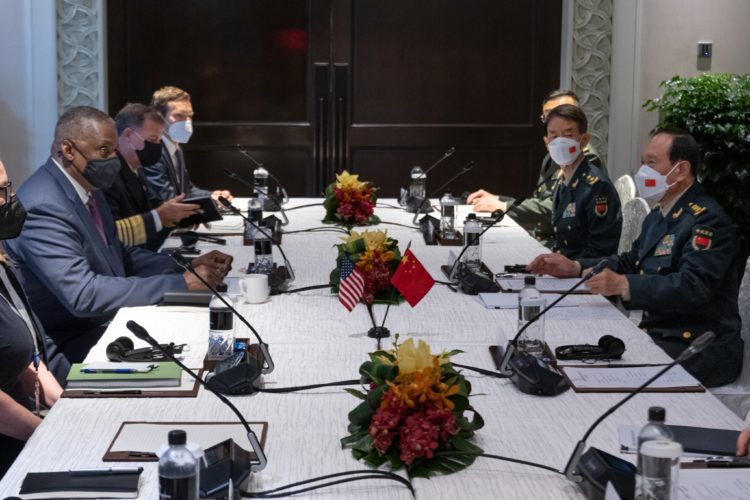
“We remain firmly committed to our longstanding one-China policy—guided by the Taiwan Relations Act, the three Joint Communiques, and the Six Assurances. We categorically oppose any unilateral changes to the status quo from either side. We do not support Taiwan independence. And we stand firmly behind the principle that cross-strait differences must be resolved by peaceful means,” he explained.
However, he did maintain that the US will still continue to support Taiwan under the Taiwan Relations Act, which includes assisting Taiwan with its self-defense capacity. He would later go on to say that China has not been holding up its own end of the deal by being increasingly aggressive towards other countries in the Indo-Pacific.
“We remain focused on maintaining peace, stability, and the status quo across the Taiwan Strait. But the PRC’s moves threaten to undermine security, and stability, and prosperity in the Indo-Pacific. And that’s crucial for this region, and it’s crucial for the wider world.”
Furthermore, Austin vehemently denied that the US was forming an “Asian NATO” and a “New Cold War,” as China has suggested in the past few months. This concept of an “Asian NATO” was brought about last April when China accused Australia, the US, and the UK, otherwise known as “AUKUS,” of forming the Asia-Pacific NATO as the three countries committed to developing hypersonic weapons together to share information, technology, and resources.
“Its (AUKUS’) ultimate goal is to build a NATO replica in the Asia-Pacific to serve the US hegemony and self-interests through and through. Asia-Pacific countries will resolutely say no to it for sure,” Chinese Foreign Ministry Spokesperson Zhao Lijian said last April, with his colleague Chinese envoy to the UN Zhang Jun stating that AUKUS will fuel a crisis much like Ukraine in Asia.
In turn, Austin would draw a parallel between the Russian invasion of Ukraine and the heated tensions between China and Taiwan, stating that the indefensible assault on a peaceful neighbor had reminded the world of the dangers of undercutting an international order rooted in laws.
“Russia’s invasion of Ukraine is what happens when oppressors trample the rules that protect us all,” he stated. “It’s what happens when big powers decide that their imperial appetites matter more than the rights of their peaceful neighbors. And it’s a preview of a possible world of chaos and turmoil that none of us would want to live in.”
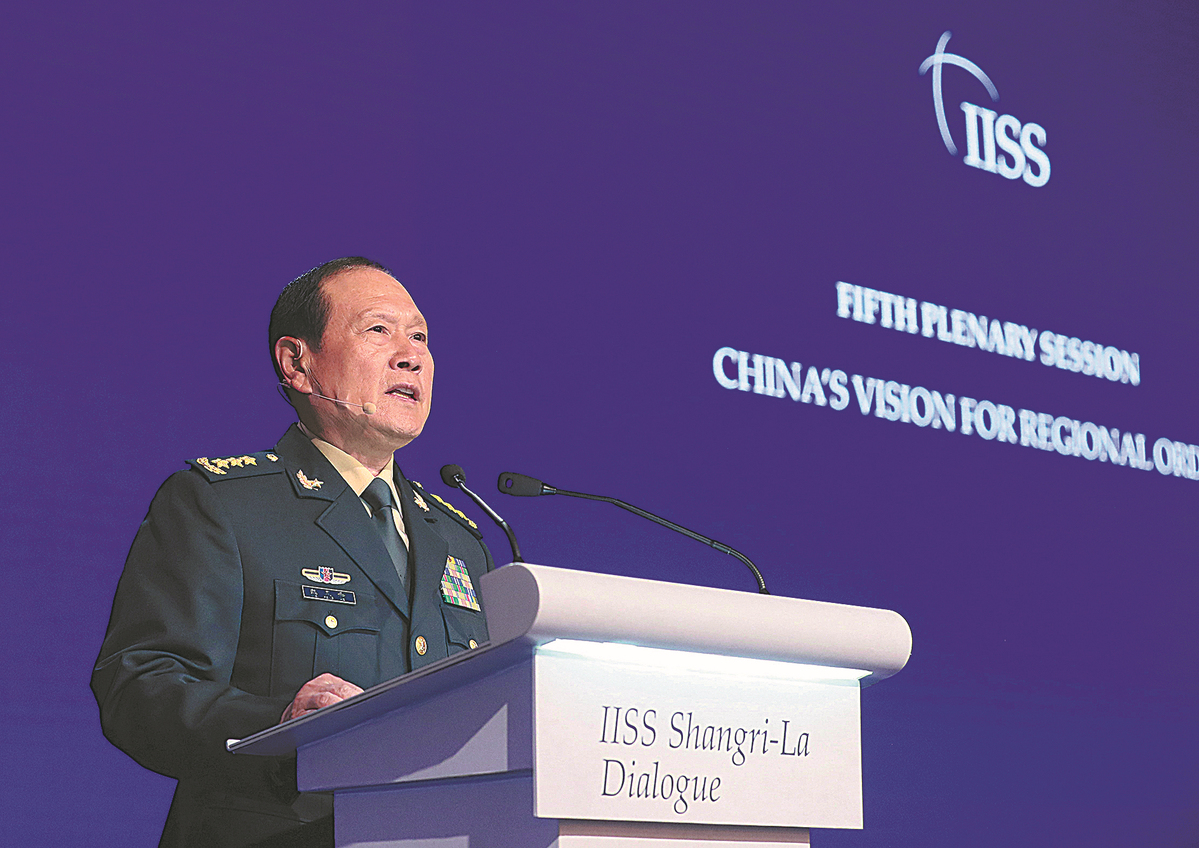
Chinese Defense Minister General Wei Fenghe would reject all of the sentiments of Austin, to which he called the speech a “smearing accusation” and that it was an attempt by Washington to facilitate its own interests within the Indo-Pacific disguised as “multilateralism.”
“No country should impose its will on others or bully others under the guise of multilateralism,” the Chinese general stated. “The strategy is an attempt to build an exclusive small group in the name of a free and open Indo-Pacific to hijack countries in our region and target one specific country — it is a strategy to create conflict and confrontation to contain and encircle others,” he added.
Wei would then reverse the statements of Austin and would claim that it is the United States along with its allies who are being aggressive towards them in the South China Sea by conducting freedom of navigation patrols. The Philippines, Vietnam, and Indonesia have all rejected Chinese claims on several islands in the vicinity. The Philippines has especially enjoyed the continued military exercises with the US, which do not just aim to facilitate the exchange of knowledge between the two old allies but also serve as a check for Chinese aggression in the region. To this, China urged countries in the Indo-Pacific to come to them directly and find their own solutions without the intervention of the US.
“China calls for turning the South China Sea into a sea of peace, friendship and cooperation,” Wei said. “This is the shared wish and responsibility of countries in the region.”
China continues to state that all they want is a peaceful reunification with Taiwan. Despite these sentiments, the Chinese also expressed that they will do anything to obtain reunification, even through force if needed.
Later, the Chinese general would say that they would “not hesitate to fight” if anybody dares to secede Taiwan from China.
“If anyone dares to secede Taiwan from China, we will not hesitate to fight. We will fight at all costs. And we will fight to the very end,” Wei said.
“No one should ever underestimate the resolve and ability of the Chinese armed forces to safeguard its territorial integrity,” he continued.
Speaking at Asia's premier security summit, the Shangri-La Dialogue, Chinese Defence Minister Wei Fenghe hits back at his US counterpart Lloyd Austin, that China is being too aggressive with in the region with Taiwan pic.twitter.com/jqAyJ4jOjl
— TRT World Now (@TRTWorldNow) June 12, 2022
These Chinese sentiments were fueled primarily by President Biden’s comment last month that the US would intervene militarily if China were to invade Taiwan, stating that it was a “commitment” the US made to Taiwan.
Later, Austin would backtrack the President’s statement and would reiterate that the US support for the One China policy had not changed, a sentiment he echoed during the Shangri-La Dialogue.








COMMENTS