Medal of Honor recipients just got their pension bumped finally putting real weight behind the nation’s highest award. Meanwhile, the Gaza ceasefire is barely holding as clashes flare around the unmarked Yellow Line, and a final Afghanistan watchdog report says the U.S. left billions of arms and equ
Read the full article for more on:
Important insights and detailed analysis
Expert commentary on current events
Breaking developments and updates
Updating summary...
Evening Brief: Medal of Honor Pay Boosted as Gaza Ceasefire Frays and Taliban Inherit U.S. War Gear
Galen Fries
Speed
1x
Listen
COMMENTS
Medal of Honor recipients just got their pension bumped finally putting real weight behind the nation’s highest award. Meanwhile, the Gaza ceasefire is barely holding as clashes flare around the unmarked Yellow Line, and a final Afghanistan watchdog report says the U.S. left billions of arms and equipment in the hands of the Taliban.
Sgt.Maj. John L. Canley. Image Credit: Cpl. Daisha Ramirez
Medal of Honor Pensions Get Major Boost
Medal of Honor recipients will soon receive a much larger special pension, reflecting both the historic weight of the award and the continued service many of these veterans provide long after their actions in combat. Under new legislation, their honorary payment will shift from a modest supplement to a substantial financial acknowledgement of their sacrifice and ongoing commitments.
Advertisement
The Monetary Enhancement for Distinguished Active Legends Act, known as the MEDAL Act, raises the Medal of Honor pension from roughly $1,406 per month to $5,625 per month. That change increases the annual amount from about 18,000 dollars to 67,500 dollars. The higher rate applies to all living Medal of Honor recipients and will be adjusted each year to keep pace with inflation. The law also establishes a new monthly payment at the previous base rate, 1,406.73 dollars, for surviving spouses of deceased recipients, with the same annual cost-of-living protection.
This special honorarium is administered by the Department of Veterans Affairs and has existed in some form for more than a century. Congress first authorized a Medal of Honor stipend in 1916, setting it at 10 dollars per month for the lifetime of each recipient, with later increases tied to the rising cost of living. The award itself dates back even further. Created during the American Civil War in 1863, the Medal of Honor is the nation’s highest military decoration for valor in combat. Since then, 3,528 service members have received the medal, though only a small fraction remain alive.
According to the Congressional Medal of Honor Society, there are currently 61 living recipients. Forty-five of them earned the medal for actions in Vietnam, while sixteen received it for actions in the post 9/11 conflicts, often grouped as the Global War on Terror. Many of these men spend significant time on the road speaking with units, appearing at commemorations, visiting schools, and engaging with civic groups. Retired Master Sergeant Earl Plumlee, who received the Medal of Honor for actions in Afghanistan in 2013, noted that recipients are reluctant to turn down requests to share their stories and the values associated with the medal, even when heavy travel places a strain on their own families and finances. He has said the new law helps balance that burden and allows them to continue serving without carrying the costs alone.
Advertisement
The legislation moved through Congress with broad bipartisan support. The House of Representatives passed the bill earlier in the year, and the Senate approved it in the following months. The president signed it into law on December 1. Representative Troy Nehls of Texas, who sponsored the measure in the House, argued that the increased pension was necessary in light of cases where recipients received little or no reimbursement for supporting recruiting events or where families had resorted to fundraising to cover expenses. In his view, lifting some of the financial pressure is a basic responsibility owed to individuals whose actions went far beyond the normal call of duty.
A separate but related measure, the Medal of Honor Act, also directs the Department of Veterans Affairs to implement the new pension level, bringing the statutory language into line with the higher annual figure of 67,500 dollars. Together, these laws significantly update a benefit that had not kept pace with modern realities. They ensure that the small and aging group of living Medal of Honor recipients, and the spouses of those who have died, receive a level of financial recognition more commensurate with both their extraordinary heroism in uniform and their continued efforts to mentor, inspire, and serve the broader community.
Advertisement
IDF troops mark the yellow line in the Gaza Strip. Image Credit: IDF Spokesperson’s Unit
Ceasefire in Peril as Israeli Forces Clash Across Gaza’s ‘Yellow Line
The situation in Gaza is still tense and ugly, even with a truce on paper. A U.S.-brokered ceasefire went into effect on October 10, 2025, but both Israel and Hamas keep accusing each other of violations, and civilians are getting caught in the middle. Qatar and Egypt remain the main brokers and guarantors, and their leaders warn the current pause is not yet a full, stable end to the war.
One of the biggest friction points is the so-called Yellow Line. Under the deal, Israeli forces pulled back to this notional boundary inside Gaza, leaving roughly 60 percent of the strip under Israeli control during phase one. The problem is the line is more map ink than real fence. In many areas there are no clear markers, signs, or barriers, so civilians near it may not know when they are stepping into a restricted zone. That confusion has turned the Yellow Line into a daily flashpoint where approaching it can draw fire or air strikes, depending on who is watching and what they think they see.
Advertisement
Over the last several days, Palestinian health officials reported at least seven people killed in northern Gaza in incidents linked to ceasefire friction. Reuters confirms the deaths while noting Israel says it has fired on militants who breached ceasefire limits. Specific stories circulating on social media about drones pursuing individual civilians have not been independently confirmed by major wires, so they should be treated as allegations unless backed by a verified outlet.
The wider casualty picture remains grim. Gaza’s Health Ministry reports more than 70,000 Palestinians killed and over 170,000 wounded since October 2023. Israel disputes the totals, but the UN and most international outlets continue to cite the ministry’s running count as the best available figure. On the Israeli side, about 1,200 people were killed in the October 7, 2023 Hamas attack and 251 were taken hostage. After multiple exchanges and recoveries under the 2025 truce, only one hostage remains unaccounted for, with most living captives freed and many remains returned.
Phase two negotiations are now the political minefield. Plans on the table include releasing the final hostage, reopening the Rafah crossing, forming an interim Palestinian technocratic administration, and standing up an International Stabilization Force to help enforce security along the Yellow Line and support Hamas disarmament. Qatar and Egypt are pressing for Israeli withdrawal and an international security backstop, but the makeup and mandate of that force are still being fought over.
Bottom line: the truce has reduced large strikes, but the ground fight around the Yellow Line keeps Gaza lethal and unpredictable. Until the boundary is clearly enforced, civilians protected, and phase two signed and implemented, this is a fragile pause, not peace.
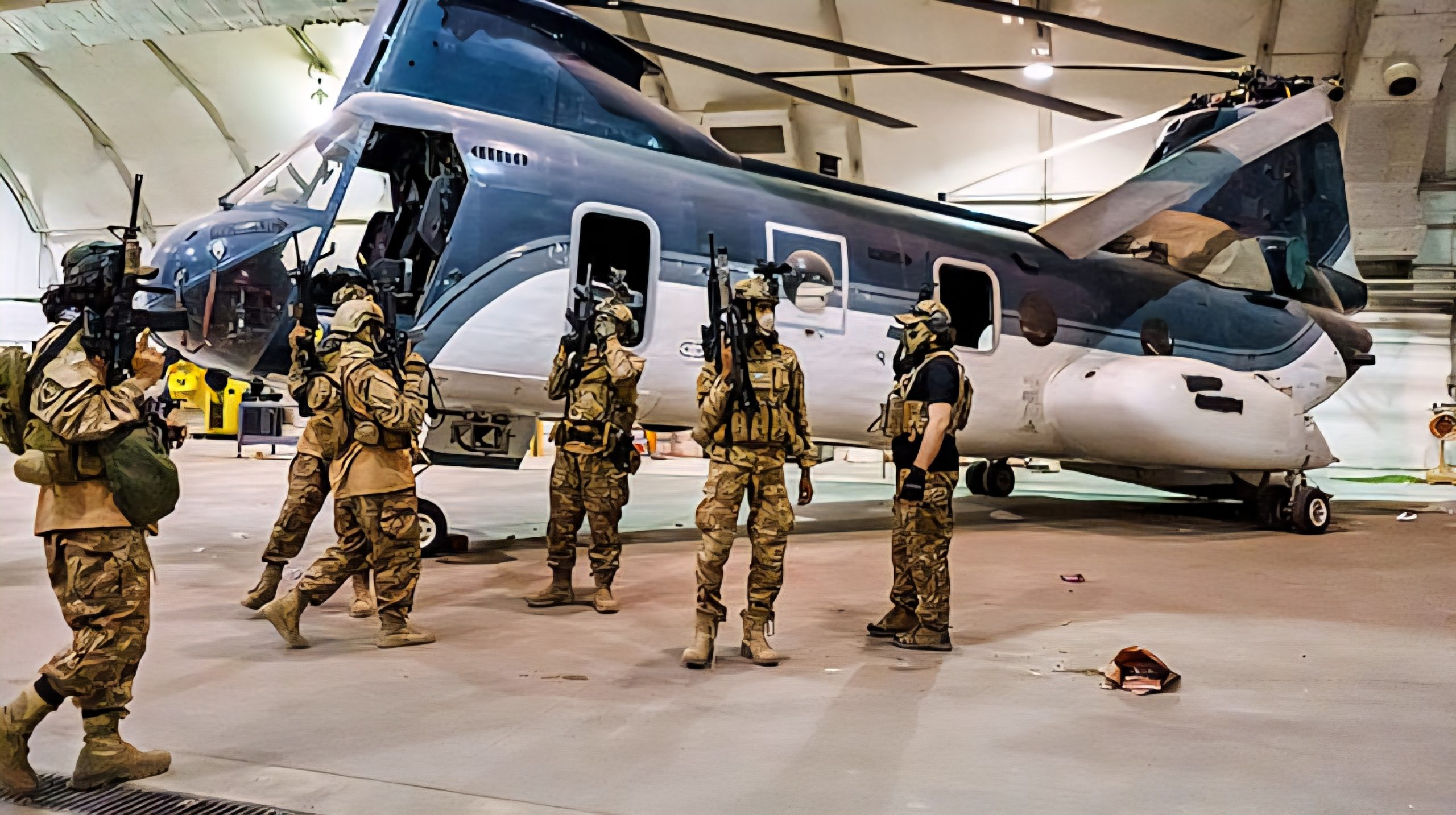
Taliban fighters, wielding American-supplied weapons, equipment and uniforms. Image Credit: Marcus Yam/Los Angeles Times/Getty News
Afghanistan Watchdog: U.S. Left $7.1B in Gear for the Taliban
The final report from the Special Inspector General for Afghanistan Reconstruction (SIGAR), released December 3, 2025, is a cold splash of water after twenty years of warm Kool-Aid. Congress poured about $148.2 billion into Afghan reconstruction from FY2002 through FY2025, with $144.75 billion of that spent before the 2021 withdrawal. The stated goals were democracy, stability, and a self-sustaining Afghan state. SIGAR’s closing assessment is what a lot of veterans and taxpayers already knew in their bones: the strategy was incoherent, the execution was sloppy, and the outcome collapsed fast once U.S. support left the room.
When U.S. forces wrapped up the withdrawal in August 2021, the exit was chaotic and the Afghan government folded in days. SIGAR documents that the Department of Defense reported leaving at least $7.1 billion in U.S.-funded military equipment and defense articles in Afghanistan. That includes aircraft, vehicles, weapons, comms gear, and facilities bought for the Afghan National Defense and Security Forces. After Kabul fell, the U.S. could not verify what remained serviceable or where most of it ended up. But SIGAR’s bottom line is blunt: a huge slice of that gear is now in Taliban hands and forms a real part of their security force backbone.
SIGAR also highlights how the Afghan forces were built in America’s image. We tried to “clone” a modern U.S. military complete with complex logistics, high-end maintenance chains, and leadership requirements that assumed a deep bench of trained officers and NCOs. That model created permanent dependence on U.S. contractors, air support, intelligence, and pay systems. When those supports vanished during the drawdown, the Afghan force did not bend. It snapped. Morale cratered, units disintegrated, and the Taliban walked into the gap. SIGAR has been saying this for years, and the final report ties the bow on it: the force was not designed to survive without us.
Even after the fall, U.S. money kept flowing, just in a different lane. SIGAR’s funding tables show about $3.47 billion in post-withdrawal appropriations through June 30, 2025, mostly humanitarian and refugee accounts. The intent is to keep Afghans from starving and to limit regional spillover, but SIGAR repeatedly warns that aid delivery under Taliban rule is vulnerable to diversion, coercion, and indirect benefit to the regime.
SIGAR’s final take is not complicated. The U.S. spent nearly two decades and almost $150 billion trying to build a state on timelines, assumptions, and systems that did not fit Afghanistan. We ignored corruption, chased metrics that looked good on slides, and built security forces that could not function without American life-support. Then we pulled the plug and left billions in equipment behind like the world’s worst yard sale. If the report is for anything, it’s a warning for the next time Washington tries to rebuild a country by copying and pasting our own playbook.
—
** Editor’s Note: Thinking about subscribing to SOFREP? You can support Veteran Journalism & do it now for only $1 for your first year. Pull the trigger on this amazing offer HERE. – GDM
Advertisement
What readers are saying
Generating a quick summary of the conversation...
This summary is AI-generated. AI can make mistakes and this summary is not a replacement for reading the comments.










COMMENTS