

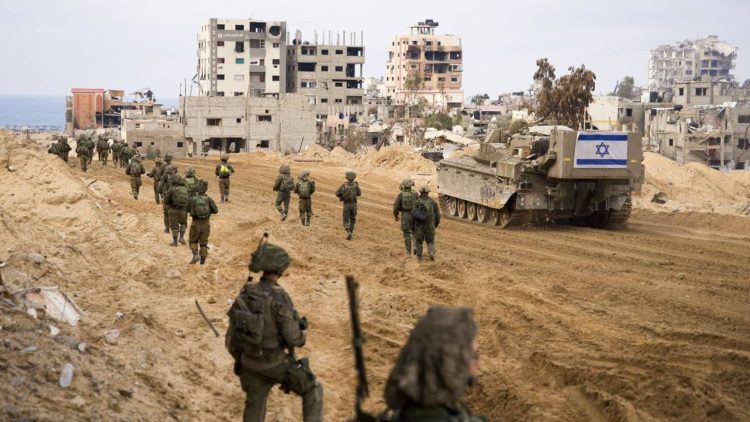
The UN Office for the Coordination of Humanitarian Affairs (OCHA) warned the proposal would cut off large parts of the population—particularly the vulnerable—from life-saving aid and labeled it a “pressure tactic” embedded in Israel’s broader military strategy. Aid groups voiced strong opposition to using armed or uniformed personnel to distribute supplies, saying it could put civilians at risk.
Meanwhile, Hamas condemned the Israeli plan as an extension of a “starvation policy” and a violation of international law. The group continues to reject Israeli demands to disarm as part of any ceasefire agreement, while Israel has stated it will not end the war until Hamas’s military and governing capabilities are dismantled.
A third Israeli official said implementation of the plan would likely begin only after US President Donald Trump’s expected visit to the region later this month. This delay leaves open the possibility of a temporary ceasefire.
Israel’s push to escalate pressure on Hamas appears to be faltering diplomatically, as negotiations remain deadlocked. The hostage crisis remains a central issue, with families of Israeli captives expressing anger over the prolonged conflict. The Hostages and Missing Families Forum demanded that government leaders prioritize a deal for their return. Some reservists have signaled an unwillingness to serve in what they view as an increasingly politicized war.
Israel’s previous full withdrawal from Gaza in 2005 and its subsequent blockade set the stage for years of intermittent warfare. Reoccupying Gaza would raise major legal and logistical questions about governance and civilian control in a hostile and devastated environment. Rights groups have already warned that forced population transfers and aid manipulation could constitute war crimes under international law.
WWII-Era Philippine Navy Ship Sinks Ahead of US-Philippines Live-Fire Drill in South China Sea
A planned ship-sinking exercise involving US and Philippine forces was abruptly canceled Monday after the BRP Miguel Malvar, a World War II-era Philippine Navy vessel, accidentally sank in rough seas ahead of the scheduled live-fire drill.
The decommissioned ship went down approximately 30 nautical miles (35 miles) off Zambales, facing the contested Scarborough Shoal in the South China Sea. No personnel were on board at the time.
Philippine and US military officials confirmed the incident, citing rough sea conditions as the cause.
“It’s an 80-year-old dilapidated ship and it wasn’t able to withstand the rough seas,” said Philippine Lt. Col. John Paul Salgado.
The BRP Miguel Malvar was originally a US Navy patrol vessel from the 1940s, later transferred to Vietnam, and eventually acquired by the Philippines.
Despite the cancellation of the ship-sinking event, other Balikatan (“shoulder-to-shoulder” in Tagalog) exercises continued as planned, with 14,000 US and Filipino troops participating in a series of joint drills from April 21 to May 9.
The exercises have included mock island assaults, such as one staged Sunday in Balabac, Palawan, simulating the retaking of territory from hostile forces.
The now-canceled sinking drill was expected to be one of the highlights of the annual combat exercises and was planned near Scarborough Shoal, a strategic flashpoint increasingly guarded by Chinese coast guard and militia vessels. Tensions in the area have steadily intensified, with multiple confrontations between Chinese and Philippine forces in recent years.
These military drills have taken on added strategic importance amid China’s assertive maritime claims. Although officials from both the US and the Philippines insist the exercises are not directed specifically at China, the scenarios reflect broader defense concerns and Washington’s mutual defense treaty commitment to Manila.
US Defense Secretary Pete Hegseth has reaffirmed that commitment, stating the US would defend the Philippines in the event of an armed attack, including in the South China Sea. Japanese and British military observers also joined the exercise, highlighting growing multilateral security coordination in the region.
Lithuania to Spend $1.2 Billion Fortifying Border with Russia and Belarus
Lithuania announced Monday it will allocate 1.1 billion euros ($1.2 billion) to strengthen its border defenses against Russia and Belarus, citing escalating security threats and the need to deter potential aggression along NATO’s eastern flank.
The move is part of a broader Baltic regional effort to harden defenses amid fears that a Russian victory in Ukraine could embolden Moscow to target neighboring countries.
The Lithuanian Ministry of Defense said the plan will enable the country to “block and slow down the actions of hostile states.”
The largest portion of the funding—800 million euros —will go toward acquiring anti-tank mines, as Lithuania and its Baltic neighbors Latvia and Estonia shift focus toward area denial and territorial defense.
The ministry is also accelerating work on what it called the “Baltic defensive line,” a joint regional initiative to bolster security infrastructure. Lithuania aims to fortify key terrain, particularly around the Suwalki Gap, a strategically vital 70-kilometer (43-mile) corridor that connects Poland to the Baltic states and is flanked by Russia’s Kaliningrad exclave and Belarus.
Additional planned measures include:
- Stockpiling anti-tank systems and physical fortifications
- Deepening irrigation ditches to serve as trenches
- Reforesting border zones and planting roadside trees to shield civilians and troops
- Enhancing electronic warfare capabilities and early-warning systems
- Deploying anti-drone technologies
In January, Lithuania announced it would raise defense spending to 5–6% of gross domestic product (GDP) annually between 2026 and 2030, placing it among NATO’s top contributors by percentage.
In a controversial move, Lithuania, along with Latvia, Estonia, Finland, and Poland, also withdrew from the Ottawa Convention earlier this year. The treaty prohibits the production and use of anti-personnel mines, which rights groups argue cause long-term civilian harm.
Lithuania will spend €1.1 billion to fortify its border with Russia and Belarus, including to purchase anti-tank mines, the NATO member on the alliance’s eastern flank has said https://t.co/8awq4XjtkN
— RTÉ News (@rtenews) May 5, 2025
Amnesty International and the International Committee of the Red Cross (ICRC) condemned the decision, warning of the indiscriminate risks posed by landmines.
Lithuania defended the shift as necessary in light of the changed threat environment, arguing that such tools are essential for creating defensive depth and slowing enemy advances.
The announcement underscores NATO’s increasing military posture in Eastern Europe and reflects growing concern over Russia’s intent following its 2022 invasion of Ukraine. Baltic governments have cited past border provocations and alleged Russia-orchestrated migrant flows as additional reasons for urgent defense upgrades.
Pakistan Conducts Second Missile Test Amid Rising Tensions with India Over Kashmir
Pakistan’s military announced Monday it conducted a second missile test in as many days, demonstrating growing readiness amid heightened tensions with India over the disputed region of Kashmir.
The latest test involved a short-range missile with a range of 120 kilometers (75 miles), designed to validate the system’s advanced navigation and enhanced accuracy, according to a military statement.
On Saturday, Pakistan tested a surface-to-surface missile with a range of 450 kilometers (280 miles). While the military did not disclose test locations, Prime Minister Shehbaz Sharif praised the launches, stating the demonstrations showed Pakistan’s defense was in “strong hands.”
The missile drills come amid a fresh standoff following the April 22 attack in Pahalgam, on the Indian side of Kashmir, where 26 tourists were killed. India has blamed Pakistan for harboring the attackers—an allegation Islamabad strongly denies, calling instead for an independent investigation.
Indian Prime Minister Narendra Modi granted his military “full operational freedom” to respond, escalating fears of retaliation. In response, Islamabad has placed its forces on high alert and warned of retaliatory strikes if attacked.
The crisis has reignited tensions along the Line of Control (LoC), the de facto border dividing Indian- and Pakistani-administered Kashmir.
Indian defense sources report nightly exchanges of gunfire for over a week. Both sides have implemented emergency measures: civilian evacuations, bunker preparations, and school closures have been reported in border areas.
On the Pakistani side, emergency drills were conducted in public areas, residents were instructed to stockpile essentials, and Prime Minister Sharif postponed a diplomatic visit to Malaysia, citing the deteriorating situation.
Iranian Foreign Minister Abbas Araghchi visited Islamabad on Monday in an apparent attempt to defuse the crisis. Pakistan’s Information Minister Attaullah Tarar confirmed that Islamabad is lobbying support from friendly nations to present its case diplomatically.
International calls for de-escalation have intensified, as both nations remain heavily armed, nuclear-capable powers with a long history of conflict over Muslim-majority Kashmir, claimed in full by both but divided in practice.
The back-to-back missile launches underscore Pakistan’s emphasis on showcasing operational readiness as the threat of renewed armed conflict looms.
Sources: News Agencies








COMMENTS