

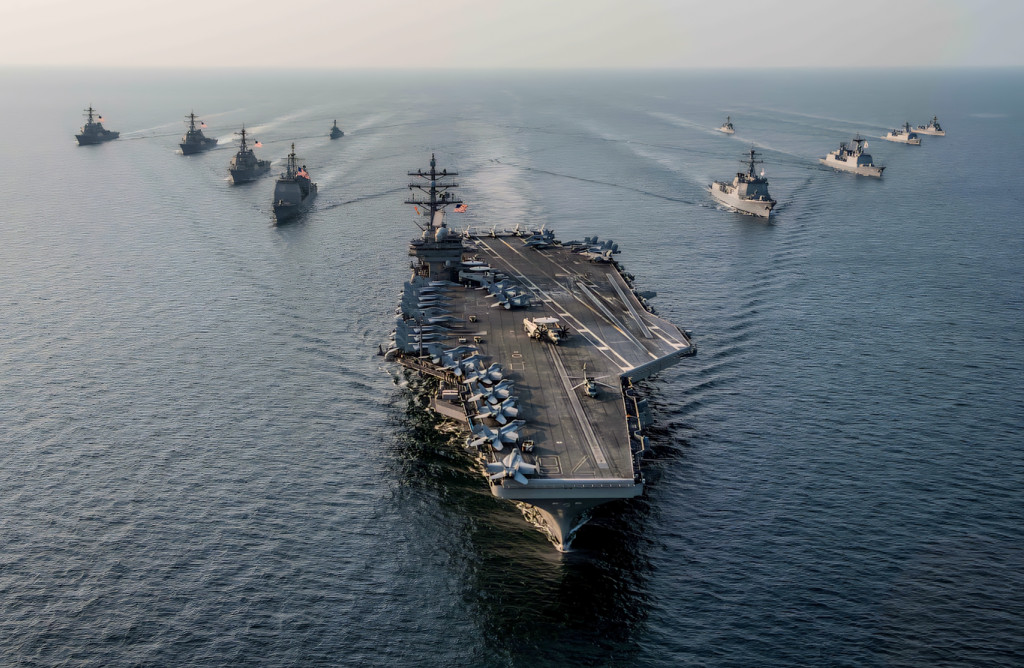
One of many Iranian naval strike groups that currently threaten U.S. Forces. At closer inspection, this appears to actually be a United States Naval Strike Group. They look so similar, SOFREP readers will kindly forgive my mistake. Image Credit: Petty Officer 3rd Class Sara B. Sexton
Iran Threatens U.S. Forces After Trump Warns Tehran Over Protest Crackdown
Iranian officials issued sharp warnings against U.S. intervention after President Donald Trump publicly threatened action if Tehran continues its violent suppression of anti-government protests, raising tensions across the region as unrest inside Iran spreads.
In a Truth Social post around 3:00 a.m. Eastern on January 2, Trump said the United States is “locked and loaded and ready to go” if Iran “violently kills peaceful protesters, which is their custom,” adding that America would “come to their rescue.” The statement marked Trump’s most explicit warning to Tehran since U.S. and Israeli strikes in June 2025 degraded Iran’s nuclear infrastructure.
Tehran responded quickly and aggressively. Ali Larijani, secretary of Iran’s Supreme National Security Council, accused the United States and Israel of inciting unrest and warned that any intervention would bring “chaos” to American bases in the region. Foreign Minister Abbas Araghchi called Trump’s remarks “reckless,” while Parliament Speaker Mohammad Bagher Ghalibaf declared U.S. forces across the Middle East “legitimate targets” if Washington escalates.
As of early January 2, there were no confirmed Iranian troop movements or unusual deployments. U.S. Central Command posture appears unchanged, and no surge activity has been publicly detected.
The backdrop to the exchange is Iran’s worst wave of unrest in years. Protests began on December 28 amid hyperinflation, a collapsing rial at historic lows, and mounting public anger over economic mismanagement. Demonstrations spread from Tehran to multiple major cities, with chants openly targeting the regime. By January 2, activists and Iranian state-linked reporting indicated at least seven to nine protesters had been killed by security forces.
Trump explicitly linked his warning to that crackdown, invoking past Iranian responses to mass protests in 2019 and 2022, when hundreds were killed. Unlike regime-change rhetoric, his language framed U.S. action as conditional and tied to civilian protection rather than overthrow.
From a military signaling standpoint, “locked and loaded” echoes Trump’s phrasing ahead of the June strikes on Iranian nuclear sites. Analysts interpret the language as a deterrent signal rather than an immediate attack order, potentially referencing elevated readiness for long-range strike aircraft, carrier strike groups already operating in the region, and pre-positioned special operations forces.
The risk for Tehran is miscalculation. Iranian leadership has historically framed internal unrest as foreign-instigated, a narrative now reinforced by President Trump’s comments. That framing could justify harsher Basij and IRGC action on the streets, raising the likelihood of additional civilian deaths and accelerating escalation dynamics.
For Washington, the message is calibrated pressure. The White House has not elaborated beyond Trump’s post, and Secretary of War Pete Hegseth has not issued public guidance. The silence suggests deliberate ambiguity rather than indecision.
Bottom line: Trump has drawn a public red line tied to protester killings, and Iran has answered by threatening U.S. forces. The next inflection point will not be rhetoric, but bodies. If protest deaths spike or IRGC deployments expand, the clock starts moving fast.
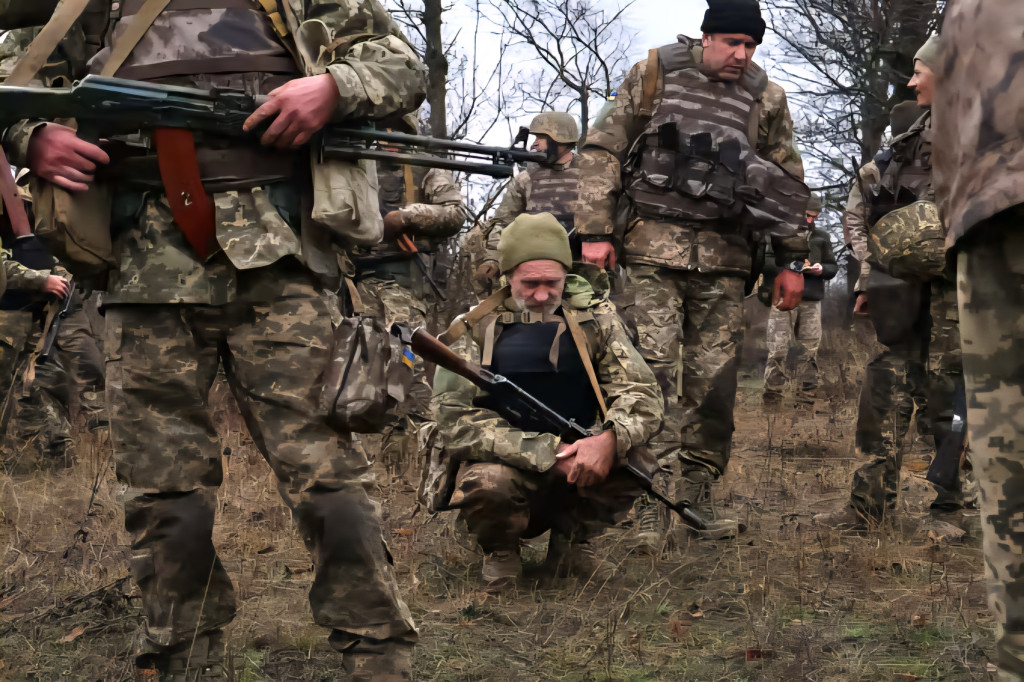
Russia Claims Huliaipole Capture as Ukraine Holds Gray Zone
Russian military officials are claiming control of another town in southern Ukraine. Ukrainian forces and independent mappers say the reality on the ground is far messier.
At a meeting attended by President Vladimir Putin, Russian commanders said their forces had taken Huliaipole in Ukraine’s
Zaporizhzhia region, according to reporting by CNN and Russian state media. Russian officers also claimed their units had seized roughly 210 square kilometers of territory in Zaporizhzhia and neighboring Dnipropetrovsk regions since early December.
Those figures come solely from Russian reporting and cannot be independently verified in real time. Western outlets, including Reuters, routinely note that such claims often exaggerate control or conflate temporary presence with durable occupation.
Ukrainian officials are not confirming the loss of Huliaipole. Ukrainian military reporting has described the situation as “intense” and highly contested, with Russian forces applying sustained pressure but without clear, uncontested control of the town. An officer from Ukraine’s security services, speaking under the call sign “Bankir,” said Russian units are attempting to improve their negotiating position by capturing additional ground ahead of any future talks.
According to that officer, Russian assaults are being conducted by small infantry groups probing for weakly defended positions, a tactic increasingly common across the front as armor becomes vulnerable to drones and precision fires.
Independent Ukrainian conflict mapper DeepState reported that parts of Huliaipole remain under Ukrainian control, while other areas are contested. DeepState categorized the town as a “gray zone,” meaning neither side holds firm, stable control, and front-line positions are fluid, shifting under constant fire.
Geography is important, and it has been frequently misstated elsewhere. Huliaipole is a small, largely rural town, not a major city. The often-cited 700,000 pre-war population figure applies to Zaporizhzhia city, which lies roughly 50 to 60 miles to the west, depending on route. Huliaipole has been on or near the front line since 2022 and has suffered extensive destruction, which helps explain why control is difficult to define cleanly.
Ukrainian-aligned reporting has also noted that the low-lying terrain around Huliaipole complicates reinforcement, while surrounding elevations favor attackers’ observation and drone reconnaissance. That terrain dynamic aligns with DeepState’s assessment that holding fixed defensive lines in the area is increasingly difficult.
From Moscow’s perspective, a “capture” headline serves a political purpose. Reuters has reported that the Kremlin continues to frame incremental advances as proof it will ultimately occupy the four regions it claims as Russian territory. Even modest gains can be presented as momentum, particularly ahead of any diplomatic maneuvering.
On the Ukrainian side, concern is evident. Ukrainian authorities have expanded evacuations in nearby frontline settlements, a move reported by multiple Western outlets as Russian pressure increases across southern and eastern sectors.
Bottom line: Russia claims Huliaipole is taken. Ukraine and independent mappers say control is disputed. The most accurate description at this stage is that the town is a heavily contested gray zone, with Russian forces pressing hard, Ukrainian units still present, and no confirmed, stable occupation.








COMMENTS