

A crucial passage that Iran has threatened to target if US forces launch a ground assault: pic.twitter.com/18PIVlzdlS
— FRANCE 24 English (@France24_en) March 27, 2026
In the air, the tempo remains high. Israel reported more than 140 strikes across central and western Iran in a 24-hour period, targeting missile infrastructure and storage sites. Iran continues to respond with missile salvos. In southern Israel near Beersheba, impacts from missiles or debris hit a chemical facility and residential areas, injuring civilians and triggering hazardous material warnings.
The targeting envelope is expanding. A building housing Qatar’s Al-Araby TV in Tehran was struck, with journalists reporting the structure was heavily damaged. There were no indications of a military target at the site. At the same time, Israeli operations in southern Lebanon continue to generate casualties, including health workers, as the conflict bleeds across borders.
The military picture is escalating. The political track is fragmenting.
Washington is now reinforcing the region. Thousands of US Marines have been deployed, with initial forces arriving aboard an amphibious assault ship. US officials indicate the Pentagon is preparing for the possibility of ground operations, though no final decision has been made by US President Donald Trump.
That decision point is approaching. Analysts say the administration faces a narrowing set of options. A negotiated exit requires concessions neither side is signaling. A ground escalation risks a prolonged conflict with unclear end states.
Meanwhile, the war is already shaping domestic pressure. Protests have spread across US cities, and political costs are rising ahead of midterm elections.
Iran said it was ready to respond to a US ground attack, accusing Washington of preparing a land assault even as the Trump administration sought talks and as regional powers met in Pakistan to try to end the conflict https://t.co/Nt6RfmSH7C pic.twitter.com/koHNykqCYV
— Reuters (@Reuters) March 29, 2026
Expect continued high-tempo air campaigns, persistent maritime disruption, and incremental force buildup by the United States. Diplomatic overtures will continue in parallel, but without alignment on end conditions, talks risk becoming another layer of the conflict rather than a path out of it.
Pakistan is offering a table.
The question is whether either side is ready to sit down before the next escalation makes that table irrelevant.
Afghanistan–Pakistan Border Erupts Again as Truce Collapses
The ceasefire is over. The fight is back.
Afghanistan’s government on Sunday accused Pakistan’s military of shelling the outskirts of Asadabad in Kunar Province, killing one civilian and wounding at least 16 others. Most of the casualties were women and children. Afghan officials said mortars and heavy weapons struck rural homes in the afternoon. Pakistan has not responded.
This is not an isolated flare-up. It is the continuation of the most intense phase of Afghanistan–Pakistan fighting in decades.
The current cycle began in late February and has steadily escalated from cross-border skirmishes to airstrikes and urban strikes. Both sides claim defensive intent. Both are operating offensively.
At the center of the conflict is a familiar accusation. Islamabad says Kabul is providing safe haven to militants, particularly the Pakistani Taliban. Kabul denies it. But the battlefield suggests the dispute is no longer rhetorical. It is kinetic, sustained, and expanding across domains.
Recent strikes underscore that shift.
#BREAKING
Pakistan’s military regime carried out an artillery attack today (Sunday) on the city of Asadabad, the center of Kunar province, as a result of which one person was martyred and 15 others were injured.The head of public health in Kunar, Muzafar Mukhlis, told TOLOnews… pic.twitter.com/x7RW6gG3TK
— TOLOnews English (@TOLONewsEnglish) March 29, 2026
Earlier this month, Afghan officials accused Pakistan of striking a drug treatment hospital in Kabul, claiming more than 400 killed. Pakistan rejected the allegation and said it targeted an ammunition site. The UN has yet to verify the death toll. The information space is contested. The escalation is not.
What began as retaliation has turned into a cycle.
Afghanistan launched cross-border raids into Pakistan following earlier Pakistani airstrikes along the frontier. Islamabad framed those strikes as counterterrorism operations. Kabul called them attacks on civilians. Each move justified the next.
Last month, Pakistan formally declared it was in “open war” with Afghanistan. That declaration now appears less rhetorical and more descriptive.
Attempts to pause the fighting have failed to hold.
A temporary truce brokered by Saudi Arabia, Turkey, and Qatar ahead of Eid al-Fitr expired this week. Within days, clashes resumed. Afghan officials reported additional civilian deaths in eastern provinces as fighting reignited on Wednesday.
Diplomacy has not kept pace with the battlefield.
A Qatari-mediated ceasefire in October temporarily halted earlier violence, but it collapsed under competing narratives and unresolved security demands. Talks in Istanbul in November failed to produce a durable framework. The result is a conflict that resets, escalates, pauses, and then resumes at a higher intensity.
The Afghan health ministry said 200 people were killed and hundreds of others injured after Pakistani airstrikes hit a drug rehabilitation hospital in Kabul.
Pakistan’s government denied striking the hospital, saying its forces targeted “military installations.” pic.twitter.com/W6K7Xu45nM
— Open Source Intel (@Osint613) March 16, 2026
The risk environment is widening. This border region is not just a bilateral flashpoint. It is a contested space where militant networks including al-Qaeda and the Islamic State group retain a presence and are actively seeking to regenerate. Sustained state-on-state friction creates operational gaps. Those gaps get exploited.
Expect continued cross-border fires, limited air campaigns, and retaliatory raids calibrated to avoid full-scale war but intense enough to sustain pressure. Civilian areas along the frontier will remain exposed. Attribution will stay contested. Escalation will remain uneven.
Both governments insist they are responding.
In reality, both are shaping the next round.
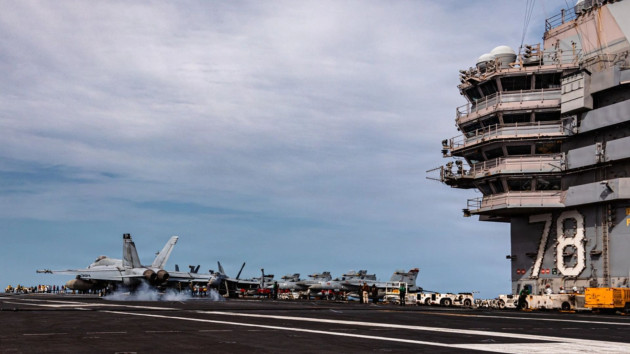
USS Gerald R. Ford Arrives in Croatia After Red Sea Fire
The carrier USS Gerald R. Ford (CVN-78) reached Split, Croatia, on Saturday following a brief three-day stay in Crete for assessments and repairs after a fire earlier this month, the US Navy said.
The fire, which originated in the ship’s laundry, injured three sailors and displaced hundreds, but did not affect propulsion or flight operations.
The visit to Souda Bay allowed service personnel to rehabilitate seven berthing compartments. Nearly 600 sailors were temporarily displaced, with 100 beds and personal items destroyed. Two injured crew members have returned to duty, while the third remains stable after medical evacuation.
The Ford’s arrival comes as the US Navy maintains a high operational tempo in the Mediterranean. The carrier remains fully capable, continuing support for US missions, including Operation Epic Fury, the ongoing US-Israel campaign against Iran.
The Navy has not indicated how long the Ford will remain in Croatia or whether it will return to the Middle East.
U.S. Sailors and Marines aboard USS Tripoli (LHA 7) arrived in the U.S. Central Command area of responsibility, March 27. The America-class amphibious assault ship serves as the flagship for the Tripoli Amphibious Ready Group / 31st Marine Expeditionary Unit composed of about… pic.twitter.com/JFWiPBbkd2
— U.S. Central Command (@CENTCOM) March 28, 2026
Meanwhile, the amphibious assault ship USS Tripoli (LHA-7) entered the Middle East Friday with the 31st Marine Expeditionary Unit, about 3,500 sailors and Marines, and aircraft from its complement. The Tripoli Amphibious Ready Group also includes USS New Orleans (LPD-18), while USS San Diego (LPD-22) remains in Japan.
The Ford Carrier Strike Group includes Carrier Air Wing 8 and the destroyers USS Winston S. Churchill (DDG-81), USS Bainbridge (DDG-96), and USS Mahan (DDG-72). Nearly 4,500 personnel are assigned to the group.
The George H.W. Bush strike group is preparing to relieve the Ford, though the carrier remains in Norfolk, Virginia, as some of its destroyers begin pre-deployment operations.
Investigations into the fire are ongoing, with military and federal law enforcement assessing cause and impacts.
The USS Gerald R. Ford aircraft carrier arrived at a port on a Greek island after leaving Middle East operations against Iran due to a laundry-area fire, but the vessel faces broader underlying problems, according to a report on Tuesday https://t.co/r3EMkMD9jg pic.twitter.com/mgeUwAn1wU
— Anadolu English (@anadoluagency) March 25, 2026
The Ford’s port call provides relief for the crew and ensures continued readiness amid ongoing regional tensions.
Editor’s Note: Details in this story reflect the latest information at publication and may change as events evolve.








COMMENTS