

When the Komnenoi Dynasty saved the empire from complete collapse after the disaster of Manzikert, the Angeloi Dynasty that succeeded them lost most of the Balkans, Anatolia, and even Constantinople. On every excellent emperor, there were always the bad and the weak that stalled the progress of the empire.
Reliance on Untrustworthy Mercenaries
After the disaster at Manzikert, numerous civil wars, and a brutal expected invasion culminating in the loss of the Balkan army at Dyrrachium, the Roman army was essentially depleted. Due to these factors, Alexios Komnenos primarily relied on mercenaries and non-Romans to stabilize the borders.
For example, the emperor called Pope Urban to send several thousand well-disciplined knights to serve under the empire to take back land from the Sultanate of Rûm, which would later be known as the First Crusade. Instead, Alexios saw a massive army of undisciplined and unprofessional knights, many led by Bohemond the Norman, who was responsible for the depleted Balkan army at Dyrrachium.
After taking oaths to Alexios, the Crusaders later reneged on their loyalty to the emperor by carving out their crusader states along the Levant after promising to give conquered territory back to the Romans during the First Crusade. As the Roman army was depleted, Alexios would also incorporate captured Turks and Hellenize them into the Roman army. One such case was Tatikios, a Turkic-born Roman general who later became the guide for the Crusaders as he knew the geography of Asia Minor well.
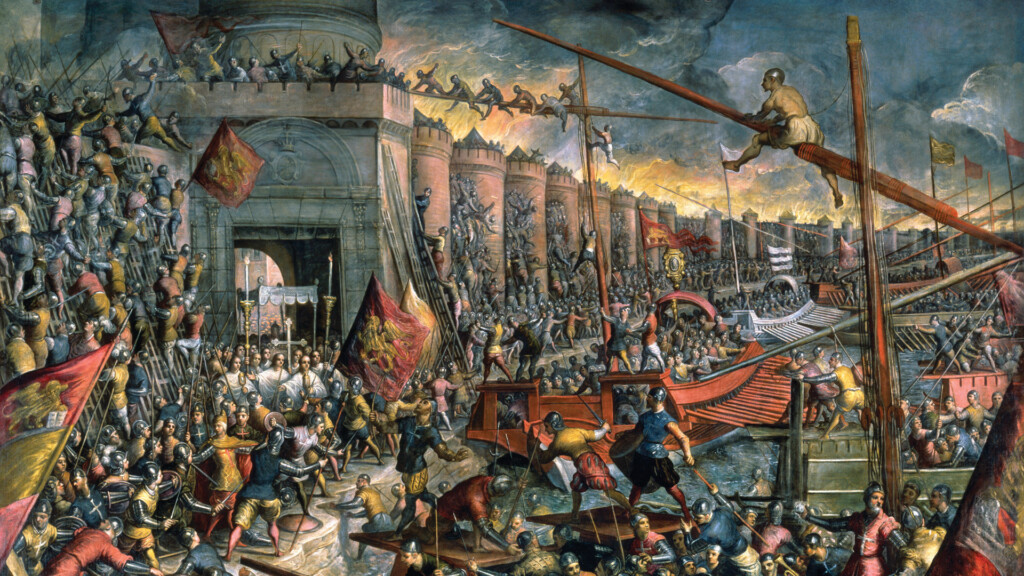
During the reign of the highly inept Angeloi Dynasty, Alexios IV Angelos, the crown Prince in exile, hired crusader mercenaries and promised them 100,000 silver marks in return for military service to have his father released and reassert him into the throne. After the Crusades helped Alexios IV, the latter soon found out he did not have enough money to pay off his crusader mercenaries, and repossessing wealth from citizens of Constantinople made him highly unpopular with the people. The situation combusted and became one of the most significant turning points in history, known as the Sack of Constantinople and the Fourth Crusade.
Unchecked Threats
During the Latin Occupation, the Crusaders carved out several states in Athens, Thessaly, and Smyrna, while the Venetians took Thessaloniki, Cyprus, Crete, and other isles. The Roman Empire was essentially an empire in exile with three rival claimants: the Empire of Nicaea, the Empire of Trebizond, and the Despotate of Epirus. Due to the Fourth Crusade and partition, the threat of the Turkic tribes, Bulgarian Empire, and Serbs was left unchecked.
After the Seljuk Turks collapsed following the Mongol invasions, many Beyliks would form while Roman states in exile, like the Nicaean empire and Trebizond, would be busy fighting each other. The most prominent and well-known splinter Turkic beylik that succeeded the Seljuks was the House of Osman (Ottomans), which would eventually conquer the empire. By the time the Palaiologoi Dynasty recovered Constantinople, the damage from the Latin Occupation was done, and neither the Romans nor the Western world knew their actual threat until it hit them in the late 14th century.
The Black Death
The Eastern Roman Empire was utterly devastated by the Justinian Plague from 541-549AD. The plague hampered progress during the reconquest of the Italian Peninsula and the lower half of Hispania, modern-day Spain. The empire would later fully recover from it but would not make a comeback after the Black Death.
When the Golden Horde besieged the Kievan Rus and sacked several great cities in the 14th century, they noticed their soldiers had succumbed to a horrible and contagious plague. The Mongols catapulted some of their dead into the Crimean forts, which infected the Rus and Genoese. Some of the Genoese merchant traders unknowingly brought the plague to the Roman capital of Constantinople, which was the center of trade in the medieval world.
The ‘queen of cities’ became the epicenter of the pandemic known as the Black Death, the same type of pathogen that devastated the town in the Justinian Plague. The deadly virus destroyed 1/3rd of the population of Europe.
The Romans were the most affected by the plague. Urban centers were decimated around the Balkans, and their population would never recover. At most, the Romans could only field an army of about 8-10,000. They would have to rely on Serbian and Italian city-state mercenaries for their final conflicts with the Ottomans and unnecessary civil wars.
Civil Wars
Arguably, the most damaging to the Roman Empire was its civil wars. Though constantly at war with various enemies who wanted to destroy them, the Romans always bounced back against setbacks from those enemies; civil wars were the ultimate setbacks of the empire.
In perspective, the Eastern Roman Empire had more civil wars (over 230) than the United Roman Empire (East and West) 220. One civil war was the most damaging of the empire: the civil war of 1341-1347. The aristocracy and John Kantekouzenos used Ottoman mercenaries towards the late empire as they attempted to carve out the remaining territories for themselves. The Roman aristocracy invited Turkic mercenaries and gave them thousands of Roman civilians as enslaved people and part of mainland Greece.
The Turks would take advantage of the cataclysm to expand their influence. The emergence of battle-hardened Turkic tribes led to the rapid expansion of the Ottomans, who took advantage of the late civil wars to force the Romans into becoming vassals. The Ottomans rapidly expanded in the Balkans from these civil wars, taking much of modern-day Serbia, Bulgaria, Greece, Albania, and Montenegro within 50 years after the civil war of 1341.
Lack of Support in the Last Days
The Eastern Roman Empire was not just an empire that helped develop modern human civilization; it also served as the ultimate line of defense from enemies in the Eastern world who wished to push West. Before the final siege of Constantinople by Mehmed the Conqueror, the city had withstood over 30 blockades, with only two being successful (the other being the Latin sack).
The final siege was different as the Romans were only an empire with few allies besides a small contingent of Genoese and Georgians, geographically separated from helping them. Though the Latin world claimed they would help defend the kingdom as the Romans defended the West for thousands of years, this would never come to fruition. The Venetians sent their relief fleet one day late after the city fell to the Ottomans.
Other major players, such as France and England, were constantly at war with each other and didn’t want to send significant contingents while those two superpowers arose. It is quite possible the West was shaken to send support after decisively being beaten by the Turks at the Battle of Varna in Bulgaria in 1444, in which the Western knights refused to follow a single unified command. In contrast, the Turks and their Islamified Janissaries had unwavering loyalty to the Sultan.
Thus, out of all the factors, civil wars and usurpations arguably were the biggest downfall of the empire, along with the Fourth Crusade, which was the nail in the coffin of the persistent Roman Empire.








COMMENTS