

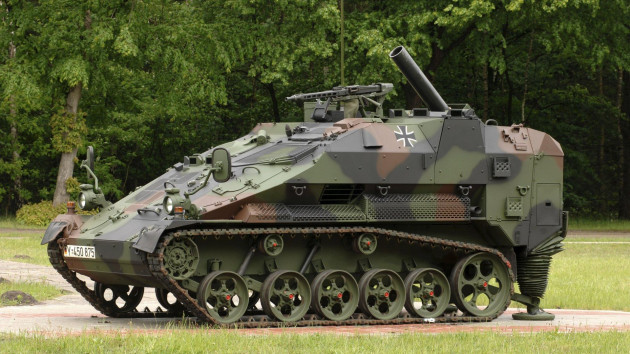
The Wiesel 2 turns isolated or lightly defended units into self-contained teams capable of providing their own indirect fire support.
Armament and Firepower
The Wiesel 2 LePzMrs mounts a Rheinmetall 120mm muzzle-loading mortar with a maximum range of approximately 8 kilometers (5 miles). The system can fire high-explosive, smoke, illumination, and infrared-guided rounds, giving commanders a range of tactical options.
Integrated electric systems handle ammunition and fire control, reducing crew workload and improving precision. These features, combined with mobility, allow units to deliver rapid, accurate fire and then relocate before the enemy can respond.
The system enhances the combat effectiveness of light, air-deployable forces by providing organic indirect fire that can be used in both offensive and defensive operations.
Role on the Modern Battlefield
The Wiesel 2 occupies a niche in modern conflict where speed, precision, and adaptability are increasingly critical.
Modern battlefields are shaped by drones, precision-guided weapons, and networked sensors. Large, stationary artillery systems can provide significant firepower but are vulnerable to these threats. Lightweight, mobile platforms like the Wiesel 2 offer an alternative that balances firepower with survivability.
For airborne and infantry units, the Wiesel 2 delivers immediate indirect fire without waiting for heavier artillery or air support. Its rapid repositioning allows commanders to engage multiple targets, respond to shifting threats, and maintain pressure on enemy forces. Its small size and mobility make it difficult to detect or target, enhancing its operational utility.
In multinational operations, Wiesel 2 units integrate with NATO rapid reaction forces, providing flexible mortar fire wherever troops are deployed. Airlift compatibility allows rapid insertion into urban areas, rugged terrain, or other difficult environments.
In these scenarios, the Wiesel 2 ensures that light forces can operate independently while still maintaining effective fire support.
Relevance in 2026 and Beyond
The Wiesel 2 remains relevant today, although it is not a replacement for heavy artillery or main battle tanks. Its effectiveness depends on careful tactical use, intelligence support, and coordination with other forces.
The vehicle excels in hybrid and asymmetric warfare, where quick strikes, mobility, and dispersed operations are decisive.
The Wiesel 2 illustrates a broader trend in modern militaries toward distributed lethality. Instead of concentrating firepower in large, obvious platforms, militaries disperse it across smaller, mobile units capable of rapid repositioning. Light, agile, and precise, the Wiesel 2 embodies this philosophy.
The Wiesel 2 in Context
Germany’s Wiesel 2 lightweight armored mortar demonstrates that indirect fire support does not need to rely on size alone.
Its compact dimensions, rapid mobility, and integrated fire control provide airborne and infantry units with capabilities once reserved for larger systems. While it cannot withstand prolonged engagements against heavy armor, its mobility, protection, and speed make it a valuable tool for rapid-reaction forces.
As battlefields become faster and more connected, platforms like the Wiesel 2 show that small, adaptable, and precise systems remain critical.
For units that must move quickly, deliver fire, and reposition before the enemy responds, the Wiesel 2 ensures that mobility and firepower remain a credible combination.








COMMENTS