The article highlights a historical photograph of a Rhodesian Air Force Aérospatiale Alouette III gunship during the Bush War, illustrating its pivotal role in combat operations. The Alouette III, known for its speed and versatility, became essential for the Rhodesian military's Fire Force tactics in the 1970s.
Key points from this article:
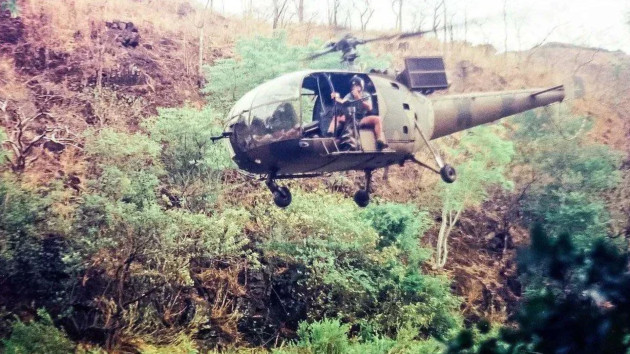
The photograph features a Rhodesian Air Force Aérospatiale Alouette III gunship during a Fire Force operation in the Bush War, circa 1970s.
How the Alouette III's design allowed it to operate effectively in the harsh conditions of Rhodesia, making it a crucial asset for the military amidst sanctions and insurgency.
Why the legacy of the Alouette III endures, as it remains in limited service in several countries, demonstrating the lasting impact of simple, reliable machinery in military operations.
Updating summary...
SOFREP Pic of the Day: Rhodesian Air Force Aérospatiale Alouette III Gunship During a Fire Force Operation in the Bush War
Guy D. McCardle
Speed
1x
Listen
COMMENTS
A light helicopter over hostile bush. No spectacle, no margin for error. Just rotors, troops, and a war fought close and fast.
A Rhodesian Air Force Aérospatiale Alouette III gunship during a Fire Force operation in the bush war, circa 1970s. Image credit: Reddit.
Today’s SOFREP Pic of the Day features a Rhodesian Air Force Aérospatiale Alouette III gunship during a Fire Force operation in the Bush War, circa 1970s.
Advertisement
Rotors Over the Mopane
At first glance, the photograph looks simple. A light helicopter hangs low over the bush, rotors biting hot air, dust, and leaves pushed flat beneath it. No jets. No spectacle. Just a machine hovering with purpose in a war that rarely offered clean lines or clear endings. This is a Rhodesian Air Force Aérospatiale Alouette III, caught mid-Fire Force operation sometime in the 1970s.
This was how the Bush War was fought. Fast, close, and personal.
An Air Force Built for a Narrow Fight
The Rhodesian Air Force was never large, never lavish, and never confused about its mission. By the mid-1960s, Rhodesia was isolated by sanctions and fighting a growing insurgency across vast rural terrain. Airpower became the equalizer. Fixed-wing aircraft struck camps and supply routes, but helicopters made contact decisive.
Advertisement
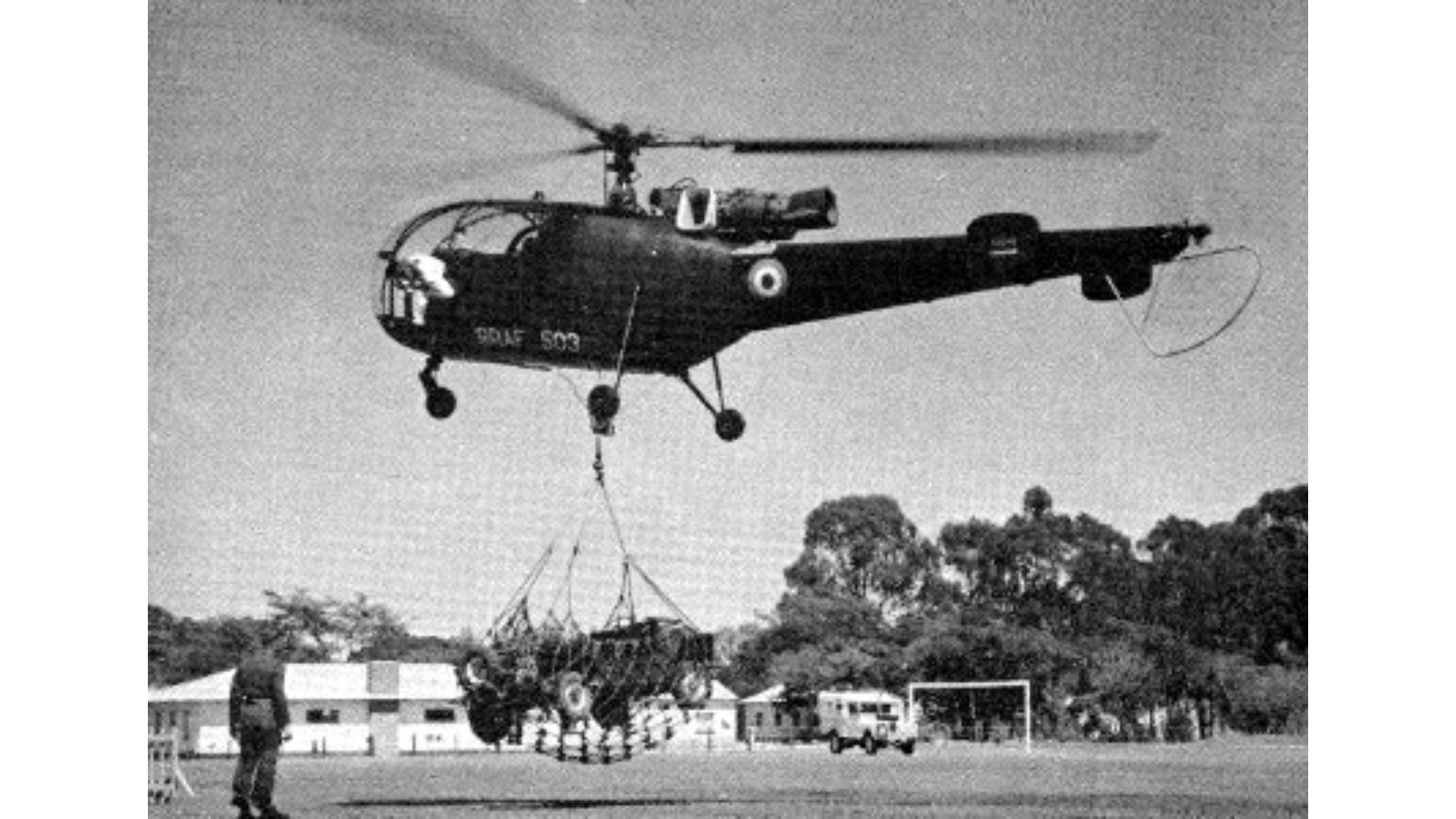
Rhodesia acquired its first Alouette IIIs in 1962, before the Unilateral Declaration of Independence and before the war reached full intensity. No. 7 Squadron became operational that March at New Sarum. By the mid-1970s, the fleet peaked at 34 aircraft. They were chosen for practical reasons. The Alouette III could operate at altitude, withstand heat, lift useful loads, and remain in the air with limited resources. It also matched what South African and Portuguese forces already used, which mattered when spare parts were hard to come by.
A Rhodesian SE 3160 Alouette III helicopter hovers with an underslung load, August 1962. Image Credit: Wikimedia Commons
By 1967, the Alouette III had shifted from utility work to combat aviation. It became the backbone of Fire Force.
Advertisement
Fire Force From the Air
Fire Force was speed weaponized. Once insurgents were located, helicopters and light strike aircraft converged with brutal efficiency. The Alouette III sat at the center of that system.
Two configurations defined its role. The G-Car carried troops. Armed with twin .303 Browning machine guns early on, later upgraded to 7.62mm FN MAGs, it delivered four soldiers plus crew directly into contact. The K-Car was the hammer. It mounted a 20mm MG 151/20 cannon firing from the port side, turning the helicopter into a hovering gun platform that pinned targets in place while troops were inserted.
The aircraft was light, loud, and exposed. It was also resilient. Alouettes returned with bullet holes, damaged tail rotors, and scars from RPG fragments. Eight were lost to combat by war’s end. Many more survived punishment that would have grounded heavier machines.
Advertisement
In 1979, one K-Car even downed a Botswana Islander aircraft during a cross-border incident, a reminder of how blurred the edges of the war had become.
This was not stand-off warfare. The Alouette III lived close to the ground and closer to the fight.
The Alouette III did not begin life as a gunship. It began as a solution to altitude.
Developed by Sud Aviation in the late 1950s, the SE 3160 prototype first flew on February 28, 1959. Within months, it was landing on Mont Blanc. By 1960, it had reached over 6,000 meters in the Himalayas. These were not publicity stunts. They were proof of concept.
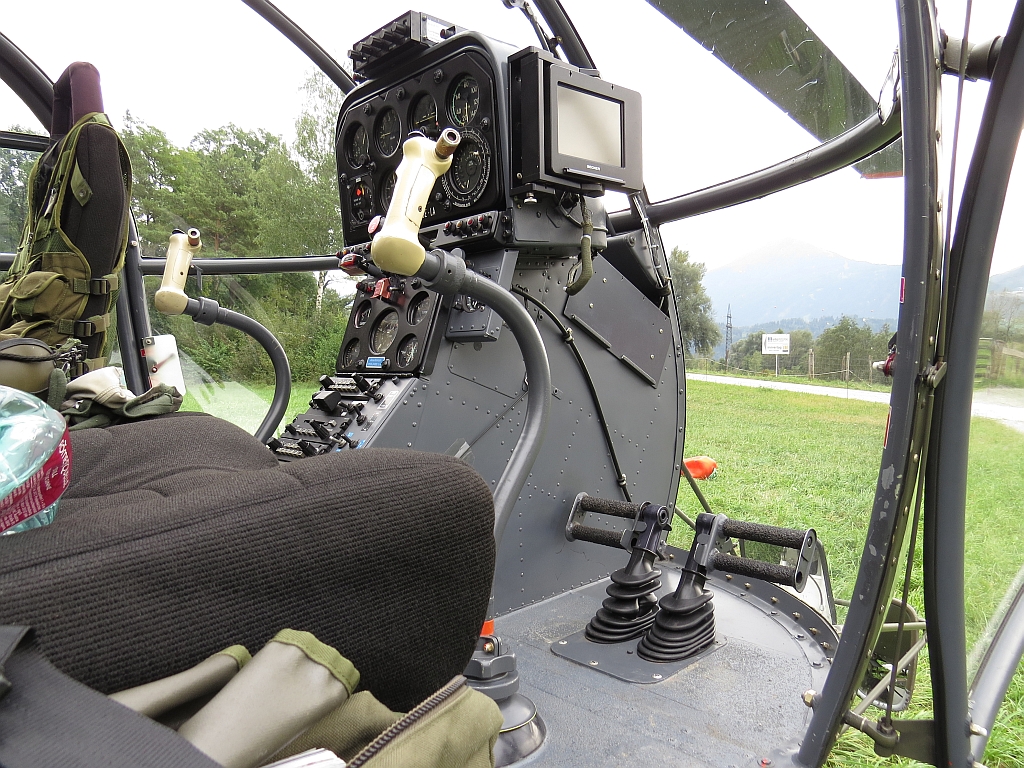
Powered initially by the Turboméca Artouste IIIB turbine, later by the more efficient Astazou, the Alouette III was light, forgiving, and mechanically straightforward. It seated up to seven, offered excellent visibility, and used a simple rotor system that maintenance crews learned quickly. Production began in 1961 and ran in France until 1985, with more than 2,000 built worldwide.
Cockpit and flight controls of an Aérospatiale SA-319 Alouette III helicopter. Image Credit: Wikimedia Commons
Engineers did not chase elegance. They chased reliability. The result was a helicopter that did many jobs well enough, in places where better machines often struggled.
Many Roles, Few Illusions
Militaries across Europe, Africa, and Asia adopted the Alouette III for transport, liaison, rescue, and training. Some armed it with rockets, missiles, or cannons. India built it under license as the HAL Chetak. South Africa pushed the design further into attack roles with experimental gunships. Others kept it strictly utilitarian.
Civilian operators used it for mountain rescue, medevac, sling loads, and agricultural work. Its ability to hover in thin air made it indispensable in places where roads stopped, and terrain took over.
By the 2010s, most operators had moved on. New helicopters were faster, safer, and better integrated into modern airspace. Production had ended decades earlier. Support chains thinned.
And yet, the Alouette III never fully disappeared.
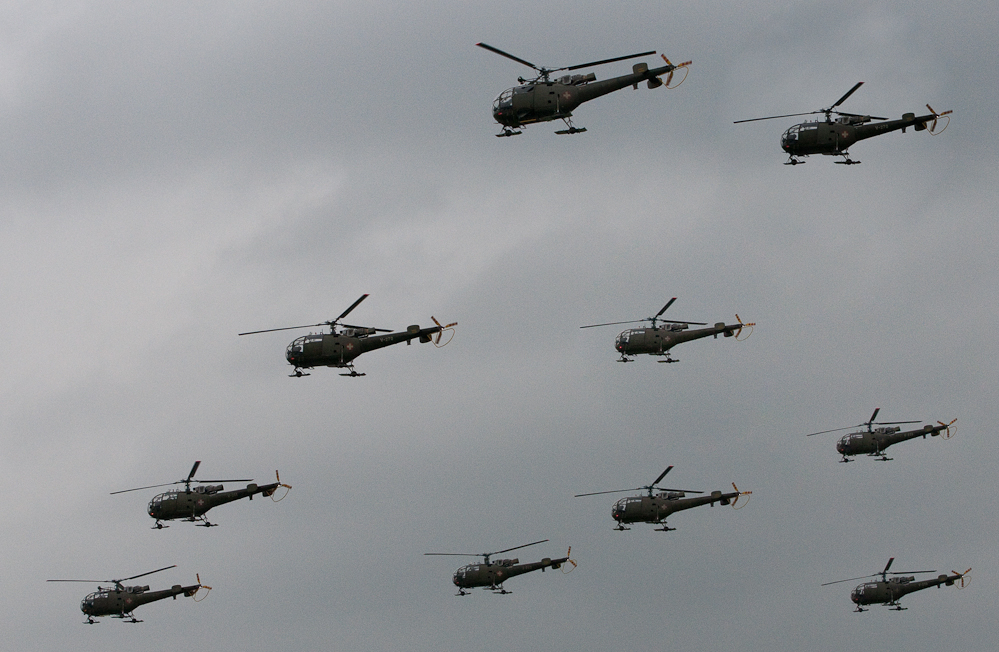
Formation flight of 10 Alouette III helicopters, circa 2010. Image Credit: Wikimedia Commons
Still Turning in 2026
In 2026, the Alouette III remains in limited service. Air arms in Angola, Bolivia, Burundi, Chad, the Democratic Republic of the Congo, and Eswatini still operate small fleets. Civilian operators in remote regions continue to fly them for specialized tasks. The airframes are old. The missions are narrow. But the logic remains the same.
Simple machines endure.
What the Photo Captures
This photograph is not about nostalgia. It is about a moment when a light helicopter, a handful of soldiers, and a patch of bush became the center of a war fought far from cameras and capitals.
The Rhodesian Air Force no longer exists. Rhodesia itself ended in 1980, replaced by Zimbabwe. The Alouette III has mostly moved on as well. But in this image, rotors still turn, dust still rises, and a gunship still does exactly what it was built to do.
Arrive fast. Stay low. Get the job done.
Advertisement
What readers are saying
Generating a quick summary of the conversation...
This summary is AI-generated. AI can make mistakes and this summary is not a replacement for reading the comments.










COMMENTS