

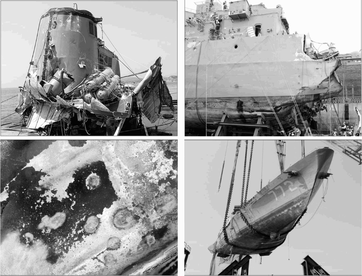
Furthermore, a report by the Center for Strategic & International Studies (CSIS) published in 2010 discussed that the investigation into the sinking found that the blast impact originated from outside the vessel, nor was it not caused by a floating mine leftover from the Korean War. Thus, the attack must have been calculated and deliberate. Most officials involved in the investigation and the majority of the South Korean public believe it was a planned assault from North Korea, the Washington-based think tank said. After all, the tension between the two Koreas has yet to settle on a peace treaty and is technically still at war, despite an armistice signed in 1953 that seized the military confrontation.
Honoring the Fallen 46
The sinking of the ROKS Cheonan (PCC-772) became the South’s most significant military setback since the end of the Korean War and has since served as a reminder of the ongoing threat the North continues to pose.
#OTD 2010, an explosion caused the ROKS Cheonan to break apart and sink in the Yellow Sea, killing 46 crew members. An investigation by an international commission concluded that the ship was sunk by a torpedo from a North Korean submarine. North Korea denied being responsible. pic.twitter.com/sJ5Ru04Gzp
— U.S. Naval Institute (@NavalInstitute) March 26, 2023
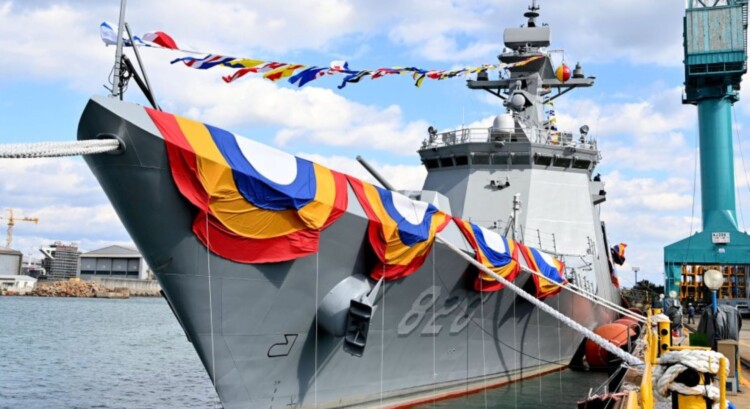
The new Cheonan is the seventh of the eight Daegu-class guided missile frigates under its Future Frigate Experiment (FFGX) program, co-manufactured by Daewoo Shipbuilding & Marine Engineering and Hyundai Heavy Industries to replace the aging Incheon class. It shares a similar hull design with its predecessor. However, the ship class’ superstructure has been overhauled to cater to the advanced modification of its weapon system. It features anti-ship and ship-to-ground missiles, anti-submarine torpedoes, and hull-mounted and towed array sonar systems. As for its gun system, it consists of a 127mm Mk. 45 Mod 4 naval gun and Raytheon’s Phalanx Block 1B Close-In Weapon System for self-defense.
The overhaul also included the enlargement of its hangar and helicopter deck, now capable of supporting up to a 10-ton aircraft, making it more capable and powerful than the Incheon-class frigates.
The class’s lead ship, ROKS Daegu (FFG-818), was initially commissioned in March 2017, while the most recent, Cheonan (FFG-826), was launched to sea in November 2021.
The 2800t Daegu-class frigate FFG-826 Cheonan launched today.
The name of the Cheonan ship inherits the name of the Pohang-class PCC-772 Cheonan ship, which sank on March 26, 2010 with ROKS Cheonan sinking. pic.twitter.com/Uundk4psAH— Hyunmin (@HyunminPppp) November 9, 2021
It measures about 400 feet (122 meters) in length and 45.9 ft (14 m) in width, with a displacement of about 2,800 tons when fully loaded. In addition, it is the first ROK ship to outfit a combined diesel-electric or gas propulsion system featuring a Rolls Royce MT30 turbine engine that generates a maximum speed of 30 knots (35 miles/hour) and a range of 4,500 nautical miles (5,200 miles).
With its arrival in the service, the Cheonan frigate will fill in a multi-role, expected to perform various missions, including anti-submarine warfare, anti-surface warfare, and maritime patrol. It is a valuable asset for the ROK Navy and its allies, particularly with the escalating tension that has been going on in the Korean Peninsula and its neighboring region in recent years.
—
You might want to add The Coldest Winter: America and the Korean War by David Halberstam to your reading list today and dive deep into the pivotal moment that forever changed America’s perspective on involving in international conflicts.









COMMENTS