

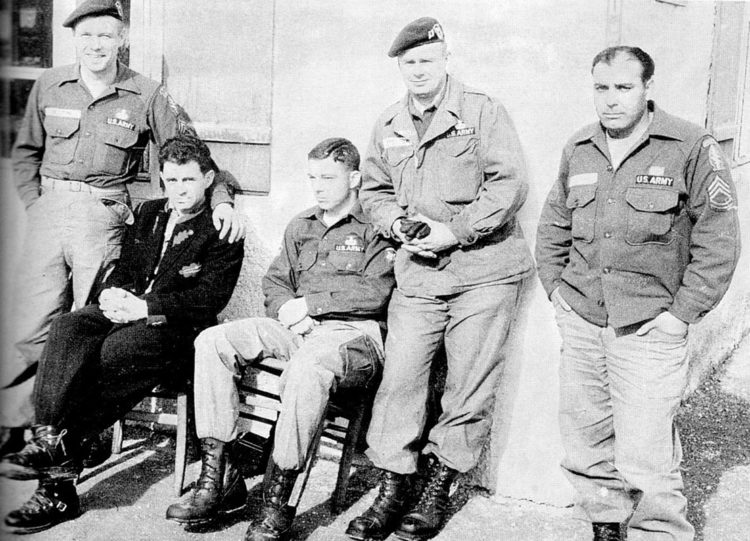
In 1941, Thorne volunteered to fight for the Germans in the Waffen-SS against the Soviets. He fought for a year, before returning to the Finnish military to continue his fight against the Soviet communist forces. His unit, experts at guerrilla warfare, became known as Detachment Törni. They were so successful, the Soviets put a bounty of three million Finnish Marks on his head. He was awarded the Finnish equivalent of the Medal of Honor (Knight of the Mannerheim Cross).
He was briefly imprisoned for service in the Nazi army, escaped, and boarded a ship for Venezuela that was diverted to the U.S. Thorne lived in NYC, working as a carpenter but enlisted in the U.S. Army under the Lodge Act using the name Larry Thorne.
He was an alpine instructor and by 1960 was commissioned as a lieutenant in the 10th Special Forces Group (Airborne), 10th SFG(A) at Bad Tölz, Germany. Thorne and an SF A-Team conducted a body recovery and secured secret documents in 1962 when a U.S. Air Force C-130 crashed in the Zagros Mountains, a 14,000-foot mountain range that rests between the Iran-Soviet border.
Vietnam would be his next… and last war. Thorne, by then a captain commanding A-734 of the 7th Special Forces Group, was among the very first MACV SOG troops in Southeast Asia. While conducting a reconnaissance mission into Laos on October 18, 1965, Thorne’s helicopter crashed due to bad weather. His remains weren’t found until 1999. States. After being identified he was buried in Arlington National Cemetery on June 26, 2003.
Another SF legendary operator was Henryk Szarek, known as “Frenchy.” He was a Polish native who served in five armies, all fighting communism.
“I hated the Russians then… Nazi brutality was mild compared to what I had seen from the Russians.” Szarek said according to retired SF officer Bob Seals, who had researched his history.
Szarek served in the Polish army, was pressed into the German Army (as a barber), then served with the British Army’s II Corps (Polish), the French Foreign Legion (twice), as a paratrooper fighting in Algeria, and made combat jumps in Vietnam in 1950. He later learned of the Lodge Act and joined the American Army. He volunteered for airborne duty and after American jump school, he joined the 504th Parachute Infantry Regiment of the 82nd Airborne Division. As he said, “My French airborne wings got me a lot of pushups.”
He too joined Special Forces and helped the 10th SFG (A) set up E&E (escape and evasion) nets, something that would be needed if war with the Soviets ever broke out. Szarek died in 2011 and was buried in Massachusetts Veterans Memorial Cemetery.
A good part of “Detachment A” in Berlin was initially composed of Lodge Act soldiers. A very detailed and excellent look at Det-A can be read here. While technically not part of the Lodge Act, Ludwig Faistenhammer’s story was typical of naturalized Americans who rose to prominence in Special Forces. Born in Germany, Faistenhammer was so popular as an SF officer with the local Germans that he was nearly elected mayor of Bad Tölz, and in the end, was only stopped by the intervention of the U.S. 7th Army.
Faistenhammer rose to be a lieutenant-colonel during the Vietnam war. Jim Morris’s outstanding book War Story has a long passage dedicated to him.
Despite the Lodge Act’s short duration, the impact of the Europeans who earned their Green Berets and American citizenship is a prime example of how the U.S. can prepare for global conflicts in the future. There is a lack of knowledge about other cultures and languages in certain parts of the world, especially due to SF units being pressed into duty in the Middle East away from their assigned area of operations.
In Europe, by dusting off an old but effective concept, teams could be created similar to the OSS Jedburgh teams. For these, NATO could draw personnel from different countries to comprise mission-specific Special Operations teams from within the command.
But in regions such as Africa, it would be much more effective to recruit, train, and employ native speakers to join Special Forces and create for them a path to American citizenship. These operators would know the language, culture, and immediately be able to build the rapport necessary for mission success.
The military tried and failed once already in resurrecting the Lodge Act with the Military Accessions Vital to the National Interest program (MAVNI), whereby select immigrants with certain critical skills are recruited into the U.S. military. That program, which began in 2008, was frozen in 2016. The same or a similar program for Special Forces needs to be looked at as a possible way to prepare for the next threat.
SOFREP would like to thank Stu Bradin (SF colonel retired) and retired SF CSM Rick Lamb for much of the background information on some of the Lodge Act SF troops. Although CSM Lamb acknowledges the MAVNI program’s shortcomings he believes that something like it needs to be instituted.
“There was a recent program called MAVNI that didn’t make it… I don’t know why. I assume it was deemed too hard and didn’t produce enough recruits. If they ran it like the initial recruitment of Indig Forces going into Syria, it was a clown show! Sadly, the failure of MAVNI will be an easy excuse to do nothing,” he said in an email to SOFREP.
“I would argue that we need something like this again for Asia… and beyond. I think we’d get a lot of our partners, frustrated with [a] lack of training, promotion, and resources within their nations’ services to join… It’s also a credible way to earn citizenship,” he added.








COMMENTS