

The staff of the 101st then read the typewritten German demand for surrender.
“December 22nd, 1944
To the U.S.A. Commander of the encircled town of Bastogne.
The fortune of war is changing. This time the U.S.A. forces in and near Bastogne have been encircled by strong German armored units. More German armored units have crossed the river Ourthe near Ortheuville, have taken Marche and reached St. Hubert by passing through Hompre-Sibret-Tillet. Libramont is in German hands.
There is only one possibility to save the encircled U.S.A troops from total annihilation: that is the honorable surrender of the encircled town. In order to think it over a term of two hours will be granted beginning with the presentation of this note.
If this proposal should be rejected one German Artillery Corps and six heavy A. A. Battalions are ready to annihilate the U.S.A. troops in and near Bastogne. The order for firing will be given immediately after this two-hour term.
All the serious civilian losses caused by this artillery fire would not correspond with the well-known American humanity.
The German Commander.”
McAuliffe left the command post to personally congratulate a group of soldiers who had destroyed a German roadblock. When he returned he received a phone call that the two German officers were still waiting for an answer.
“Well, I don’t know what to tell them.” At that point, LTC Harry Kinnard, the Division’s Operations Officer said, “What you said initially would be hard to beat.” McAulliffe asked “What do you mean?” Kinnard, said, “Sir, you said nuts.” All members of the staff agreed, so McAulliffe wrote it down on a message pad and said, “Have it typed up.”
“December 22, 1944
To the German Commander,
N U T S!
The American Commander”
McAuliffe’s written reply was delivered back down to the Command Post where the German officers were being held, still blindfolded. Asking if it was written or verbal, the German officer was told that the message was written. He was told that it consisted of a single word, “Nuts!” the German officer was confused. “Is that reply negative or affirmative?” The Americans said, “The reply is decidedly not affirmative.”
The Germans were taken back to the front lines were, confused, they again asked what the reply meant, not understanding the American slang. An American enlisted man who spoke German said, “Du kannst zum Teufel gehen.” He told the American officer it meant “You can go to Hell.” Then the officer said to the Germans, “If you continue to attack, we will kill every goddamn German that tries to break into this city.”
Henke replied, “We will kill many Americans. This is war.” The American officer Major Harper then said, “On your way Bud,” and without thinking, added, “and good luck to you.” After Henke translated, the major acknowledged. They saluted and the Germans started to walk away. Harper angrily called out to them, “If you don’t know what I am talking about, simply go back to your commanding officer and tell him to just plain “Go to Hell.”
The Germans didn’t take Bastogne. Soon afterward the skies cleared and American fighter-bombers began to pound the German panzers in the Bulge, while C-47s began airdropping supplies and ammunition to the men of the 101st. On the afternoon of December 26th, the lead tanks of the 37th Tank Battalion, 4th Armored Division of the Third Army under General Patton had broken through the German encirclement and created a tenuous lifeline where the most seriously wounded paratroopers could be evacuated. The American lines were restored and the 101st was no longer encircled. Getting back the terrain lost took another month.
The German attack had failed at a tremendous cost. The German reserve armor had been smashed and there were no more to replace them. With the Russians pushing from the east and the Western Allies squeezing them from the Belgian/German border, the Nazis were finished. It was just a matter of time. Germany capitulated on May 7, 1945.
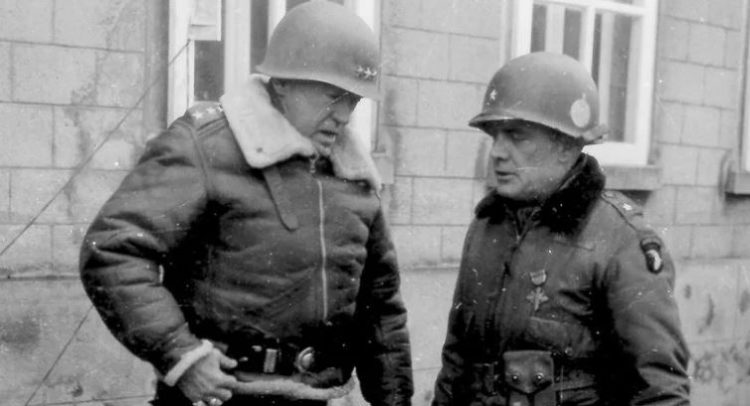
When the Third Army linked up with the 101st, General Patton personally decorated McAuliffe with the Distinguished Service Cross on January 14th, 1945. The next day, McAuliffe was promoted to Major General and given command of the 103rd Infantry Division. He would lead the division against the Germans for the remainder of the war and later liberate the Kaufering concentration camp, part of the Dachau complex. The 103rd would take Innsbruck in Austria and secure the Brenner Pass where elements of the Fifth Army, moving up from Italy, linked up and joined the Italian and Western fronts.
After the war McAuliffe returned to Europe as the commander of the 7th Army in 1953 and in 1955. After being promoted to full General (4 stars), he was named Commander-in-Chief of the United States Army Europe. He retired in 1956.
McAuliffe died of leukemia on August 11, 1975, aged 77. He is buried in Arlington National Cemetery alongside his wife, son, and daughter.








COMMENTS