A landmine near the Preah Vihear Temple has ended Trump’s peace deal and reminds Thailand why vigilance is its oldest habit.
I came to Thailand in 2012 after leaving a security contract in Kuwait. The work had become mechanical: long shifts, concrete walls, a life measured in rotations. When I finally quit, I came here with no plan beyond quiet. Thailand gave me that. Over time, it became more than a pause between jobs; it became proof that order and endurance could still exist in this part of the world. From Phuket, I’ve watched this country move through crisis after crisis with a composure the West seems to have forgotten.
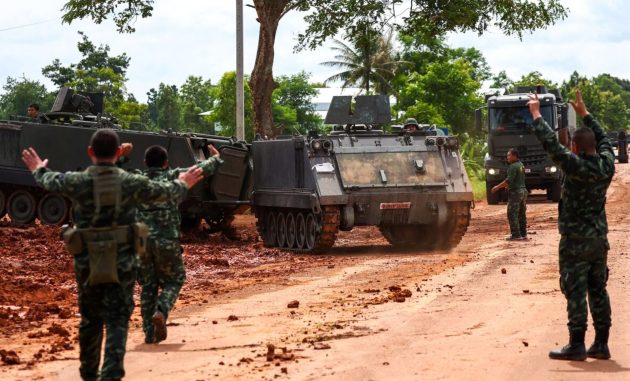
That steadiness was tested again on November 10, when a landmine detonated near the Preah Vihear Temple, an eleventh-century Khmer sanctuary perched on the cliffs that divide Thailand and Cambodia. Sgt. Maj. 1st Class Therdsak Samaphong lost part of his right foot; three others were wounded. The blast ended a fragile ceasefire brokered by Donald Trump earlier this year and reopened a frontier that has never truly healed.
The Thai military says the mine was newly planted on their side of the line in Si Sa Ket Province. Cambodia claims it was a leftover from old wars. Both cannot be true, and along the border, few believe the latter.
The boundary itself was drawn by foreign hands. In the late nineteenth century, France forced Siam to surrender territory to avoid colonization. Those concessions still weigh on Thailand’s memory. When the International Court of Justice awarded the Preah Vihear Temple to Cambodia in 1962, Thailand complied but never forgot. Every flare-up since has felt like unfinished history demanding attention.
This latest mine was the seventh since fighting resumed in July. Therdsak took the worst of it. In Bangkok, Prime Minister Anutin Charnvirakul’s government faces quiet pressure from an army that still considers itself the backbone of national defense. The generals described the suspension of the truce not as escalation but as correction: a way to remind their neighbor that peace is built on boundaries, not goodwill.
Across the border, corruption has hardened into routine. In Banteay Meanchey and Poipet, Chinese cash moves through banks, police units, and provincial offices without friction. Entire neighborhoods are built around scam compounds where trafficked workers live under guard, forced to run online fraud operations that feed the accounts of officials and businessmen. It isn’t hidden, and it isn’t new. It’s the operating system of modern Cambodia.
Already have an account? Sign In
Two ways to continue to read this article.
Subscribe
$1.99
every 4 weeks
- Unlimited access to all articles
- Support independent journalism
- Ad-free reading experience
Subscribe Now
Recurring Monthly. Cancel Anytime.
Hun Manet, the West Point–educated son of Hun Sen, presides over this system while Beijing keeps it solvent. Chinese money finances the highways, bridges, and the Ream Naval Base, where Chinese vessels now make port calls. The debt load binds Phnom Penh more tightly to Beijing each year. From Ream to Poipet, power runs downhill in a straight line of obligation and profit.
Thailand’s loyalties remain anchored elsewhere. It is a U.S. treaty ally under the 1954 Manila Pact and a Major Non-NATO Ally since 2003. Every year the Cobra Gold exercise brings Thai and American forces together in one of the world’s largest joint drills. Thai pilots fly Western aircraft; their doctrine and logistics trace back to the same manuals used in Virginia and Hawaii. China may dominate trade, but Thailand’s defense posture still points west.
The landmine fits the broader pattern. Thai police and special units have spent the past year dismantling Chinese-linked networks operating along the frontier. Raids in Poipet freed hundreds of trafficked workers; a telecom shutdown in February crippled scam zones that had funneled millions through Cambodian shell companies. Western intelligence supported the operations quietly. Phnom Penh lost face, and the people who profit from chaos took note. When the November blast hit, most in the Thai ranks read it as retaliation.
Trump’s ceasefire lasted four months: an initial truce in July, reinforced at the October ASEAN summit in Kuala Lumpur. Washington now calls for restraint, but everyone here knows the pattern. Thailand stands on this fault line between Washington and Beijing, keeping its balance through patience and strength. The wounded soldier was more than a casualty; he was a reminder that in this region, peace is never given—it is maintained by those willing to hold the line.
The frontier tonight is tense but quiet. Patrols move slowly through the jungle. The temple rises above it, silent and indifferent. From Phuket, it feels distant until you remember how close history always is here, never gone, only sleeping.
If the fighting flares again, I’ll go north. Borders like this have their own gravity. Thailand knows how to live beside that pull: steady, disciplined, and unafraid to defend what’s its own.










COMMENTS