

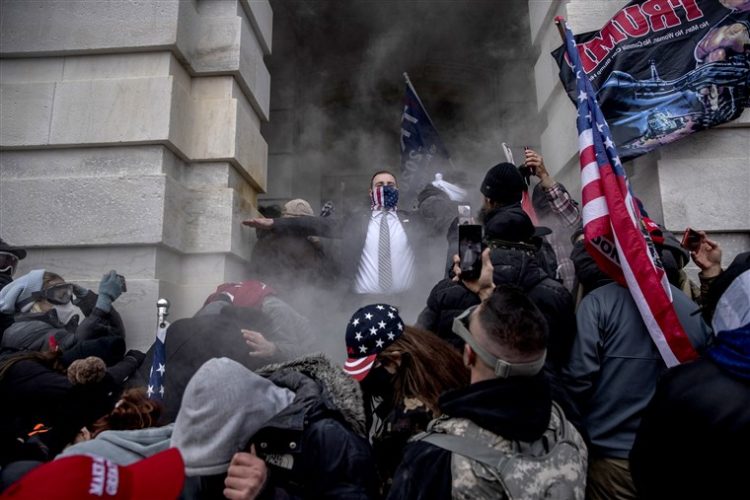
Extremist language incites extremist people. They then tend to act upon their extremism while everyone in the middle on both sides looks on in shocked horror. That isn’t the way it’s supposed to be. A great part of our success as a country has been due to the political middle of the country rejecting the extremism of both the Right and the Left and working in the center of things, moderately, calmly, and deliberatively. And we should return to that, to a rejection of not only extremism but the language that goes with it. Here, we do have the terrible lesson of an unheeded warning in our own history to draw from.
Lincoln in the Face of Civil War
In 1860, Abraham Lincoln was elected president of an already badly divided country. He had only won 40 percent of the popular vote because two Democratic candidates ran on a split ticket. On his Inauguration Day, as he prepared to give his first speech as president, seven Southern states had already announced their secession from the Union; more were expected to join them soon. The arriving crowds were met with patrolling cavalry, infantry guarding intersections, and sharpshooters on rooftops.
Washington was still awash with Confederate agents and sympathizers bitter over the defeat of the Democratic Party. It was feared they would make trouble.
Lincoln’s speech given in plain contemporary English was not that of a firebrand denouncing the Southerners as evil slavers. Quite the opposite. Lincoln said he had no constitutional authority to end slavery in any state. The states themselves had made slavery legal in the administration of their own internal affairs before the United States was a country. The states would have to decide to abolish it themselves.
Lincoln also pled even as he warned that the secession of the Southern states could not stand. The right of states to manage their internal affairs did not extend to a right to break from the Union and endanger all the other states in doing so. The Union existed in perpetuity by implication. The Constitution does not provide for the dissolution of itself but seeks a more perfect union between the states by being adopted, enforced, and protected. Secession was not the perfection of the Union under the law, but the destruction of it.
Lincoln argued that a desire to seceded was steeped in an impulse towards tyranny and anarchy. No country can expect or hope for unanimity in everything or presume to survive in the pursuit of it. The states do not have a shared identity of purpose in all things; their interests and that of their people diverge from state to state. It was anarchy, Lincoln argued, for any state or states to simply quit the Union because they could not get their way in everything, every time. The Constitution makes provisions for the People to modify, add, or subtract from the powers of the federal government, but no state had any right to abolish the national government altogether on its own. That was the limit on the rights of the states.
Lincoln reminded the audience that while none of them had sworn an oath before God to destroy the Union of the United States, he had certainly taken an oath to protect it and he would keep it. Lincoln in this speech rejected the extremism of both the Left and the Right in 1860. He would not overreach the powers of his office and end slavery, nor would he accept the secession of southern states that feared he might do so.
As he closed his speech, Lincoln tried to remind all Americans that the decision to fight a civil war was theirs, not his:
“In your hands, my dissatisfied fellow-countrymen, and not in mine, is the momentous issue of civil war. The Government will not assail you. You can have no conflict without being yourselves the aggressors. I am loath to close. We are not enemies, but friends. We must not be enemies. Though passion may have strained it must not break our bonds of affection. The mystic chords of memory, stretching from every battlefield and patriot grave to every living heart and hearthstone all over this broad land, will yet swell the chorus of the Union, when again touched, as surely they will be, by the better angels of our nature.”
Tragically, America did not listen to Abraham Lincoln that day and a great civil war did occur. One that took some 600,000 lives and laid waste to the lower half of the country. And after it was finally over, and the country set about rebuilding and reconciling, Lincoln himself was murdered in a final spasm of extremism.
It is not up to our elected leaders to decide how we treat each other; that is up to us as individuals. A choice very clearly exists between political extremism and moderation, between civil war and union. Let’s hope we listen to the “better angels of our nature” this time.








COMMENTS