

“The United States is baiting China and Russia….we have allowed China to increase their military strength and Russia to recover from Sovietization, to give them a false sense of bravado, this will create an altogether faster demise for them.”
- Henry Kissinger, Former US Secretary of State
The PLA Navy, while numerically superior to the US Navy, lacks deep-water operational experience. Chinese submarines remain noisy, comparable to those of the 1980s Soviet boats. This makes them vulnerable to detection and engagement by air, surface, and subsurface forces. The conventionally powered Fujian carrier cannot match the global reach of nuclear-powered American carriers. Questions persist about weapons integration and whether Chinese systems can withstand sustained combat.
The air force faces similar gaps. The J-20 lacks internal air-to-ground bomb capacity. Chinese pilots remain constrained by micromanagement from ground controllers, unlike autonomous American pilots. Most critically, China’s strategic airlift and sealift capabilities remain insufficient for sustained overseas operations. The PLA essentially remains a regional military power unable to project force globally.
Communist Control: The Fundamental Constraint
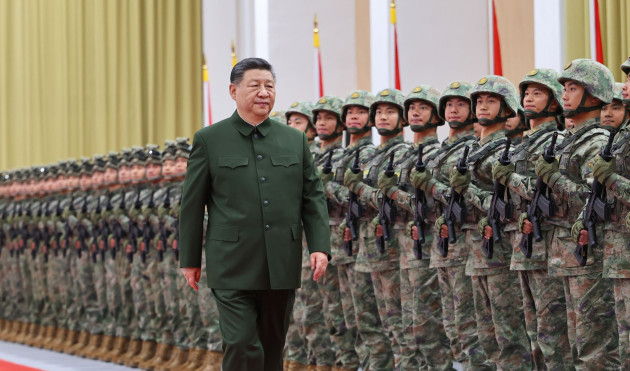
These tactical limitations stem from a deeper structural problem. The PLA exists primarily to maintain Communist Party control rather than to fight foreign wars. As Timothy Heath argued in a recent analysis, coup-proofing measures promoted loyalty rather than merit, fragmented command structures, and highly centralized control – come “at the cost of reduced potential combat effectiveness.”
Xi’s reforms since 2016 have tightened political control rather than enhancing warfighting capability. He reversed the delegation of authority that existed under his predecessor Hu Jintao, centralizing all major decisions in his own hands. The restructuring strengthened auditing, discipline inspection, and legal mechanisms that report directly to Xi. These reforms prioritize ensuring the military’s subordination to the Party above all else.
This fundamental tension between political control and military effectiveness cannot be resolved within the Chinese communist system. The ghost of Tiananmen Square—when the Party nearly lost control in 1989—haunts every decision about military organization. The leadership remembers how militaries throughout history have overthrown governments when they accumulated too much independent power. Xi can modernize equipment and reshape organization charts, but he cannot grant the decentralized decision-making authority and merit-based leadership that characterize effective modern militaries without risking the Party’s control.
The Taiwan Timeline Dilemma
These limitations create a dangerous paradox for Xi. US intelligence reportedly assessed that he ordered the PLA to be ready to invade Taiwan by 2027. Yet the military purges suggest his generals don’t believe they’re ready—or worse, that some actively oppose his Taiwan timeline. As one analyst suggested, Xi’s urgency to speed invasion planning may be colliding with a military that senior officers know isn’t prepared.
“China is already a foreign hostile force as defined in our Anti-Infiltration Act”
- Taiwan President Lai Ching-te, March 2025
The current purge leaves the PLA in disarray at precisely the moment Xi supposedly wants it combat-ready. Theater commands operate under inexperienced leadership. Junior officers lack seasoned mentors. The institutional knowledge base has been decimated. As Lyle Morris noted, “There is no way they could pull off the Taiwan contingency with no senior leaders in charge.”
Perhaps that is exactly the point. Perhaps the purge revealed that elements of the PLA leadership recognized their unreadiness and pushed back against Xi’s aggressive timeline. In a system where the Party controls everything, such pushback could be interpreted as disloyalty and warrant removal. Or perhaps Xi discovered genuine plotting and acted preemptively.
Conclusion: The Hollow Dragon
China’s military modernization, while impressive in hardware, masks profound institutional weaknesses. An untested military led by politically selected officers, constrained by communist controls, lacking combat experience, and struggling with joint operations remains fundamentally unprepared for high-intensity conflict with a peer adversary.
Xi’s purges may ensure his political survival and the Party’s control, but they also degrade the military capability he needs to achieve his strategic objectives. The PLA may be the world’s largest military, but size means little when systemic limitations prevent effective employment. The communist party overshadows and influences every decision about military organization—the leadership cannot grant the decentralized authority and merit-based leadership that characterize effective militaries without risking Party control.
As Xi consolidates absolute control over a hollow military, the gap between his ambitions and his forces’ actual capabilities may prove to be the most dangerous dynamic in the Indo-Pacific. The dragon’s roar may be loud, but whether it can bite remains dangerously uncertain.
—
Alex Vohr is a retired Marine Corps Colonel and combat veteran. He served as a commanding officer, Director of the USMC School of Advanced Warfighting, and as the J4 for US Southern Command. He is the author of Speed Kills and is currently the President of One LNG, a Texas-based energy company.








COMMENTS