

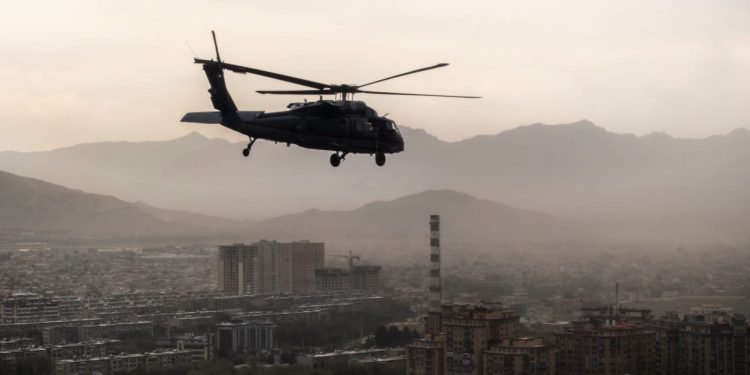
Second, special operations forces are better equipped and suited for precision, time-sensitive operations in semi-permissive or non-permissive environments. From recruitment to selection to training, special operators are conditioned to operate in ambiguous and fluid environments.
Although the U.S. military and State Department were working with the Taliban to evacuate people, uncertainty about the intentions of the Taliban or factions within it added to the complexity, as did intelligence suggesting that ISIS-K, a local affiliate of the terrorist group, would try to take advantage of the confusion to launch attacks. A bombing by ISIS-K outside the Kabul airport killed 13 U.S. servicemembers and hundreds of Afghans.
Preparation for unconventional warfare is emphasized from the recruiter’s office to the retirement ceremony, a former Green Beret told Insider. “We thrive in the unstructured situations the folks on the ground in Kabul faced.”
Finally, special operations units have worked with their Afghan counterparts for years and were in a good position to use these relationships to facilitate evacuations.
For years, U.S. special operators trained, advised, and fought alongside their Afghan counterparts, often with devastating effectiveness. Afghan special operations forces were probably the units most hated by the Taliban.
“It’s also about human relationships. We fought alongside these guys for decades. Many bled besides us. Others saved our lives and facilitated our mission on a daily basis. These relationships don’t fade away just like that,” the former Green Beret said. “When the whole shitshow started unfolding, vets who had maintained contact with their Afghans were in a very good position to try and exfiltrate them and their families.”
Instrumental in the Evacuations
U.S. and coalition special-operations forces’ ability to leave Hamid Karzai International Airport, find U.S. citizens, third-country nationals, and Afghans, and escort them to safety was instrumental in saving thousands.
“U.S. special operations forces reached out to help bring in more than 1,064 American citizens and 2,017 SIVs, or Afghans at risk, and 127 third-country nationals, all via phone calls, vectors, and escorting,” Gen. Kenneth McKenzie, who is responsible for military operations in the region as head of U.S. Central Command, said on August 30.
But U.S. and Coalition special operations units were not alone in their efforts outside the wire.
Members of the Taliban “were actually very helpful and useful to us as we closed down operations,” McKenzie added.
Afghan special operators from the National Directorate of Security, Afghanistan’s now-defunct intelligence service, also assisted evacuation efforts from within Kabul.
Trained by the U.S. intelligence community, these Afghan units were able to operate behind enemy lines far easier than U.S. or coalition troops.
The Afghan special operators’ language skills, physical appearance, and familiarity with the area enabled them to operate seamlessly in Taliban country and facilitate or conduct the extraction of large numbers of people.
A Coalition of Special Operators
International special operations units were also pivotal in the evacuation.
Most countries that participated in the war against al-Qaeda and the Taliban sent military forces to evacuate their embassies and the Afghans who had cooperated with or worked for them.
The U.K., Canada, France, Spain, Australia, Germany, Italy, Belgium, Denmark, the Netherlands, and Slovakia were some of the countries that deployed troops for the evacuations.
All of those contingents included special operators who were responsible for providing security or going outside the wire to rescue or transport people. They also worked with U.S. commandos.
This article was written by Stavros Atlamazoglou and originally published on the Insider.








COMMENTS