

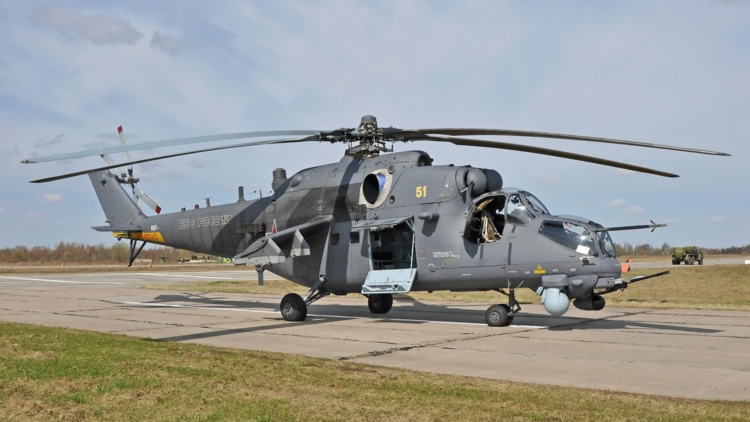
Role and Technical Specifications
Primarily serving as an attack helicopter, the Mi-35M is also capable of performing troop transport, medevac, and reconnaissance missions.
It boasts a crew of two – a pilot and a weapons officer – and can transport up to eight troops or provide casualty evacuation.
Powered by two VK-2500 turboshaft engines, the Mi-35M has a maximum speed of about 310 kilometers (193 miles) per hour and a range of approximately 450 kilometers (280 miles).
Its operational ceiling is around 5,700 meters (18,700 feet), making it effective in high-altitude environments where the air is as thin as Twiggy after a seven-day fast.
🇧🇾🚁 Mil Mi-35M Attack Helicopter
📹"CTV"
/Dec. 2023/ pic.twitter.com/ImbzPdlsDJ— Massimo Frantarelli (@MrFrantarelli) December 12, 2023
The helicopter’s robust airframe and advanced avionics enable it to operate in diverse weather conditions, day or night.
The Mi-35M’s armament is a highlight, equipped with a 23mm twin-barrel cannon, anti-tank guided missiles, unguided rockets, and a variety of bombs.
This arsenal allows it to engage a range of ground targets, from armored vehicles to fortifications.
Furthermore, its electronic warfare system and countermeasures enhance its survivability in hostile environments.
Operational Use and Performance
The Mi-35M has seen extensive use in various conflict zones around the globe.
Its versatility and firepower make it a valuable asset in counter-insurgency operations, close air support missions, and anti-armor engagements.
The helicopter’s ability to operate in challenging terrains like deserts and mountains has been particularly beneficial in regions like the Middle East and Central Asia.
Footage of Army Aviation (Ka-52, Mi-35M, Mi-35) working AFU targets in Krasny Liman direction. pic.twitter.com/HH1oNXd9W3
— Blackrussian (@Blackrussiantv) December 16, 2023
Operators of the Mi-35M, including countries like Brazil, Venezuela, and Nigeria, have praised its performance in combat and humanitarian operations.
Its reliability and ease of maintenance are often highlighted as essential factors for military aircraft in sustained operations.
Equivalent in the Western Arsenal
The Mi-35M’s closest equivalent in the Western arsenal is arguably the AH-64 Apache, produced by Boeing in the United States.
Like the Mi-35M, the Apache is a multi-role combat helicopter designed primarily for an attack role.
Both helicopters possess advanced targeting systems and powerful armaments and can operate in varied environments.
However, there are distinct differences.
The Apache is more focused on precision attacks and is equipped with sophisticated targeting systems like the Longbow radar.
In contrast, the Mi-35M offers more versatility with its troop transport capability—a dual role, which can be a significant advantage in scenarios requiring multiple capabilities from a single platform.
The Apache also tends to be more expensive and technologically advanced, reflecting the different military doctrines and budget priorities of Russia and the United States.
Mi-35M vs Emerging Technologies
The advent of technology and its rapid, ever-evolving nature means the evolution of military aviation is also accelerating.
The growing prominence of unmanned aerial vehicles (UAVs) on the battlefield poses both challenges and opportunities for traditional helicopters like the Mi-35M.
As we’re all familiar with by now, UAVs offer several advantages, including reduced risk to human pilots, lower operational costs, and enhanced capabilities for surveillance and precision strikes.
In response, military strategists are exploring ways to integrate traditional helicopters with UAVs.
For instance, the Mi-35M could operate in conjunction with UAVs for enhanced situational awareness, target acquisition, and coordinated strikes.
This integration would combine the Mi-35M’s robust firepower and versatility with the UAVs’ advanced reconnaissance and precision capabilities.
The future battlefield is expected to be more networked and complex, with urban warfare and electronic warfare becoming more prevalent, pushing Mi-35M and other traditional helicopters to adapt to remain effective.
The Mi-35M helicopter stands as a significant advancement in military aviation, embodying the evolution of the combat helicopter.
Its blend of firepower, versatility, and robustness makes it a formidable asset on the modern battlefield. Respect your enemy and live to fight another day, that’s what I say.
As geopolitical landscapes and warfare tactics continue to evolve, the Mi-35M will undoubtedly adapt, maintaining its status as a vital tool in the arsenals of its operators.
Its comparison with Western counterparts like the AH-64 Apache highlights the diverse approaches to military aviation technology, each tailored to meet specific strategic needs and doctrines.
—
You might also want to check out:










COMMENTS