

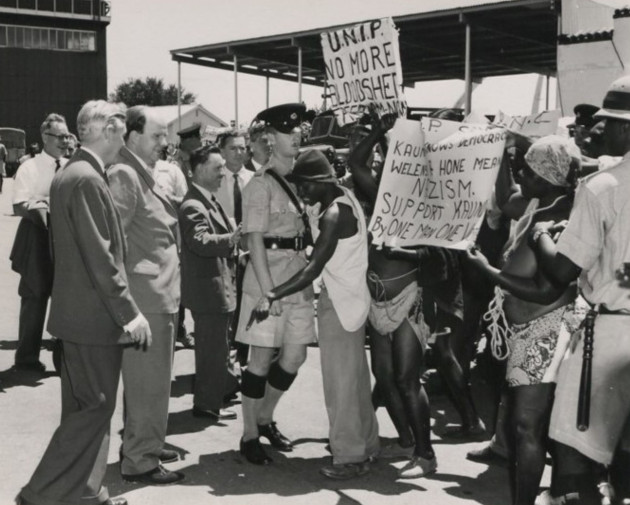
One has to appreciate that Southern Rhodesia had not implemented South African style apartheidism. This was a fragile multi-ethnic state that was grappling with how best to adjust under the tides of cultural development, racial integration, and emerging political consciousness amongst African tribesmen.
Policing efforts to break up black African labor unions and community organizers, often led by South African Police (SAP) Special Branch operating in Southern Rhodesia, were common. However, as African Nationalism picked up speed both in Southern Rhodesia and across the continent, the whites of Rhodesia began to grapple with the potential for a different kind of future. By 1960, a majority of white Rhodesians believed a transition to full enfranchisement of black Africans and majoritarian rule was inevitable. The question increasingly being asked was: how best to secure the transition?
Unilateral Declaration of Independence in 1965
British Prime Minister Harold Macmillan gave his famous “Wind of Change” speech in 1960, championing decolonization. His government was firm that majority rule had to be established in all former colonies in accordance with norms promoted by the UN. He wrote Britain’s guiding policy, which would be inherited by Harold Wilson, rejecting demands from Southern Rhodesia’s white leadership for independence on their terms. Macmillan warned explicitly that any Unilateral Declaration of Independence (UDI) would be illegal and unrecognized.
Macmillan was also formative in his willingness to confront settler governments directly, and his government oversaw the 1963 dissolution of the Central African Federation (Southern Rhodesia, Zambia, and Nyasaland) in the face of fierce white settler opposition. Majoritarianism secured, the new republics of Zambia and Nyasaland (now Malawi) held elections once, and then quickly devolved. Tribal ethnic majorities translated to electoral majorities, and once in power, brutal autocrats entrenched themselves.
Under Hastings Kamuzu Banda, Malawi became one of the most repressive and tightly controlled states in Africa. In 1966, he formally declared a single party state under the Malawi Congress Party (MCP). By 1971, he was declared “President for Life”. His regime was marked by a pervasive “culture of fear,” enforced by the Malawi Young Pioneers, a paramilitary wing that monitored and harassed the public. He instituted strict dress codes and extreme censorship, even banning television until the 1990s. Critics were regularly jailed, exiled, or assassinated.
Under Kenneth Kaunda, Zambia’s transition to authoritarianism was more gradual but culminated in a formal one-party state. Kaunda initially led a multi-party system but became increasingly intolerant of dissent after political violence during the 1968 elections. In 1972, following the “Choma Declaration,” he banned all opposition parties and introduced a new constitution in 1973 that established a single party state. Kaunda maintained a perpetual State of Emergency, which allowed him in imprison political opposition without trial, until he finally left office in 1991.
Macmillan realized he may have overreached. The loudest point of order made by white settlers in the many respective post-colonial transitions occurring throughout the Empire was that majority rule without protections for minorities, an independent judiciary, rule of law, and stable institutions, was just a transition into autocracy—even if the autocrat was fairly elected. His government reluctantly recognized a new constitution for Southern Rhodesia in 1961, acknowledging that if the legitimate fears of the white settlers were not given due consideration, then they would fight a post-colonial transition to the bitter end.
The 1961 Constitution was a step forward in that it enfranchised black Rhodesians for the first time and removed explicitly racialist language from the law. The 1961 Constitution also secured strong protections for private property and land ownership, security of tenure for civil servants, and independent courts. Everyone, whites and blacks, were guaranteed due process of law and rights for the accused. Most importantly, the new constitution recognized the need to transition to full voting enfranchisement and majority rule. It was offered to London as a custodianship for a gradual transition into full majoritarian governance.
“While many black Rhodesians had successfully transitioned into a middle-class lifestyle, most blacks still dwelled on TTLs under tribal law, with little education to participate in a modern democracy…” or so the argument went. It’s easy to dismiss such claims as mere justifications for maintaining white minority rule, but a fair glance at history reveals that the first modern experiment with democracy in France (1789) ended in catastrophe, mass executions, and a return to monarchy (Napoleon Bonepart). England herself took 700 years to transition into a real democracy.
The Rhodesian Parliament was structured with 65 seats, 50 of which were elected by A-roll voters (with property worth £500, annual income of at least £720, or roughly 2 years of secondary education). The remaining 15 seats were elected by B-roll voters (with property worth £150, annual income of at least £180, a primary education or those who could pass a basic literacy test).
While some black Rhodesians did qualify for the A-roll, basing the right to vote on property ownership, wealth, and education put blacks at a structural disadvantage. And those without a primary education or property (the vast majority of blacks living on the TTLs) were essentially unrepresented.
As those black Rhodesians leaving the TTLs gradually joined the middle-class off the TTLs, they would enjoy the same A-roll voting privileges—so the argument went. In the long run, this system would create a society of full enfranchisement while maintaining stable institutions and the benefit of rule of law. Regarding long-horizon prognostications that hypothesize efficient outcomes, the famous economist John M Keynes once said, “In the long run we are all dead.” The Constitution of 1961 was unacceptable to African Nationalists, unacceptable to the UN, and unacceptable to European liberal critics.
In 1964 Harold Wilson, reviewed the new constitution and rejected it entirely. Instead, Wilson announced Five Principles to govern the transition that had to be fulfilled before his government would recognize Rhodesia as an independent state within the British Commonwealth:
-
Unimpeded Progress to Majority Rule
-
Guarantees Against Retrogressive Legislation
-
Immediate Improvement in Political Status
-
Progress Towards Ending Racial Discrimination
-
Acceptability to the People as a Whole
While all of Wilson’s points were perfectly reasonable from a moral standpoint, they were a hardline insofar as they ignored any and all concerns communicated by the white Rhodesian settlers, and they ignored England’s own history.
The English had to learn how to participate in a democracy over a vast expanse of time. In contrast, the catastrophe of the French Revolution was a clear demonstration of what happens when people are plunged into a new political order, particularly without the cultural appreciation for the benefits of democracy. And similar demonstrations were now occurring all over post-colonial Africa.
White Rhodesians had countless examples of authoritarian, racialist, and socialist states that had emerged from post-colonial transitions.
—
**Editor’s Note: This is the second of a multi-part series penned by former Green Beret Curtis Fox. You can read the first part here.








COMMENTS