

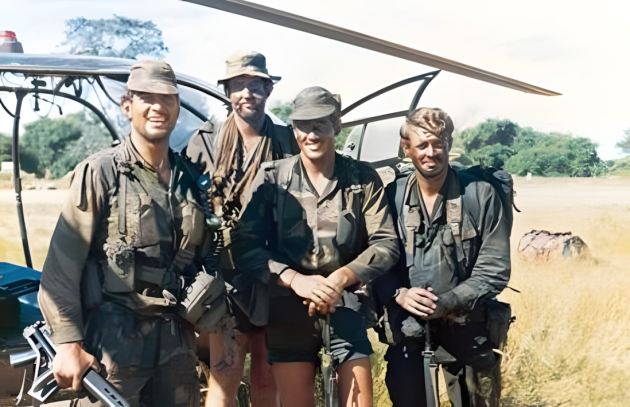
A Small Air Force Built for War in the Bush
Rhodesia also constructed an air force out of what resources it could acquire despite international sanctions.
The Rhodesian Air Force operated Hawker Hunter fighter-bombers and older De Havilland Vampire jets for strike missions. Reconnaissance in the bush was carried out by piston-engine Cessna 337 aircraft known locally as the “Lynx.”
The most important aircraft in the Rhodesian arsenal, however, was the Aérospatiale Alouette III helicopter. The helicopter became the backbone of Rhodesian counter-insurgency operations, serving as troop transport, gunship, medical evacuation platform, and command-and-control node.
Later in the war, Rhodesia also obtained a small number of Bell 205 helicopters, the export variant of the American UH-1 Huey. A Douglas Dakota transport aircraft supported airborne operations by RLI paratroopers.
Despite its small size, the Rhodesian Air Force was built around a single operational concept that would come to define the war.
That concept was known as Fireforce.
Fireforce
Fireforce was an integrated counter-insurgency tactic designed to locate guerrilla units quickly and destroy them before they could disperse into the countryside.
The system relied heavily on intelligence and tracking.
Selous Scouts and Special Air Service reconnaissance teams moved through the bush searching for guerrilla infiltration routes and encampments. Once an insurgent group was identified, aircraft and helicopter-borne infantry were dispatched to strike immediately.
Fireforce operations typically followed a three-step sequence.
First, reconnaissance units fixed the enemy’s location.
Second, aircraft struck the target to disrupt and disorient the guerrilla force.
Third, helicopter-borne infantry and paratroopers from the Rhodesian Light Infantry were deployed to encircle and eliminate the insurgents before they could escape.
The emphasis was always on speed and surprise.
Rhodesian commanders pushed decision-making authority down to very low levels. Small units, often referred to as “sticks,” were given wide latitude to maneuver independently once they made contact with the enemy. Corporals and sergeants frequently exercised tactical autonomy that would normally be reserved for higher-ranking officers in more conventional armies.
This decentralized structure allowed the Rhodesian Security Forces to respond rapidly to guerrilla infiltration.
It also contributed to the impressive tactical success that Rhodesian units achieved throughout much of the war.
The Guerrilla Movements
Opposing the Rhodesian state were several African nationalist movements that organized armed wings and received external support.
The two most important groups were the Zimbabwe African National Union (ZANU) and the Zimbabwe African People’s Union (ZAPU).
ZANU’s military wing, the Zimbabwe African National Liberation Army (ZANLA), operated primarily from bases in neighboring Mozambique. ZANLA was heavily influenced by Maoist doctrine and received ideological training and military assistance from China.
Its strategy emphasized political indoctrination in rural villages and the mobilization of peasant support rather than large-scale conventional combat.
ZAPU’s military wing, the Zimbabwe People’s Revolutionary Army (ZIPRA), was supported by the Soviet Union and operated primarily from Zambia. ZIPRA adopted a more conventional military structure and attempted to build organized formations capable of confronting Rhodesian forces directly.
Together these groups formed a loose political alliance known as the Patriotic Front.
Both movements benefited from external sponsorship, foreign training, and the ability to operate from neighboring states beyond Rhodesia’s borders.
Tactical Success, Strategic Limits
Despite severe sanctions and a small population, Rhodesia developed one of the most tactically effective counter-insurgency forces of the Cold War.
Elite units such as the SAS, Selous Scouts, and Rhodesian Light Infantry demonstrated an extraordinary ability to track guerrilla fighters, penetrate insurgent networks, and launch rapid Fireforce raids against enemy camps.
Small units operated with remarkable independence and flexibility, often maneuvering through remote bush terrain to locate insurgent groups before directing air strikes and helicopter assaults.
These tactics inflicted heavy losses on guerrilla formations and disrupted many infiltration attempts.
Yet tactical brilliance could not overcome Rhodesia’s broader strategic constraints.
The guerrilla movements continued to expand, supported by China, the Soviet Union, and sympathetic governments across southern Africa. Zambia and Mozambique provided safe havens for insurgent training camps beyond the reach of most Rhodesian operations.
While the Rhodesian Security Forces were capable of winning individual battles, the insurgent movements possessed greater manpower reserves and deeper external support.
As the war intensified during the 1970s, the conflict increasingly became a political and diplomatic struggle as much as a military one.
And it was in that arena, far from the Rhodesian bush, that the final outcome of the war would ultimately be decided.
In 1976, that struggle would bring a powerful new figure into the conflict.
Henry Kissinger.
—
**Editor’s Note: This is the third of a multi-part series penned by former Green Beret Curtis Fox. You can read the second part here.








COMMENTS