Fuentes sells antisemitism and Kremlin-friendly authoritarian nostalgia the way the internet sells everything else, as meme-flavored entertainment stripped of consequence, and Europe cannot afford to treat that kind of cultural poison as harmless content.
Read the full article for more on:
Important insights and detailed analysis
Expert commentary on current events
Breaking developments and updates
Updating summary...
The Rise of Nick Fuentes: Why His Extremism Matters Far Beyond America
Benjamin Reed
Speed
1x
Listen
COMMENTS
Fuentes sells antisemitism and Kremlin-friendly authoritarian nostalgia the way the internet sells everything else, as meme-flavored entertainment stripped of consequence, and Europe cannot afford to treat that kind of cultural poison as harmless content.
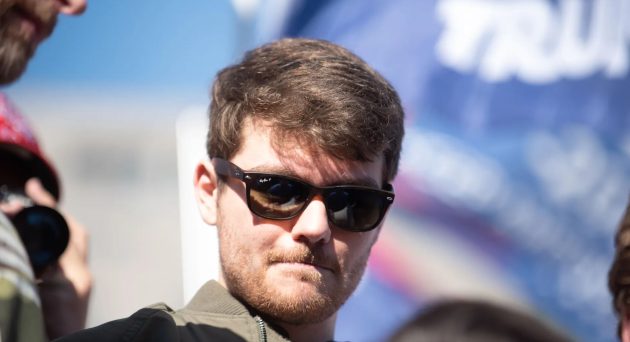
Nick Fuentes preparing to speak to a group of his followers in Washington, D.C. Image credit: Zach D. Roberts/NurPhoto via Getty
The U.S. Influencer Exporting Antisemitism and Pro-Kremlin Narratives to Europe
Nick Fuentes is gaining influence; Tucker Carlson’s decision to platform him has helped. Fuentes has become one of the most effective communicators of extremist ideas in the United States, packaging them in meme-driven humor and adolescent irony. Those ideas no longer stay in America. They travel through Western social media, carried by clipped soundbites and the kind of digital mimicry that spreads faster than context. His open antisemitism, admiration for authoritarianism, and unapologetically pro-Russia worldview make him a figure worth monitoring—and condemning—wherever his message appears. Silencing him is neither moral nor effective. The responsible approach is to expose where he is wrong so his followers do not transform him into a martyr if he is deplatformed.
Fuentes’ worldview is not complex. He praises Adolf Hitler, minimizes or denies the Holocaust, and targets Jews as a collective enemy. There is no coded language. His admiration for autocrats stems from his belief that Western liberalism is collapsing. His commentary on the war in Ukraine reliably mirrors Kremlin narratives, framing Russia’s invasion as a justified correction to American influence. These positions are not incidental; they form the core of his identity. He is not merely a conveyor of antisemitic tropes but an open white nationalist.
This rhetoric once lived on fringe forums such as Stormfront or in the speeches of David Duke. Since Meta relaxed parts of its hate-speech enforcement in January, it has found a new home through secondary creators who clip and republish his statements as reels.
Part of Fuentes’ recent momentum comes from the Israel–Gaza war, which has left many Americans skeptical of unconditional support for Israel. That skepticism deserves serious debate. Fuentes exploits it—not to encourage honest reassessment but to redirect anger toward the same communities extremists have targeted for generations.
The Kremlin has long relied on Western fringe voices to fracture democratic unity. Fuentes gives them something more potent: a young, media-literate figure who calls democracy a sham, dismisses NATO, and insists that supporting Ukraine is a mistake. He accomplishes this not by engaging in policy arguments but by eroding the idea of shared meaning itself. When discourse becomes a fog of irony, cynicism, and fatigue, Russian aggression begins to look like just another viewpoint rather than a direct threat to European security.
This pattern should be familiar to Europeans. It echoes the strategy Moscow has used on its own population since the Soviet collapse: dissolve the possibility of shared truth, and you dissolve the possibility of shared purpose. If the Holocaust becomes a joke, if Hitler becomes misunderstood, if Ukraine’s sovereignty becomes optional, then the moral foundation of post-war Europe becomes negotiable.
Fuentes does not need to convert millions. He only needs to offer permission. Permission to doubt the reality of Russian imperial ambition. Permission to mock Jewish communities who still live with the memory of genocide. Permission to treat liberal democracy as a failed experiment rather than the fragile inheritance it is. A generation raised on nihilism and ironic detachment is primed for this shift. Smaller creators on TikTok, Telegram, and YouTube already repurpose his themes, accelerating their spread.
For Central and Eastern Europe, this matters. Antisemitism is not abstract here; it left graves across the region. Russian imperialism is not hypothetical; it shaped borders, crushed uprisings, and erased nations. And yet Fuentes’ message has gained visibility through Tucker Carlson, who recently debated whether Britain had any obligation to defend Poland in 1939. The mediascape young conservative men navigate today is a minefield. An American internet personality rehabilitating both antisemitism and Russian apologetics—wrapped in pseudo-philosophy and meme culture—should be a warning. The West risks forgetting its own history at the worst possible time.
Fuentes does not present himself as a geopolitical thinker; he presents himself as a cultural one. That is more dangerous. Culture moves faster than politics. A bad idea attached to a charismatic personality travels farther than any policy argument.
Once antisemitism, authoritarian nostalgia, and pro-Russia apologetics become part of the entertainment economy, they stop looking like threats. They start looking like trends.
Europe knows where these trends lead. It cannot afford to relearn those lessons through an American provocateur who admires dictators.
—
** Editor’s Note: Thinking about subscribing to SOFREP? You can support Veteran Journalism & do it now for only $1 for your first year. Pull the trigger on this amazing offer HERE. – GDM










COMMENTS