

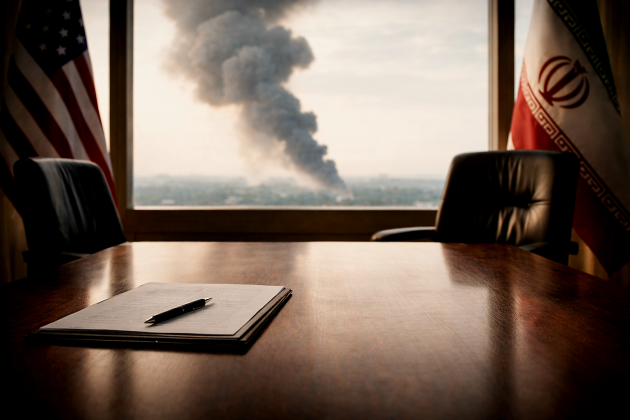
When an agreement falls apart within hours of being announced, one of two things is usually true:
The agreement was never real, or the decision to escalate had already been made.
Neither possibility strengthens long-term stability.
As of publication, reports describe a coordinated military action involving U.S. and Israeli assets striking targets in Tehran, Isfahan, and other locations. Iranian officials have claimed retaliatory missile launches toward U.S. positions in the Gulf. Some regional airspace closures have been confirmed. Casualty reports remain inconsistent and unverified.
If this does indeed represent the largest direct U.S. military action in Iran in decades, the strategic implications extend far beyond the immediate battlefield.
But the operational details, while critical, are not the point of this piece.
The timing is.
The Iranian people have endured significant economic and political strain in recent years. Major protest waves in 2019, 2022, and most recently beginning in late December 2025 were met with force. The most recent wave, driven by economic collapse and currency devaluation, spread to over 100 cities… the largest in scale since the 1979 revolution, according to multiple international reporting outlets. Casualty estimates vary widely depending on the source, but independent human rights organizations have documented thousands of deaths across multiple protest cycles.
That internal pressure matters. Because external military action during internal unrest can have one of two opposite effects:
It can fracture a regime or consolidate it.
And the picture inside Iran appears to be exactly that complicated. Reports from today show some Iranian citizens celebrating strikes on government targets. Videos circulating on social media show women cheering and students chanting against the regime. The Iranian diaspora has held massive solidarity rallies in recent months, with some openly calling for foreign military intervention.
At the same time, history suggests populations under foreign bombardment often rally around national leadership… even if they opposed it the day before.
That’s not ideology. That’s pattern recognition.
Both of those realities can exist simultaneously. And any analysis that ignores either one is incomplete.
There are also coalition concerns.
France, Germany, and the United Kingdom issued a joint statement confirming they did not participate in the strikes. France’s President Macron characterized the escalation as an “outbreak of war” and called for an emergency UN Security Council meeting. Spain publicly rejected the military action. The Omani mediator who brokered the diplomatic progress posted on X that he was “dismayed,” adding that “neither the interests of the United States nor the cause of global peace are well served by this.”
Canada and Australia voiced support. But the broader European response has been one of distance, not solidarity.
Strategic credibility compounds over time. But so does strategic isolation.
There is also an operational consideration that affects long-term coalition dynamics. The partner in this action currently faces ICC arrest warrants, issued in November 2024, for war crimes and crimes against humanity. Whether one views those warrants as legitimate or politically motivated, their existence is a legal reality in 124 nations… nations whose cooperation the United States may need in future coalitions. That’s a strategic variable.
Then there’s the diplomatic dimension.
If Iran had, in fact, signaled willingness to accept stricter nuclear terms than previous frameworks… something that would require formal verification before being treated as binding… then preemptive military escalation changes the negotiation landscape dramatically.
If those diplomatic overtures were preliminary, non-binding, or strategically performative, that’s a different consideration.
But the Omani Foreign Minister didn’t describe it as preliminary. He described it on American television, on the record, as a breakthrough “that has never been achieved any time before.”
Timing reveals intent.
I am not arguing for or against the use of force. Force can be necessary. Force can be strategically sound. Force can also be politically expedient.
Those are not all the same thing.
The question isn’t whether war is justified.
The question is whether escalation is aligned with strategic necessity, whether it preceded the full exhaustion of other leverage, or whether it is politically motivated.
In undercover work, you learn to ignore words and watch the sequence: Who moved first? Who acted before the ink dried? Who benefited from accelerating the clock?
When someone gives a thumbs-up on Friday, and bombs fall on Saturday… either the thumbs-up was theater, or the bombs were inevitable.
Neither scenario suggests stability.
And stability is what long-term security depends on. That should keep you up tonight.
Tegan Broadwater spent 13 years with the Fort Worth Police Department, including two years assigned to the FBI working deep undercover inside a violent Crip organization. That operation, detailed in his book Life in the Fishbowl, resulted in 51 convictions. He has since founded Tactical Systems Network, an armed security & protection firm primarily staffed by veterans, is a creative writer and musician, and hosts The Tegan Broadwater Podcast. All book profits benefit children of incarcerated parents. Learn more at TeganBroadwater.com








COMMENTS