

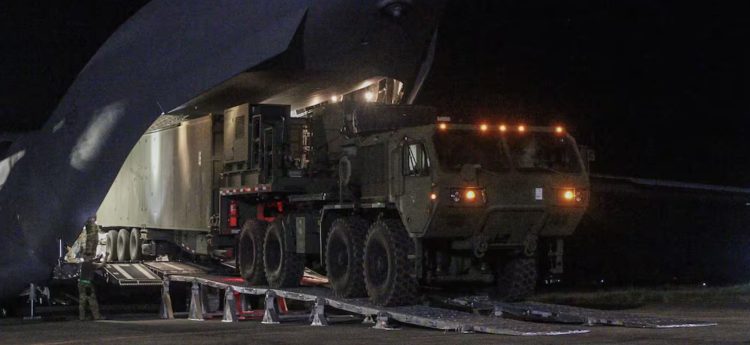
Strategically, Typhon is part of the U.S. Army’s Multi-Domain Task Force, a unit designed to operate across land, sea, and through the air. It’s tailor-made for the kind of joint warfare that’s becoming the norm in the Indo-Pacific. With Typhon on the ground, the U.S. can back up its allies with real teeth, not just promises and press releases. It’s a powerful deterrent—especially when deployed forward, like it was in the Philippines in 2024.
Bottom line: Typhon is a fast, flexible missile platform that brings serious range to the fight. It’s the kind of weapon that makes adversaries think twice before making aggressive moves, particularly in hotspots like the South China Sea or Taiwan Strait. It gives American forces the kind of reach they haven’t had on land since the Cold War—and this time, it’s aimed straight at the future.
Beijing Is Not Amused
China’s reaction to the U.S. deploying the Typhon missile system in the Philippines has been about as subtle as a bullhorn at a funeral. Beijing did more than merely grumble—they almost blew a gasket.
Chinese officials are calling Typhon a “strategic offensive weapon” and claim its presence on Philippine soil poses a direct threat to China’s national security. The Chinese Foreign Ministry even warned they “won’t sit idly by” while their interests are being threatened. In diplomatic speak, that’s the equivalent of flipping the table and daring someone to make a move.
China’s also accusing the Philippines of going back on their word. According to Beijing, Manila promised the Typhon system would be yanked out after the joint military drills were done. Now that the launchers are still tucked away at an “undisclosed location” like a coiled rattlesnake, China’s crying foul—saying the whole thing smells like a bait-and-switch. They’re linking it to the ongoing standoff in the South China Sea, implying the Philippines is using Typhon as a bargaining chip in the larger territorial dispute.
But Beijing isn’t stopping at broken promises. They’re claiming this whole situation throws gasoline on an already tense region. Chinese defense officials are accusing the Philippines of throwing open the doors to an arms race and basically outsourcing its national security to Washington. In their view, Manila is giving up its sovereignty to play sidekick in America’s Pacific power play.
And of course, the warnings have been ratcheted up with typical Beijing flair. China has made it clear: if the Philippines doesn’t “change its course,” there could be consequences—not just for bilateral ties, but for the whole region. They’ve painted the Typhon system as a destabilizing force, a spark in a powder keg.
The U.S. and the Philippines, for their part, aren’t budging. Both have defended the deployment as a purely defensive move, part of long-standing agreements and regional cooperation. And the Philippine government flat-out denies it ever made any promises to remove the Typhon system following the military exercises. If China’s looking for a retreat, they’re not going to find one in Manila. Not this time.
Marcos’s Gamble
Philippine President Ferdinand “Bongbong” Marcos Jr. walks a geopolitical tightrope. On one hand, he’s allowed the U.S. access to nine military sites under the Enhanced Defense Cooperation Agreement (EDCA), up from five a year earlier. On the other, he has to manage a delicate trade relationship with China and a population wary of becoming a battleground.
After the Typhon system moved, Marcos floated a conditional offer: the missile launchers could be removed—but only if China stops harassing Philippine vessels and militarizing the South China Sea. Beijing has not responded.
It’s a bold move, and one that signals Marcos isn’t bluffing. The Philippines may be tired of getting shoved around by a neighbor that thinks it owns every reef, rock, and shoal from Hainan to Palawan.
The Bigger Picture: Deterrence with Teeth
Typhon’s deployment is a warning shot to any would-be regional bully. The U.S. Army hasn’t had a land-based missile in Asia with this kind of range since the 1980s.
Unlike fixed naval or air bases, the Typhon system is mobile, concealed, and unpredictable. That alone changes Beijing’s military calculus. It complicates their targeting. It forces them to consider multiple vectors of retaliation. It injects uncertainty where there used to be relative predictability.
More importantly, it reassures regional allies—Japan, South Korea, Australia, Taiwan—that the U.S. isn’t only talking about deterrence, it’s operationalizing it.
Final Thought: Don’t Blink
Typhon in the Philippines is not a footnote. It’s the loudest signal yet that Washington is playing hardball in the Indo-Pacific.
The U.S. isn’t waiting for China to act—it’s acting first.
And if you’re in Beijing, you’d better believe the crosshairs just got a lot closer.








COMMENTS