

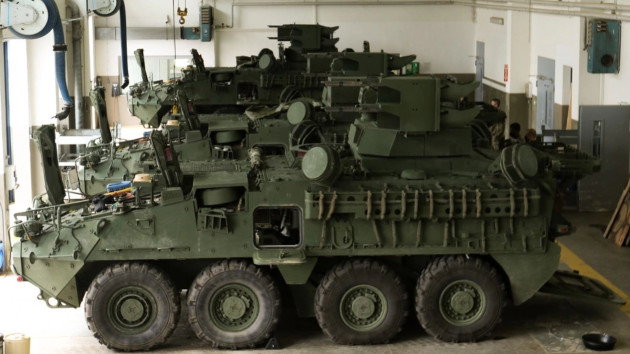
On the kinetic side, options include Stinger missiles and the Next Generation Short Range Interceptor. Precision-guided rockets like the Advanced Precision Kill Weapon System are also under consideration. Guns remain part of the mix. The XM914 30mm cannon offers compact firepower, backed by .50-caliber and 7.62mm machine guns.
Electronic warfare systems will disrupt incoming drones. Sensors will detect and track threats. The goal is a layered defense that can engage early and often.
Fitting all of that onto a lightweight platform is no small task. Size, weight, and power constraints will shape every decision. The Army acknowledges the tradeoffs. Packing missiles, guns, sensors, and electronic warfare gear into a compact system pushes the limits of current technology.
That is why modularity is central to the design.
The Army is pushing for a Modular Open Systems Approach (MOSA). Components must be adaptable and swappable. Systems must evolve without a complete redesign.
This effort builds on earlier M-SHORAD increments. Increment 1 mounted missiles and a cannon on a Stryker vehicle. Increment 2 explored directed energy before being canceled. Increment 3 will upgrade existing systems with improved interceptors and firepower.
Increment 4 breaks from that model. It strips the concept down to mobility and flexibility, focusing on systems that can move with light infantry in contested environments.
The system must meet strict mobility requirements. It must be transportable by C-130 aircraft. Air droppable. Sling-load capable. It must go wherever light infantry goes, without slowing them down.
That reflects a broader shift in Army thinking.
Future conflicts may demand rapid deployment into contested zones where air superiority is not guaranteed. Small units will need to operate independently, with their own protection against aerial threats.
Safety concerns are mounting for airline pilots already grappling with drone incursions as the Middle East war puts hundreds of ballistic missiles and attack drones in the skies https://t.co/C52W58Ji6G pic.twitter.com/ZbWwP0RnnJ
— Reuters (@Reuters) March 7, 2026
A Race Against the Threat
The Army aims to field the system between 2027 and 2029. To move fast, it plans to rely on existing technologies with high readiness levels. Future upgrades will follow through modular integration and competition.
The urgency is clear.
Drones are cheap, adaptable, and everywhere. They have reshaped battlefields from Eastern Europe to the Middle East. For light infantry, they are a constant threat overhead.
The Army’s answer is not heavier armor, but smarter design.
A pallet. A modular system. A layer of protection that moves at the speed of the fight.
If it works, it could give small units a fighting chance in a sky that is no longer theirs to control.








COMMENTS