

At the recent US Army Best Drone Warfighter Competition in Huntsville, Alabama, a clear pattern emerged. The most relevant innovations were not coming solely from formal acquisition pipelines. They were being shaped in real-time by Soldiers.
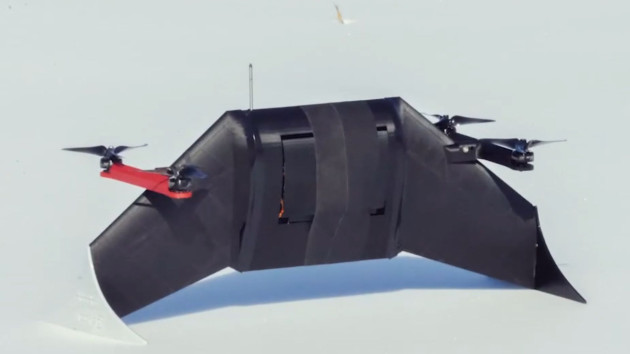
The Soldier Portable Autonomous Reconnaissance Transitioning Aircraft (SPARTA) sits at the center of that shift. Developed by the Army Research Laboratory (ARL) under the Development Command (DEVCOM), the drone is not just another small unmanned aerial system (UAS). It is a test case for how the Army might build, adapt, and field drones moving forward.
Lightweight, modular, and 3D-printable, SPARTA reflects a design philosophy grounded in use rather than theory. It was built with direct Soldier input, iterated quickly, and pushed into field experimentation within months.
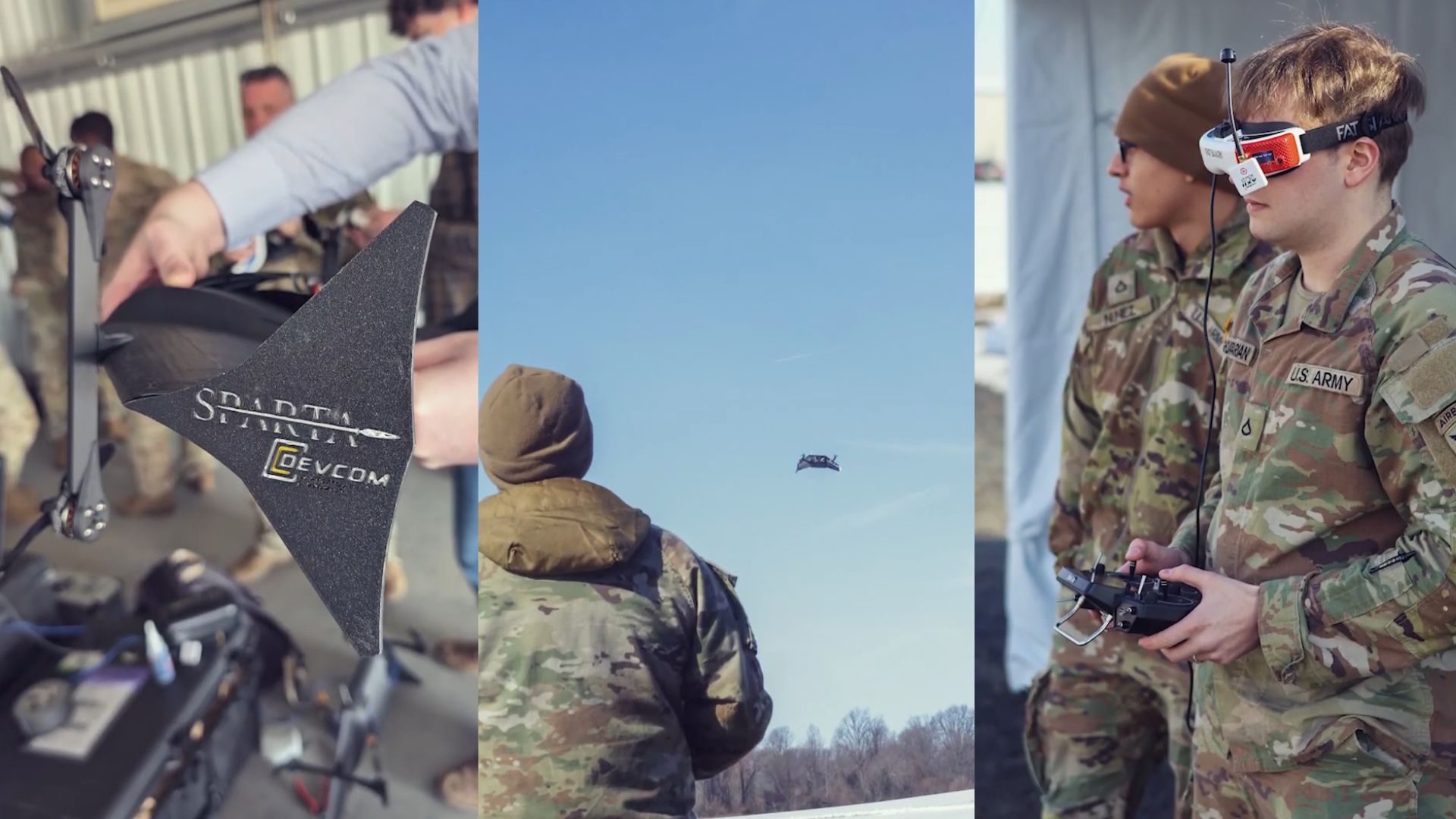
“When Soldiers visited ARL last spring, they expressed the need for a lightweight, modular drone that could be easily assembled, repaired, and adapted in the field,” said Dr. John Hrynuk, mechanical engineer at ARL.
Hrynuk added that the SPARTA was designed around that input, and prototypes were in the field within months.
The system emphasizes rapid assembly, low cost, and modular design. It is meant to be used frequently, repaired quickly, and modified without waiting on external supply chains.
In practical terms, that changes how a unit can employ drones, shifting them from scarce assets to routine tools of maneuver and reconnaissance.
SPARTA Drone: Key Specs at a Glance
Weight: ~2 pounds (~0.9 kilograms)
Flight type: Hybrid VTOL (vertical takeoff + fixed-wing flight)
Flight time: 30–60 minutes, depending on payload
Range: 30+ kilometers
Altitude: <500 feet above ground level
Cost: Just over $1,000 per drone
Assembly: Fully 3D-printed airframe in under 24 hours
Electronics: Modular bay allows mission-specific camera/sensor swaps in minutes
Designed for the Way Units Actually Fight
SPARTA’s hybrid configuration is not a novelty. It is a practical solution.
Traditional quadcopters offer vertical lift but limited endurance. Fixed-wing drones extend range but require space and planning to launch. SPARTA merges both, giving units the ability to launch from confined terrain and still cover meaningful distances.
That balance showed up during field testing.
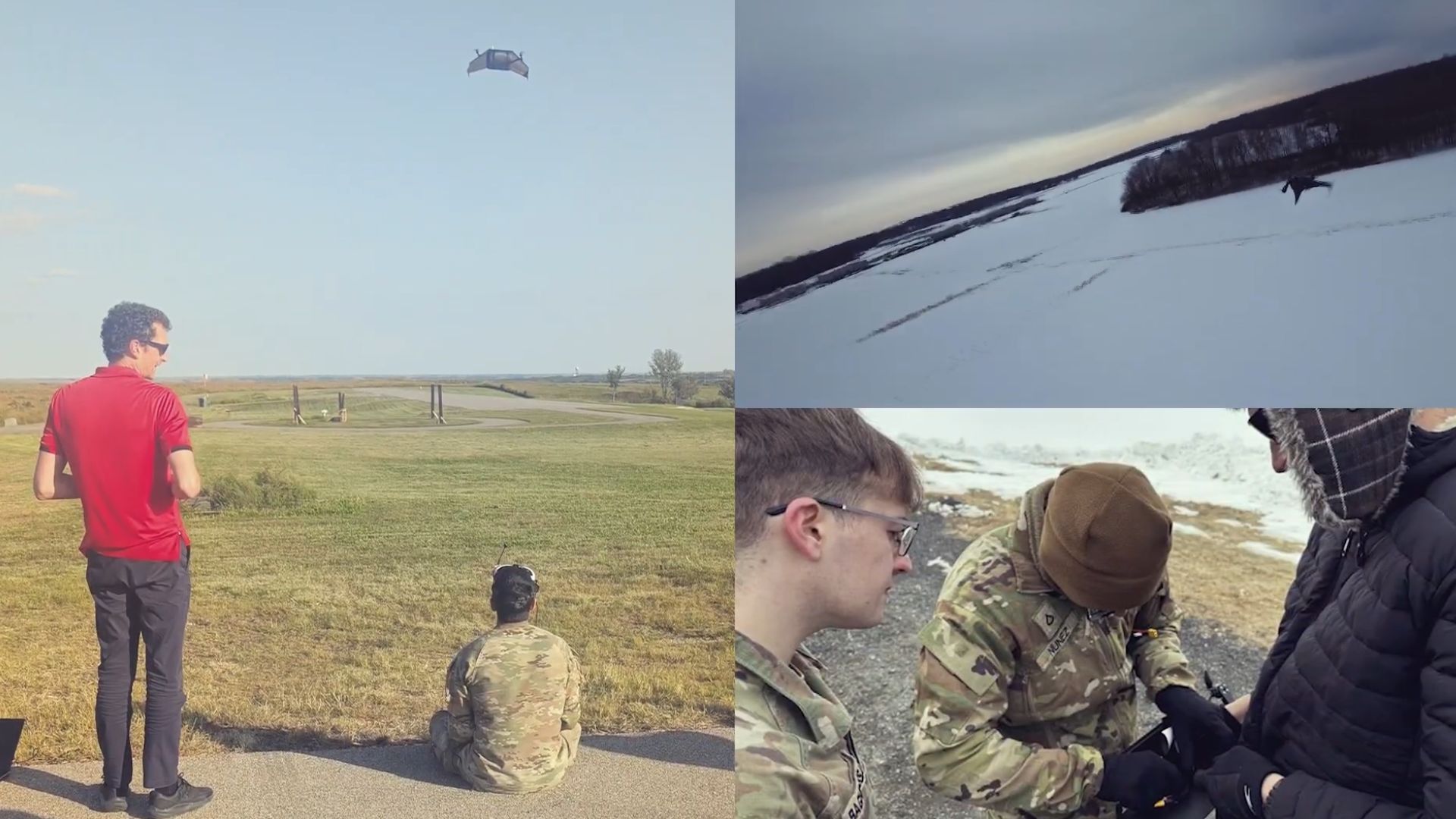
Soldiers from the 1st Infantry Division integrated SPARTA into the Danger Gauntlet exercise at Fort Riley, Kansas. There, the drone was used in multi-day combat scenarios that stress mobility, survivability, and adaptability.
The integration of the Buildable Innovation Shop for Operational Needs (BISON), a mobile 3D-printing lab, added another layer. Soldiers were not just flying SPARTA. They were building, repairing, and modifying it at the point of need.
“The ability to create mission-specific solutions at the point of need transforms how Soldiers operate,” said Dr. Arwen DeCostanza, ARL program manager for Catalyst Pathfinder and Accelerating Force.
That capability changes the logistics equation.
A Different Cost Curve
Cost is not a side detail. It is central to SPARTA’s relevance.
At just over $1,000 per unit, SPARTA sits far below most military-grade small drones. More importantly, its 3D-printed airframe is designed to absorb damage, allowing electronics to be reused after a crash.
This directly addresses a known friction point.
“When Soldiers worry about crashing expensive commercial drones, they fly less often,” Hrynuk said. “SPARTA removes that barrier and makes experimentation practical in the field.”
The result is more frequent use, more experimentation, and faster adaptation at the unit level.
Drones, Then and Now
To understand SPARTA’s significance, it helps to look at how drones reached this point.
Early military drones were large, expensive, and centrally controlled.
Platforms like the Predator and Reaper defined drone warfare in the early 2000s. They offered persistence and precision but were limited in number and tightly managed.
Over time, that model began to shift.
Conflicts in Ukraine, Nagorno-Karabakh, and the Middle East demonstrated the impact of small, inexpensive drones used at scale. Commercial quadcopters were adapted for reconnaissance and strike roles. Units began to rely on drones not just for intelligence, but as integral elements of daily operations.
At the same time, counter-drone systems evolved. Electronic warfare, jamming, and kinetic intercepts made the airspace more contested, especially at lower altitudes.
This created a new dynamic:
- Drones became easier to deploy.
- They also became easier to lose.
In that environment, cost, replaceability, and adaptability matter as much as performance.
Where SPARTA Fits
SPARTA aligns directly with that reality.
It is not designed to replace higher-end systems. It fills a different role, one built around volume, flexibility, and resilience.
A unit equipped with SPARTA can:
- Launch ISR quickly without extensive setup
- Replace lost systems without waiting for resupply
- Adapt payloads to match mission needs
- Iterate tactics in real time
In a contested drone environment, that matters.
Instead of relying on a limited number of high-value drones, units can operate a distributed network of low-cost systems. Losses become manageable. Adaptation becomes continuous.
That is where SPARTA offers leverage.
From Prototype to Practice
SPARTA is already moving beyond the lab.
The 11th Airborne Division has received systems for operational experimentation. Feedback from these deployments is feeding directly into design updates, refining everything from flight control to durability.
At the same time, ARL is working with industry partners to transition SPARTA toward scalable production.
This is not a traditional acquisition timeline.
It is an iterative loop where Soldiers test, provide feedback, and see changes reflected in the next version within months, not years.
SPARTA is part of a broader effort under the Army’s Transformation in Contact initiative, which aims to accelerate the delivery of technology to operational units. Programs like Catalyst Pathfinder and Accelerating Force are built around that goal.
But the deeper shift is conceptual.
For decades, new military technology followed a top-down model: define requirements, develop systems, and field them years later. SPARTA points in another direction—continuous adaptation driven by the user.
“By working directly with Soldiers, we ensure technology is practical and mission-ready,” DeCostanza said. “SPARTA shows how rapid prototyping, 3D printing, and Soldier innovation can deliver the next generation of ISR capabilities faster than ever.”
Not Built to Impress, But to Adapt
SPARTA is not the most advanced drone in the Army’s inventory.
That is not the point.
It is lightweight. It is inexpensive. It is modular. It can be built overnight and repaired in the field.
More importantly, it reflects a shift in how capability is generated.
In an era defined by rapid drone proliferation and equally rapid countermeasures, the advantage may not come from a single platform anymore. But from how quickly a force can adapt, replace, and evolve its systems.
SPARTA gives the Army a foothold in that model.
And that may prove more decisive than any single piece of hardware.








COMMENTS